Friday, August 04, 2006

The Dutch race for triple play can really start

At the beginning of the week it became clear that cable company UPC was not the candidate to acquire Essent Kabelcom. The investment consortium Warburg Pincus and Cinven, which bought earlier Casema, become also the owners of Essent Kabelcom. By bringing in an earlier Warburg Pincus acquisition of Multikabel, the investors can form now a new company with 3.3 million clients. This new combination will be the largest cable company in the Netherlands relegating UPC with 2.2 million clients to a second place.

Despite the fact that the Dutch monopoly police MNa still has to approve the mergers (Multikabel and Casema as well as the approved combination with Essent Kabelcom), it is clear that the Dutch cable scene is fast moving into consolidation. I have no new map available yet, but I can make it clear from the 2005 cable map (courtesy of the cable branch organisation VECAI). UPC is servicing the purple area. The new combination delivers services in the light blue area (Essent Kabelcom), Casema the red area and Multikabel the brownish area in the western part of the Netherlands.

The mob-up of the smaller companies can now start. Of the 6,1 cable households there are still 0.6 million clients being serviced by some 25 companies. They usually have started out as local companies and have joined a regional co-operation. However many of those small companies will be unable to keep up with UPC and the new combination as more investments are required to go into triple play and later on into glass fibre.

But the merger is not just news for the cable companies. The new combination will become a serious competitor for the Dutch incumbent telecom company KPN. Cable can even become a more serious competitor when the combination teams up with UPC in order to reach a national presence. The cable companies have become a threat to KPN as they are loosing clients of the fixed net for the fast internet and telephone service. And as 90 percent of the house holds have already a cable television connection it is interesting to subscribe also to fast internet and telephone, having one bill a month to pay.

And KPN is feeling the pain. Despite the fact that KPN made a profit on the second quarter, it is loosing subscribers to the fixed net to mobile operators and to cable operators (253.000 in the 2Q 2006). Some subscribers just go mobile, while others subscribe to the triple play option. This hurts and the pain shows. Last month KPN went to court in a summary procedure, claiming that it was unfair treated by the telecom watchdog OPTA in comparison with the cable operators. The judge could do nothing else but decline the request of KPN, as the summary procedure was not the right instrument for this claim.

Tags: ,

Blog Posting Number 463
Thursday, August 03, 2006

A crazy project

Beginning of this week the news was leaked that about 1 million selected Dutch households would receive a free newspaper in the near future. Financing would be done by an investor, not familiar with the newspaper world. The editing would be done by an experienced magazine editor-in-chief. It looks like a crazy plan with five ingredients: starting a broadsheet in the Netherlands, circulation of 1 million selected households, for free, a flamboyant editor-in-chief and an investor.

Starting a newspaper in the Netherlands is not an easy job. Most of the national newspapers with a total circulation of 1,8 million copies are in decline. Regional newspapers are not very popular. House-to-house distributed newspapers are seen as dirtied paper. And who wants to start a newspaper in this high-tech era? Is there still a future for printed paid and free newspapers?

The circulation would be about 1 million households. Given that in the Netherlands there are 6,4 million households, only selected areas will receive the newspaper. I guess that the segmentation will match the advertiser and the ZIP code. You may suppose that it will be distributed in prosperous neighbourhoods in urban areas.

The newspaper will be for free. National and regional newspapers have always been paid; their subscription prices are becoming very hefty; the distribution of the newspapers is very expensive. Up to 1995 only house-to-house broadsheets were for free. But then Metro and Sp!ts were introduced; Metro being sponsored by the National Railways Corp. (NS) and Sp!ts being set up by the newspaper company De Telegraaf as an advertising competitor of Metro.

So, starting a free newspaper circulated among a selected audience of 1 million people is a crazy plan. Who are the people behind it?

The financing will be done by Marcel Boekhoorn. He got rich as a dealmaker, buying and selling companies. He scored a hit when he sold a start-up telecom company to incumbent KPN for about 1 billion euro. But his investments are not always successful; he and Mr Roel Pieper, ex-Compaq and ex-Philips, invested in a company The Fifth Force downsizing video volumes to only a few Ks. But he has no experience in the newspaper world.

The editor-in-chief will be Jort Kelder, presently still editor-in-chief of Quote, a glossy monthly for businessmen with an annual edition of the Forbes-like list of millionaires, in this case the Dutch millionaires, including the Queen. Besides his editorial activities he has become a national VIP, presiding forums and leading television discussion. But as the company, holding Quote, has been sold to Hachette Fillipachi, Jort Kelder wants to get out. He is afraid that Hachette will change the management style and will abolish his Maserati from his pay pack. And after being an editor-in-chief for about 13 years, he needs another challenge. But editing a free newspaper, distributed house to house. That is not exactly what can be called glamorous. In fact the free house-to-house distributed newspapers are seen as the lowest rank in the newspaper hierarchy.

All in all, it is a crazy plan with some unusual people at centre stage. Will it succeed? Looking behind the scene, there is a remarkable advisor to Mr Boekhoorn, Mr Cees van der Hoeven. He has been the boss of the Dutch grocery Ahold until he was forced to leave for pumping up the profits. Grocery shops have weekly flyers advertising their offer. This might indicate where the money will have to come from eventually.

It is a crazy project. You will hear more about it.

Tags:

Blog Posting Number: 462

Wednesday, August 02, 2006

European iTunes sold 200 Million Songs

In a press release “Apple today announced that music fans have purchased and downloaded more than 200 million songs from its European iTunes Music Stores in just over two years, and the iTunes music catalogue now includes more than three million songs from major music companies and over 1,000 independent record labels.

Launched in the UK, France and Germany in June 2004, the iTunes Music Store now operates in 17 European countries including Austria, Belgium, Denmark, Finland, Greece, Ireland, Italy, Luxembourg, Netherlands, Norway, Portugal, Spain, Sweden and Switzerland. All iTunes Music Stores offer the same innovative features, breakthrough pricing and seamless integration with iPod that have made iTunes the number one online music service in the world. … The number of songs downloaded and purchased from the iTunes Music Stores in Europe have tripled in the past year from 50 million to 200 million. …

The iTunes Music Store features a selection of over 2,500 music videos, Pixar short films, and more than three million songs from the major music companies and over 1,000 independent labels.”


What do these stats say:
1. 200 million songs over two years; the number of songs downloaded and purchased from the iTunes Music Stores in Europe have tripled in the past year from 50 million to 200 million. So iTunes in Europe is growing fast.
2. On January 12, 2005 Apple chief executive officer Steve Jobs said during the MacWorld conference in California that 230 million songs have been sold via iTunes worldwide. iTunes Europe is reaching the level of iTunes worldwide of beginning 2005 one and a half years later.
3. The population of Europe is about 800 million people. There is still a lot of marketing to be done for legal music.

Tags:

Blog Posting Number: 461

Tuesday, August 01, 2006

Lebanon: nipped in the bud again

The war between Israel and Lebanon now dominates the headlines. The small country of Lebanon is being upset, just when it started to get its act together, also its act in the field of computing and the content industry. I had the privilege to visit the country in 2004, being invited as guest of the Lebanese Personal Computer Association.

Contact man on the ground was Gaby Deek (Photograph: man at the head of the table). I had learned to know him as a Grand Jury member of the World Summit Award in Dubai. Gaby is an outspoken man full of enthusiasm, who is working for a Lebanese computing company and active in the small, but bustling computing industry.


Photographs: silent witnesses to the former war and the rebuilt center of Beirut

In the framework of the annual computer show Termium 2004, the World Summit Award was asked to be present with it roadshow, offering its forty award winning applications in the field of content. It was a busy exhibition with a gala. It is unbelievable that a country with almost 4 million inhabitants did find the resilience to bounce back after the last war and built up a new industry.

Of course there was some time to look around the beautiful country side and the bubbling city of Beirut; but you could not miss the silent witnesses of the last war. (Photograph: lunch in the port of Beirut)


The roadshow in 2004 had effect. In the second instalment of the WSA in 2005 Lebanon partook in the competition with entries. It was also part of the Arab eContent Award and in fact had four content products selected in the categories e-Health with Mobimed, e-Entertainment with LBC WebTV, e-Inclusion with Bassma and e-Business with Skileb.com.

With this war going on, the country will be thrown back again, I guess, and will have to rebuild the infrastructure. The fragile mobile and fixed telephone net will have to be reconstructed and the computers in schools will have to be replaced. It is a real pity, as the beautiful country was just getting around again to establish a normal routine of life. .

The WSA network has been contacting Gaby to see how he and family were doing. We hope for them that this outrageous war will be over soon.

Tags: ,

Blog Posting Number: 460

Monday, July 31, 2006

Kazaa giving in

It was clear at the beginning of the year that the music industry was gaining terrain on the copyright issue, at last. All the legal battles had pointed at last to the same conclusion and there was no safety any more in any country for companies like Napster, Kazaa and BitTorrent. Napster went legal, BitTorrent went legal, and Kazaa has now given up.

The music sector of the content industry has had problems in defending its copyright and cashing fees due to the peer-to-peer filesharing networks from the beginning. A legal body like the Recording Industry Association of America (RIAA) has fought battles for years, like the international organisation IFPI. But with Kazaa giving in and turning legal, every other battle will be a formal process.

Will this mean that there will not be any illegal filesharing any longer and that everyone will pay fees? That would be the time for iTunes and other services! But I guess that it will be more realistic to think that illegal filesharing will continue. So the legal cases will continue, despite the educational programs which have been established in several countries.

So the next battlefield will be the movie industry. Despite the lessons yielded by the music industry, the movie industry will have to go through a similar cycle of battles: court cases against parents, press releases, educational programs. Of course the P2P networks tuned legal can shorten the cycle by making deals with Hollywood, Bollywood and all the other local movie industries.

I am still surprised that the copyright owners fight for their position from the legal side, while never taking any pro-active action in the distribution itself. The music industry waited till Apple came up with a device and business plan for the songs with the ingredients: reasonable tariffs, no hardware limitations and a fine collection of music and songs. The movie people will have to find a similar formula and believable retail player: iTunes for movies. A similar action will be needed for the electronic books coming up: iTunes for eBooks. In this way iTunes might even surpass Amazon.com.

Tags: , , ,

Blog Posting Number: 459

Sunday, July 30, 2006

Of e-books and digital paper (20)

In the mini-series Of e-books and digital paper, I closed instalment 17 with the digital paper as electronic newspaper. I started to look back and noticed that I have not treated Sony’s e-book using digital paper.

As described in the mini-series, Sony hijacked the term Electronic book in the early 1990s. Their first sample had a lousy black and white screen with backlight. After that the company improved the screen dramatically. And while everyone in the western world left the concept of Sony’s e-book by 1995, Sony went on in Japan with promoting e-Books.

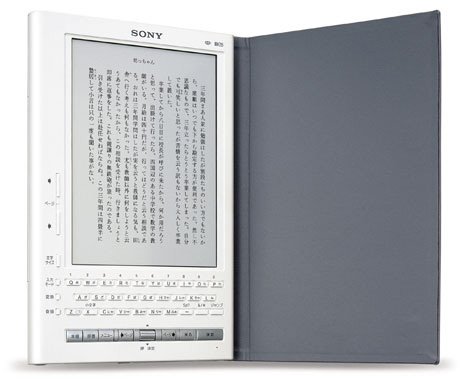
So when in 2005 the digital paper readers came about Sony adapted the e-book reader of that time Librié, which was a variation of Sony’s handheld, the Clié, and fitted it out with digital paper as a screen. So the Librié has now black letters, a white background and two grey tones; the readability is improved in the contrast, the co-reader effect and the 170 pixels per inch.

The Librié model has storage room for 20 books, but with the memory extension Memory Stick Pro, the number of books can be upgraded to 500 books. The reader is 190 grams and has the following dimensions: 126x190x13 millimetres. There is a built-in speaker and ear phone, a dictionary and a USB connection.

Again here the screen freeze once a page is turned. The power is immediately drilled down, so one can read 1000 pages on two penlight batteries. On the side of the screen knobs are available to move back and forth. For annotations a virtual key board on the screen is available.

Will the Librié which was presented in March 2006 be the new book cover of the publishing industry? I am not sure. The price is comparable with iPods: 376 US dollars (276, 96 euro; the price is much better than the first Sony e-book, which set you back for 600+ euro in 1991). But not clear is the policy on the production software (open or proprietary) and the digital rights management software (open or proprietary; the proprietary DRM software is said to be awful). IMHO the price should come down, the software should be open and bestselling publishers should offer their novels of more than 1 kilo on the Librié.

I would think that Sony after so many years of experience with e-Books would have learned enough lessons to get it right. But the fact that the company is still bent on its proprietary production and DRM software, is not a good sign. But if Sony does not get it right, the Chinese will, I guess.

Still I would like to see Sony or another consumer electronics company use its power to change the face of the publishing industry like Apple did with iTunes. The device is there and there are many electronic books available. Now we need a good business proposal in terms of assortment, price per e-Book, DRM, use over more devices, quality of download and distribution.

Tags: ,

Blog Posting Number: 458

Saturday, July 29, 2006

Moving shop (8)

Settling

It is a week now that we moved our shop from Utrecht to Almere. Most of the boxes have been unpacked and we have been able to continue labouring in the heat (30 degrees Celsius on average; subtropic temperatures for the Netherlands).

One decision, we have taken in the past week, is not to change the blogname Buziaulane. Supported by one fan we do not want to send the readers on a search trail. As Buziaulane was a virtual outlook for the content sector, we will stick to the name. So no one will have to change its bookmarks.

All necessary connections work now at more than a reasonable speed. We are happy with the Internet speed. The e-mail is working fine. Also the VoIP telephone connection is working okay, although we still have some problems with the Gigaset telephones of Siemens 450S as we still have to find the manuals. We have still to get used to the different sounds of the base station and the main set. In the coming week we will experiment with Skype and the Gigaset. It seems to be possible to relay a Skype call to the internal Gigaset telephone using a USB stick.

Slowly the schedule for coming week is announcing itself. The Content Market Monitor newsletter has to be put together, looking back at July. Normally it is a very slow month in terms of news, but with the Kazaa news of the past few days, there will be a lot of reactions, we suppose.

We will also start using the iLiad, the digital newspaper and e-book reader. We are planning to download some 450 instalments. It will be intersting to see how the blogtext is translated to the iLiad and how the colour pictures are converted for the white and black screen.

Of course there are also some chores relating to the moving. We still have to return the router of Versatel. Also the wi-fi will have to be installed. In this way it will be possible to sit on the balcony, overlooking the skyline of Almere and work. From next week onwards it will be business as usual, but now from Almere.

Tags: , ,

Blog Posting Number: 457

Friday, July 28, 2006

Moving shop (7)

Internet selfservices

When you start moving shop, selfservices might come in handy. You tell the companies that you are moving with the company, declare your old address and register the new address. You can fill out forms with the last meter registration of electricity and other services.

Well, selfservices are a disaster. They are a real nuisance in the communication with companies. Here is just a shortlist:
Newspaper. We passed the request to have the financial daily, Het Financieele Dagblad (FD), delivered on the new address through internet more than three weeks before the move. But on the requested day there was no newspaper. A telephone call to the customer service of FD makes clear that the message either has not arrived with the customer service or has just gone astray.
The old electricity company. We had informed Eneco of our move by using their internet selfhelp service. It worked as we received a letter to be signed. But Eneco automatically assumes that you love them for life. We, however, did not have any warm relationship with that company, so why should we continue the agreement from another address. So we wanted to terminate the contract and move to another electricity company. So I had to get on the phone and get everything straightened out.
Old cable company. As we move out of the region of Casema, we will have to terminate the cable subscription. Casema offers two options on its site: moving and changing subscription. We found out that moving is intended for people moving in Casema country. If you move out of the region you will have to change subscription. The internet registration is followed by a telephone call, telling us that we will have to send Casema proof of moving outside Casema country. When we asked what kind of proof they wanted, the call center worker did not know; that was our problem.
New cable company. We had selected UPC to be the triple play company. So we send in an application form. After a few days we are called by UPC as the application could not be accepted. The people from whom we bought the apartment and suite have not handed in their termination. So the company is very sorry, but will have to throw away this application. The advice is to get the other people to terminate the contract and start the procedure all over again. The same data were needed at a renewed application.

We encountered two services, which scored rather well. There was only one application which went okay. Nuon, the new electricity company, received the application by internet an confirmed the application by letter. Two days after receiving the letter, we got a phone call from a bureau checking whether the application had been handled well.

The moving service of a Dutch postal service TPG, part of TNT, centrally informs many companies of the change of address. Although it can be improved in navigation and content, it is a helpful service.

But for us it is clear that internet selfservices should be improved dramatically in their service and their scripts.

Tags:

Blog Posting Number: 456

Thursday, July 27, 2006

Moving shop (6)

The final selection

So we said goodbye to Versatel and Casema (Versatel still does not want to believe that we terminated the subscription, as they invoiced me for August!) and started to look for a triple play player.

In the Netherlands there are a host of triple play operators. Of course all the cable companies offer television, internet and telephone (in that order). Other operators are: KPN, Versatel/Tele2 and Scarlet. Potentially we have in Almere the choice out of three: UPC, KPN and Versatel/Tele2. All three have an offer, but it is divided in television and a combination of internet and telephone. This makes a financial and programme comparison between the offers almost impossible.

For us the choice was not so difficult. KPN was no candidate; the grand old dame of telephony in the Netherlands needs strong competition to get rid of its monopolistic characteristics. Besides, when we would like to use its services (again), we would have to have a new telephone line installed at a cost. And toVersatel/Tele2 we had just said goodbye. So UPC remained. On the basis of some recommendations from friends, we selected UPC: analogue television, chello classic (8192 Kbps download and 1024 Kbps upload) and Voip telephone.

While registering the helpdesk worker had a tip. We had selected chello extreme, the top end of chello internet (20480 kbps download and 2048 upload), with telephone. But the helpdesk worker advised to take chello classic and telephone as this carried a bonus for six months; after the bonus months we could upgrade to chello extreme and just pay 2 euro more than chello classic.

Having registered, we got two big boxes: one with the digital tv set-top box and one with fast internet installation material (see photograph). It should all be easy, we were told by the registration desk and by friends. But of course the configuration in our meter cupboard was more complex. So we ended up with a working internet configuration, but telephony took more time. There were a lot of telephone wires in the meter cupboard and there was a standard KPN connection. Of course we ended up connecting KPN directly to the UPC modem. That was fun, as we still could phone on the account of the former owners of the apartment. Problem was that we could not be phoned. So with the patient assistance of the UPC helpdesk people, the problem was analysed and after an hour of debate the problem was solved. We could phone and could be phoned.

The first experience with UPC classic internet is okay. It looks like the internet connection has morning mood. It looks like it has to be talked to in order to get going. But for the rest it works fine. Internet radio is not interrupted and movies are shown without interruption.

Tags:

Blog Posting Number: 455

Wednesday, July 26, 2006

Flash

My digital paper reader works at last (19)

A few days ago I closed my mini-series on e-books and digital paper on a disastrous note. Having received the iLiad digital newspaper and e-book reader my unwrapping party of the iLiad was spoiled. I could not get life in machine at all. Well the blog has been read and I received several tips.

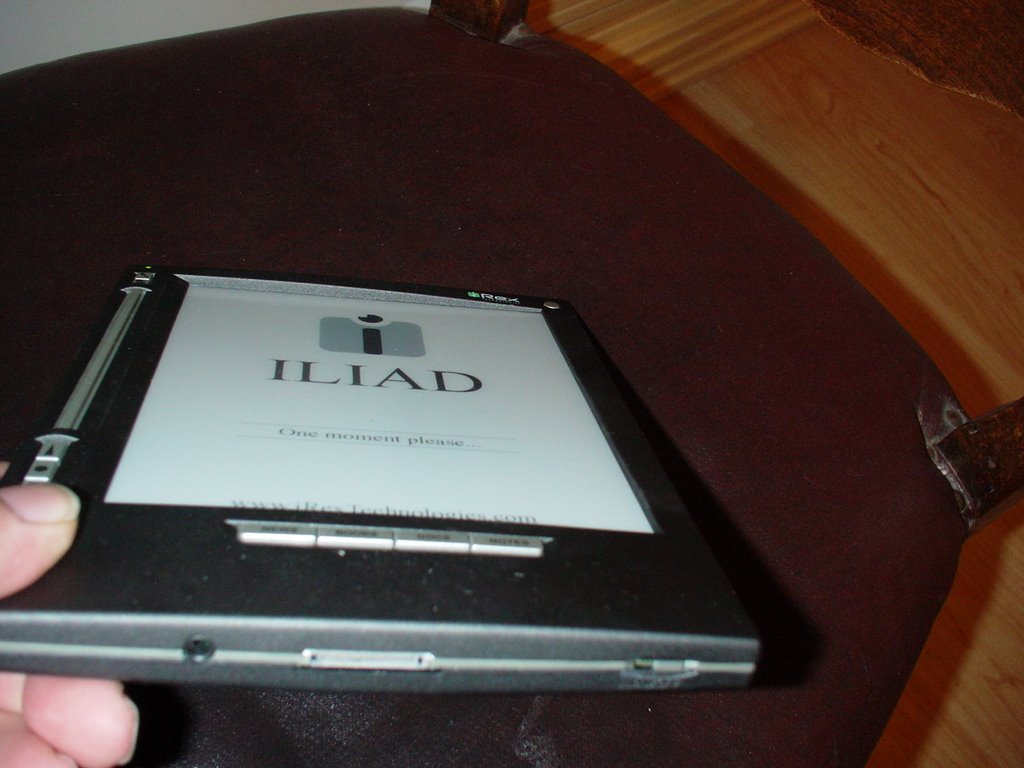
First there were remarks about the marketing. A machine like this, virtually a text iPod, should not be marketed without at least a short technical guide. In my case there there was not a short guide, just a plain small paper. As I did not have a short guide I was unable to detect the off/on switch (see photograph and try to locate the on/off switch; it is the right knob; would you have dicovred that without a quick technical guide?); you can’t call it a real switch as you slide it, which is strange for an on/off switch.

There is another observation about the ergonomy of this machine. In the right hand corner there is a visual knob. First action is to push it, but this knob is to establish the communication connection. The on/off switch is a small slide bar on the right hand. With a short guide this would have been comprehensible.

So at last the digital paper is now showing.

I still think that this is louzy marketing. The small piece of paper has been replaced with a quick guide in the meantime. At least a user can find the on/off button, which is not placed very handy in terms of usability. And I do not understand why the developers did not pre-load examples of digital newspapers and e-books. Yes they preloaded the quick guide, but you need to know where the on/off switch is first!

This product needs some marketing upgrade and not the standard Philips marketing of the pre-Boonstra era. People have paid 700 euro and still can not show advantages of the product to their friends or colleagues; no NYT or Alice in Wonderland for demonstation, which can be used without paying copyrightno copyright; no, the set just has a technical quick guide. What a chance missed. I suggest, iRex Technologies seeks permission to pre-load my mini-series of the history of e-books and digital paper.

Tags: , ,

Blog Posting Number: 454

Moving shop (5)

For sentimental reasons

Almost forgot to write down the considerations for not saying goodbye to Euronet, the business arm of the Dutch affiliate of Wanadoo, turned into Orange. Most likely we forgot to take it into consideration as this would mean giving up our e-mail address, which I have since 1995.

Euronet was founded in 1994 by Arko van Brakel and Simon Cavendish. From the start the service made quite some impression, especially as it marketed internet to the masses. It was in fact a text book example for the later ISP services like Planet Internet and World Online. One day Amsterdam woke up with a monkey in every bus stop. In 1998 the company was sold to Wanadoo, a subsidiary of France Telecom.

We got into touch with Euronet or better Euronet*Internet in 1995, when our principal consultant started an assignment for the newspaper publisher Wegener. He was introduced through Peter Bloemendaal, the internet pioneer within Wegener. From that time dates back his e-mail address, simply with his first name add euronet dot nl. Presently they do not give out e-mail addresses with first names any longer. It is 11 years now that the e-mail address in use.

So in the consideration of giving up this subscription, history and sentiments play a part. And this does not mean that we are not critical of Euronet. One of the major differences we have with Euronet about their services is their unbelievably slow web mail service. It is not just slow; it is super slow. After a command you can go and have a coffee, come back, put in another command and go for another coffee. Whenever I am abroad and use the web mail I preferably use the service in the middle of the night; but this is not a guarantee either. If you complain about this super slow service, the helpdesk people will tell you that they will pass on the message; of course you will never get an answer that they will improve the service. Besides for Euronet our soho operation is too small and not really interesting.

When looking for fast internet Euronet did not make the short list by a mile. Their ADSL offer is not really competitive in the Dutch market, not in terms of facilities (telephone, internet and television) nor financially.

But despite the super slow web mail service and all the spam (about 200 items on average daily) the e-mail address still attracts; we will stick to the service for sentimental reasons, at least for the time being.

Tags: ,

Blog Posting Number: 453

Tuesday, July 25, 2006

Moving shop (4)

Goodbye Casema

Another company we said goodbye to was the cable company Casema. We had to say goodbye to the company as we will leave their territory and move to the area of one of their colleagues. Cable companies are still territory bound. Only by the terrestrial digital television Digitenne cable companies have in some areas competition.

Casema is nice company with some interesting history. It was part of KPN, but had to separated from it as KPN would be to much of a market force; this was way before triple play in the 1990s. Recently the company was sold to Warburg Pincus and Cinven and will be consolidated with Multikabel, bought by Marcus Pincus. It will now be the third cable company in the Netherlands. As Essent Kabelcom division, the second largest cable company in the Netherlands, is still on auction, Casema might even merge with Essent Kabelcom. And this would be bad news for KPN and UPC.

Casema recently bought the wimax license from Versatel in order to extend its regional area to a national distribution network for internet.

The service of Casema was okay; nothing very good, nothing bad. I had only one run-in with them, when they offered fast internet over the cable. I talked with the call-center about a fast connection and the in-house cabling. I indicated that I wanted to have the cable come in on the first floor. The call centre, eager to sell, told me that this should not be a problem. But the engineer, who came to execute the assignment, was not willing to bring the cable to the first floor. So we refused to go ahead. That was the end of Casema internet for us.

Their offer of television channels was okay. In 1986 they started to bring the BBC with a royal marriage. Their international offer with CNN, Belgian, German, French and Spanish programs is more than you could swallow and have time for. Casema had also an offer for digital television. You had to get the set-top box yourself at a retailer and request a subscription. We did not go the digital telvision way as we didi not see the advantages of it for television itself and did not have any time to look video-on-demand. Digital television needs some more incentives.

So Casema has one client less for the time being. But they will not notice that.

Tags:, ,

Blog Posting Number: 452

Monday, July 24, 2006

Moving shop (3)

Going triple play

The fun part of this move is the triple play, getting telephone, cable television and internet all from one provider and on one invoice. Of course there is a danger that you might get stuck with one of the facilities.

Our telephone and internet provider in Utrecht was Versatel. At Electronic Media Reporting (EMR) we have always given a chance to start-ups rather than to turn to an incumbent as KPN. There should be competition and the only way to give the incumbent an incentive is to take out a subscription on services from start-ups...

Technically there is no problem with Versatel in Almere. So I could have transferred the subscription to the new address. But I was not happy with Versatel; not in the past and not in the present.

In Utrecht we had telephone and internet on ISDN ADSL with Versatel, a so called Business-all-in agreement. In fact, our company was one of the first ones which requested an ADSL line over ISDN. It took Versatel more than three months to deliver, as KPN had to transfer the line to Versatel; no blame on Versatel. Yet, the communication between Versatel and EMR was technical with no marketing sensitivity; questions were being avoided. To compensate the lower tariff promised by Versatel plus a number of days of total incommunicado, only one month subscription was given in return.

The major reason for moving to another provider is the inflexibility of Versatel. While KPN and other providers have adapted their internet connection speed at least six times in four years, we had our speed upgraded one time in four years and this was only done after that we asked for it. ISDN was blamed. The lame reason for not upgrading was that we had ADSL over ISDN and not analogue. And when the company started to offer fast analogue ADSL (up to 24Mb was claimed) we could not switch as we would have to go back to KPN, close the ISDN line, request for an analogue line and being transferred to Versatel. In this game Versatel did not want to play any role. In short, no one is going to risk some weeks of incommunicado, because of the bad communications between Versatel and KPN. So why should we?

What I have been unable to understand is why Versatel never offered their soho clients a move over from ISDN to analogue in order to boost their claim to fame of 100.000 fast ADSL users. They also never made their business relations an offer for fast ADSL plus a one year’s subscription for the soccer competition. But marketing is an art!

Last and not least Versatel claimed flawless ADSL connection as it had its own network and constant speed as companies did not have to share an ADSL line. But regular checks with the Nuria measuring tool showed that the speed was variable with at least one non-performance a month.

All in all a good, reasons enough to say goodbye to Versatel, upgrade on speed and go into triple play with… When we called Versatel to terminate the contract, we talked to the loyalty and retention officer (sic!). We went through the procedure and the financial aspects; all in a correct way. But he did not ask why we wanted to terminate the contract; nor did he make an offer to retain our company as a client. We were probably small fry.

Tags: , ,

Blog Posting Number: 451

Sunday, July 23, 2006

Moving shop (2)

Change of blogname?

When the decision was taken to move shop from Utrecht to Almere, the question of a name change for the blog arose. Should we change the name of the blog, as this is named after a street in Utrecht where we used to have our offices. The consideration would be that the company is moved from this street in Utrecht to a new one in Almere. Should the name of the blog be changed consequently? It could be logical and there might be a reason for it.

I choose Buziaulane when I started up the blog on May 1, 2005, as there is a design building with a watch tower in the Utrecht street where we had our offices. To me this was the virtual look-out of the content industry; observing from a distance and from above what was happening in the world. Just a metaphore and hopefully a brand; besides there as a link to the creative industry, as Johan Buziau was a Dutch entertainer during the first half of the 1990s.

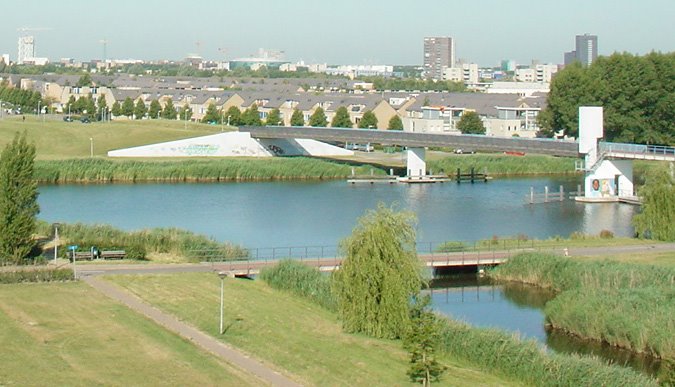
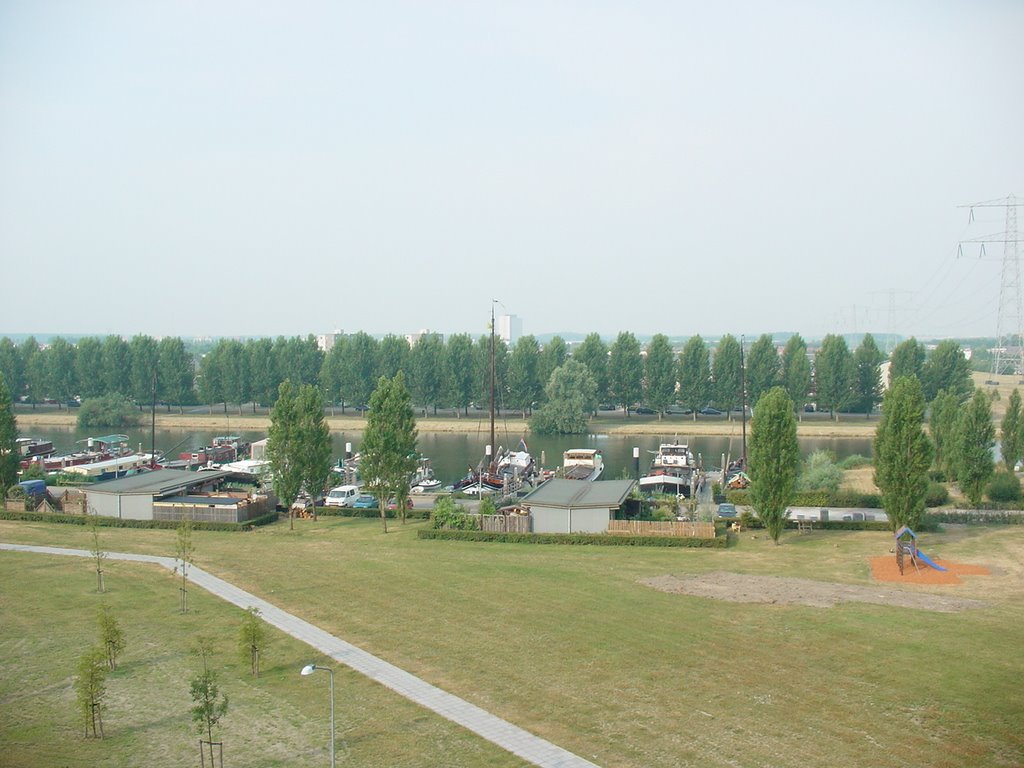
The name of the present street, where the company is located, is named after a German abstract painter. So there is also a link to the creative industry. And the building contains stocked apartments and suites. From the fifth floor where Electronic Media Reporting has its offices, there is a nice view of the city of Almere, a skyline with a few sky scrapers.

Comparing both positions a name change would not have an extra advantage. The relationship to the creative industry would not improve. Besides both locations have a virtual look-out, which can function as a metaphore. On the other hand there is no need to change the name, as no other image is needed for the weblog. And by changing the name of the weblog after more than a year, readers will be confused or loose their bookmark link.

As there is no clear advantage the name Buziaulane will be maintained as a Dutch look-out for the content-industry. (In line with social networking I should of course have held a poll, soliciting the opinion of readers with closed questions formulated by me.).

Blog Posting Number: 450

Saturday, July 22, 2006

Moving shop (1)

From Utrecht to Almere

Electronic Media Reporting (EMR) has moved from July 21, 2006. The company moved from the historic city of Utrecht to the fastest growing new town in the Netherlands, Almere.It has been a hard time lately keeping up the blog, but also taking decisions. For now there was an opportunity to chance telecom, cable and internetproviders. So we shopped around. But there was also the opportunity to start using the latest technology such as triple play and wireless telecom. It took a while to have it sorted out and of course it took a while to get everything installed. It meant of course saying goodbye to some providers. In this mini-series I will tell about the selection we made and why. I will also look at the issue of self-help services on internet.

EMR is a soho company, working from an office at home. As the house was in Utrecht when we started up the pap-and-mom company in 1990, we established the office at the Johan Buziaulaan in the residential area Rijnsweerd of the historic city of Utrecht.
By last year the time had come to move to a smaller apartment for various personal reasons. The big house of some 200 square metres with an unused floor had to be cleared from 28 years stored history of paper and digital artifacts in order to fit into a smaller apartment.


As there is no emotional bond with the city of Utrecht, we decided to choose for family ties and to move to the new town of Almere. This new town officially founded in 1976 in order to alleviate the housing shortage of Amsterdam. It has grown fast and offers now almost 70.000 houses to 178.458 people (stats January 2006). In the coming years the new town might become the twin city of Amsterdam. It belongs to the Northern wing of the creative industry of the Netherlands. There is a television studio. It has a lot of software companies in its borders. And not to forget a department of Information engineering.

In 1998 Electronic Media Reporting organized a review in the framework of Information Engineering for the European Commission in Almere. The new town had just landed the department of Information Engineering of the HvA college and wanted to open it with a bang. The review would bring a host of people and would give the students an opportunity to listen to people familiar with Information Engineering. The municipality took care of a welcome reception and hosted a dinner. But we also met the limitations of a new town: there was one small hotel with some twenty beds.. And as it was in the autumn, there was many a rain shower. But it was a great event for Almere. The department of Information Engineering is still located there and turning out graduates annually.

In the coming days I will tell you about changing providers and selfhelp services.

Blog Posting Number: 449

Friday, July 21, 2006

Of e-books and digital paper (18)

The iLiad has arrived

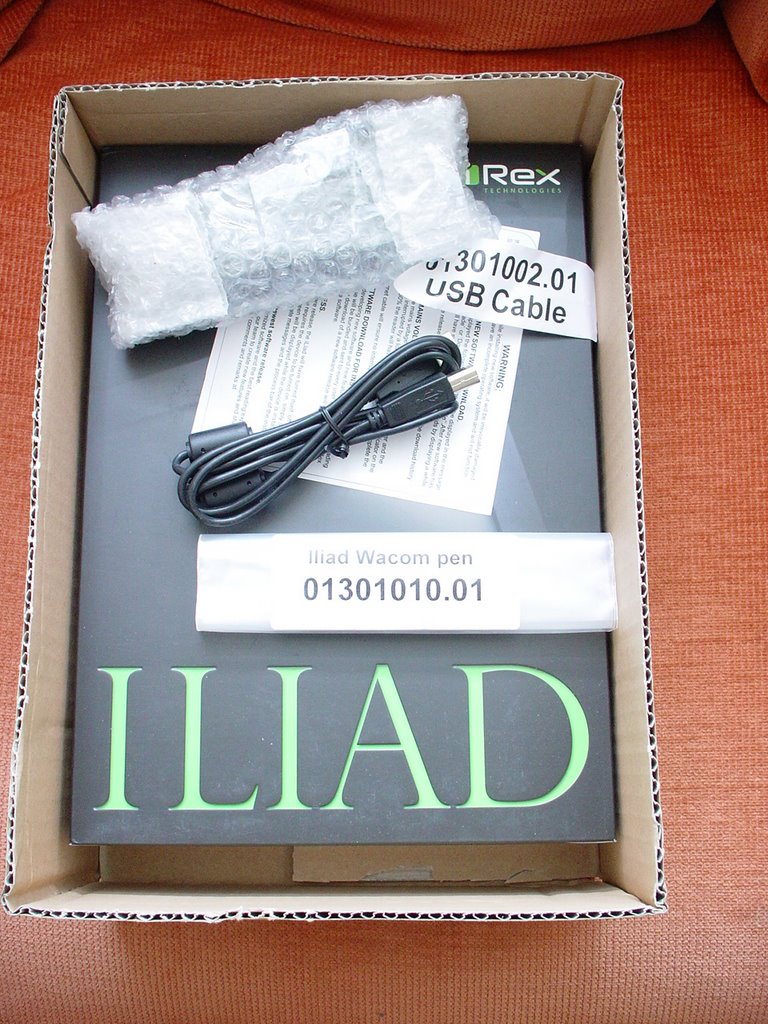
Two days ago, I received an e-mail telling me that the iLiad was to be shipped. I could track the parcel through the UPS service. And on Thursday morning the iLiad arrived, a small, decent parcel as you can see from the photograph.

Having unpacked the iLiad I noticed that I had two units of every accessory (e.g. travel hub, USB cable, stylus). As it was unclear from the web shop information what was exactly in the offer, I just ordered the extras. But, as it turns out the iLiad package contains all you need. So I am left with an extra travel hub, the USB cable and the stylus. I guess that I will get in contact with iRex Technologies and ask them to take the extras back.

What surprised me most, so far, is the almost absence of any information. On a small memo I am welcomed to the world of electronic reading by the iRex team. In the memo I am asked to register with the iRex Delivery Service (iDS) in order to receive extra software releases. For the rest there is no manual or a technical set-up sheet.

So I opened the parcel with excitement. In the box is another box, but it looks like the cover of a book with clear letters in green (see photograph). After unpacking that box I stood eye-to-eye with the tablet. It is a decent A5 size of tablet with a special top right corner, which looks like a page in perspective. The material in which the screen is encased has a special sensitive touch.
It looks like the designers did a special effort to leave out any confusing buttons. I am charmed by the looks and the slimness of it

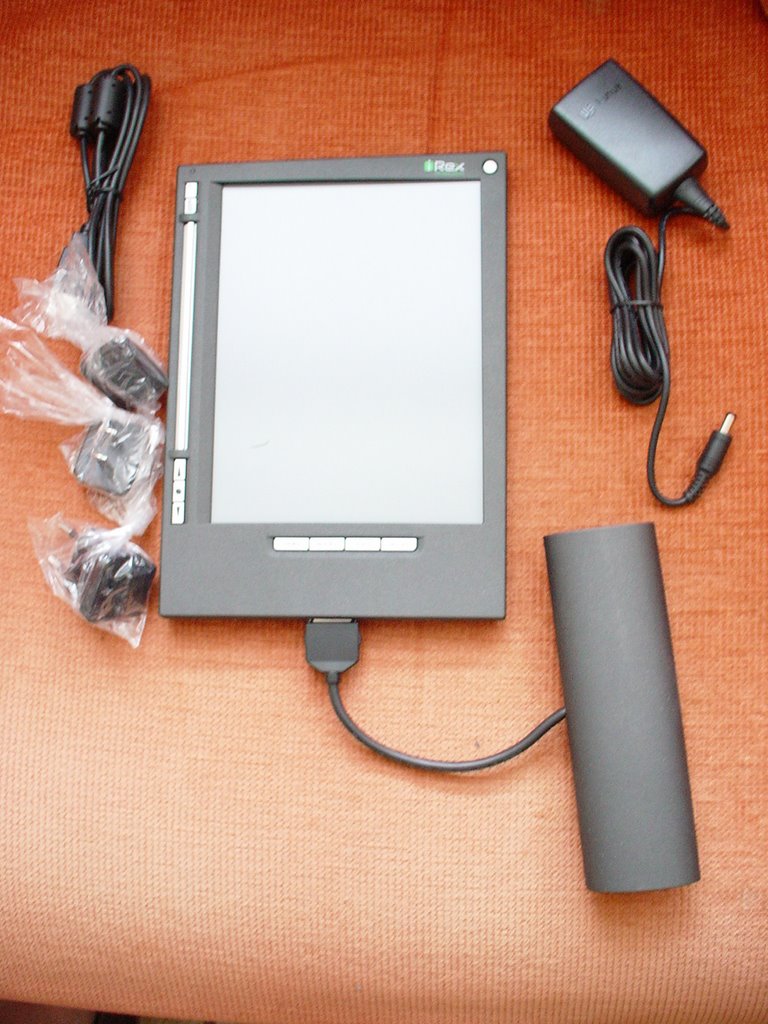
But after this first inspection I was left in doubt: what should I do. I suppose that I had to load the batteries. While loading the batteries I had a chance to register for software updates; but of course for updates you need already software in the machine. So far, there is no sign of life in the iLiad yet (see photograph).

I will continue next week on getting life in this machine. It is clear that the iRex team did not look at the example of Rocket e-Books. When that machine came out of the wrapping and the electricity was connected, an e-book showed up automatically. When the iLiad is connected to electricity, nothing happens. This is disappointing especially as you want to show what you have bought. Instead of the iLiad welcoming you to the world of electronic reading, you sit down with after 750 euro with a blank screen.

Tags: , , iRex, iLiad

Blog Posting Number: 448

Thursday, July 20, 2006

Flash

This morning I received a mail sent by a bertelsmann affiliate, that my iLiad is on its way! I will keep you informed.

Tags: ,

Blog Posting Number: 448

Of e-books and digital paper (17)

Round-up

From the historical point of view e-books and digital paper are coming into a new phase. There are many books and newspapers digitally available for PC and PDAs and mobile reading machines. There are two new and important factors are: readability and telecom accessibility. The white and black screen looks similar to the paper products and offers reading in sunlight and indoors.

But what are the real chances of a new wave. We have seen waves before. The first Sony e-book failed on several scores: lack of titles, high price for the reader, lack of readability, single-functionality. The second waves of e-books was more successful as there were more titles available; there was accessibility through internet; files were less closed by proprietary standards; prices fro the reading machines were lower due to the volume produced. Readability had not improved and there was a single-functionality.

Now readability has improved dramatically due to the white and black (16 grey tones) and the promise of a white and colours screen. And most interesting is the accessibility of titles through mobile communication and especially through wi-fi. As such the tablet like the iLiad has become as portable as a book and almost as a newspaper (but not yet as foldable).


The high price might keep the tablet from spreading. Sony has priced its electronic book reading machine on 360 till 400 euro. The tablet iLiad of iRex Technologies comes with a heftier price tag of 750 euro. For the readers to be a success the price of both devices should nose-dive to the level of prices of iPods. As the iLiad can be used for e-books, digital newspapers, digital school books, manuals and in logistics, the price should come down for the general reader and even more for bespoke devices.

The success of the products of Sony e-books and of iLiads digital newspaper/e-book device is dependent on the business models of the publishers and the business proposals which attract users:
- kind of products (e-books, digital newspapers or a combination of both);
- kind of financing (subscription base, buying hardware or sponsoring);
- marketing concept: (bundle-in book products, book clubs like Sony does in Japan);
- distribution of the content products;
- distribution and logistics of the devices.

If there is a chance of success, there is a good chance now. The availability of quality titles of books and newspapers, the diversification of the on-the-go devices as well as the technical quality of the devices should break open a new market is comparable with the iPod market.

Valuable lessons should have been learned from iTunes:
- there was a need for songs on the go;
- these songs should be played on iPod, but should also be allowed to be played on a PC or other devices;
- the price of a song should be reasonable.

The reading devices do experience a disadvantage with regard to the iPod. This music device had Apple behind the development of the iPod and the music store iTunes. E-Books so far have had Sony as a champion; but Sony is not an unsuspected candidate for the championship, as the company promotes its own proprietary production format. Perhaps HP might be a potential candidate.

THE END

Tags: ,

Blog Posting Number: 447

Wednesday, July 19, 2006

Of e-books and digital paper (16)

Digital newspapers

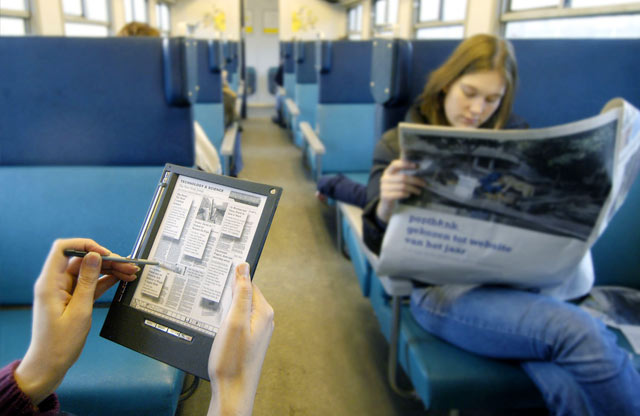
As indicated before, digital newspapers vary from websites, PDF issues and files for electronic reading machines. New in the development of electronic newspapers is the combination of digital paper and the tablet.

It was the Royal Philips spin-off iRex Technologies which developed a tablet for electronic newspapers amongst other applications. The tablet is called the ER 0100 or the iLiad. The ER 0100 is a portable electronic device specifically for reading applications. Its stable, high-brightness display makes for excellent readability both indoors and outdoors. The 8.1-inch (diagonal) monochrome Electronic Paper display contains 1024 x 768 pixels and supports 16 levels of grey (160 dpi). There is a choice of five standard connectivity options for transferring data to the Electronic reader. The product can work with a USB stick, Compact Flash and Multi Media Card using slots on the top of the device. Connection to the Internet is possible via integrated WiFi or Ethernet cable. Connection to PC/laptop: via USB-cable.
The ER 0100 is a very low power mobile device, specifically designed for reading applications. The operating time of the rechargeable battery is more than a week without recharging, based on an average use of three hours reading a day.
The content can be stored in four different archives (e.g. My newspapers, My books). These archives can be quickly accessed using the archive buttons of the device. Advanced search functions are available to locate the required content quickly.
The touch screen facility and stylus makes text input and easy navigation possible as part of a very natural user interface.

Content formats supported: PDF; XHTML; TXT; APABI; OEB*; MP3*; Optional: Customization to support customer specific content format
Interfaces: USB type A connector for USB memory stick; CF type II slot for memory extension or other
Applications: MMC slot for MMC memory cards; 3.5mm stereo audio jack for headset; WIFI 802.11g wireless LAN; 10/100MB wired LAN.
System specifications: 400MHz INTEL X-Scale Processor; 128MB free internal FLASH memory for storing content, extendable via external slots; touch sensor input using stylus; rechargeable battery; travel hub included, connecting to wired LAN, power adapter and PC using USB.
Dimensions (wxhxd): 155x216x16 mm.
Weight: 390 grams.
Operating temperature: 0°C to 50°C.
Storage temperature: –20°C to 70°C.
(*: Will become on line available in coming months via iDS (remote update to all iLiads already in the market)

Beautiful technology with advances in readability and telecom. Will the newspaper world embrace the iLiad as a tool? The Belgium financial daily De Tijd took a real stance by starting an experiment in April 2006. Now iLiad is part of a worldwide experiment if the newspaper organisation IFRA with Italian newspapers, but also USA newspapers. Many other newspapers will play around with the iLiad. I personally wonder whether the developers of the iLiad have taken notice of the Kent Electronic Newspaper Tablet (KENT) Format of Roger Fidler, which blends the popular qualities of printed newspapers with the compelling interactive features of the Web in a reader- and advertising-friendly environment. Still, Roger must be excited to see see a product so close to his brain child of the electronic tablet.

Tags: ,

Blog Posting Number: 446

Tuesday, July 18, 2006

Of e-books and digital paper (15)

The Electronic Tablet

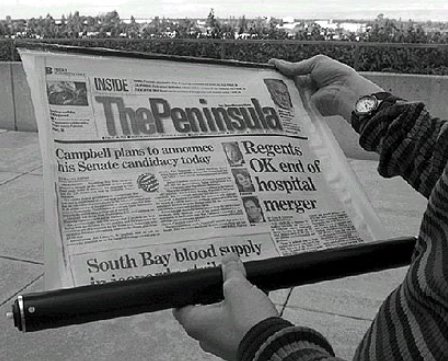
Besides digital paper as one trail to the quest, the electronic tablet was another development close to the newspaper world. It was started by Roger Fidler (see photograph) an old hand at new media at Knight Ridder, as he was already involved in Knight Ridder’s videotext project Viewtron in 1979. In 1992 he became the first corporate director for New Media for Knight Ridder heading the company's Information Design Laboratory, which he established to explore emerging online and electronic publishing opportunities for newspapers. In 1996 he joined Kent State University journalism faculty in 1996 as a professional in residence.

Much of his research work centres on the electronic tablet. In 1994 his department developed a video showing a dummy of the tablet. He travelled around the world with it. I met him with his story in Netherlands in 1995.

Since 2000, Adobe Systems and the Los Angeles Times have sponsored my work at Kent State University to develop an interactive multimedia format for newspapers that would take full advantage of pen-based Tablet PCs, and the anticipated next-generation electronic paper devices now under development by E Ink Corporation, Philips Electronics, and other companies.
The Kent Electronic Newspaper Tablet (KENT) Format, which resulted from this initiative, blends the popular qualities of printed newspapers with the compelling interactive features of the Web in a reader- and advertising-friendly environment. I publicly demonstrated the format for the first time in New York City in 2002, at the first Tablet PC conference. The demonstrations included a complete, fully functional Los Angeles Times prototype and the first Digital Newsbooks; examples of Digital Newsbooks can be downloaded from the Institute for CyberInformation Web site.

Daily newspaper editions based on the KENT Format are still a work in progress. My current efforts focus on the development of XML-based tools that could be used to streamline the production process.

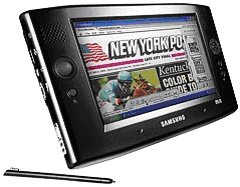
In the meantime tablets have become a common feature in computing. Nokia has launched the Nokia 770. The tablets are not exactly hot, but the newspaper world should take more interest in them and experiment with them. The other day NewspaperDirect announced that through an important new technology relationship with Microsoft, its publishing partners will now have an opportunity to reach the emerging mass market of typically young and technology savvy subscribers who wish to read news and access content while on the move. NewspaperDirect will bring media content to the new category of Ultra-Mobile PCs (UMPC), formerly code named Origami.

The tablet development by itself is not a development in its own right. But the combination of the tablet and digital paper should give another stimulus to the development.

Tags: ,

Blog Posting Number: 446