Tuesday, April 30, 2013

BPN 1633: WWW browser 20 years

Today in the Netherlands the queen has abdicated and the new King, Willem Alexander, has been sworn in. There will be no republic in The Netherlands for a generation, roughly 30 years. So no festivities for the republicans

But for the digital natives among them, there is something else to celebrate. Twenty years ago on April 30th, 1993 the research laboratory CERN in Geneva released the software for the world wide web for free. It was the beginning of a new era. If the World Wide Web software had not been there, internet would have never come about.


© Collection Jak Boumans

The World Wide Web software was developed on a Next computer by Tim Berners Lee who worked as a researcher at a laboratory in Geneva. In 1989 he produced a first proposal on paper for a new online software. Central in this software was the concept of hypertext, an idea developed by the British scientist Ted Nelson. In order to link textual information of various fragments together and not in a linear or hierarchical way but ad random. It meant that text fragments could be linked but also text and illustrations, but also text, illustrations and sound fragments. The browser was born, but for it he needed a common mark-up language (HTML), a protocol (TC/IP) and a web address. 
The software was spread around to developers from the 6th of August 1991 onwards. And only from April 30th, 1993 the web browser was released for general use for free.  So in 1993  a project group of the University of Illinois started to work on a browser, which could handle www pages, but also graphics, illustrations and text pages. By 1994 a commercial browser had been developed by Marc Andreessen, one of the Mosaic developers, under the name Netscape.

Friday, April 05, 2013

BPN 1632: Anniversary Dutch Channel 3 beginning of the end

On Thursday April 4 the Dutch public broadcast system celebrated the launch of, Nederland 3,  its third channel, 25 years ago. From 1988 the channel brought information, culture and sports. Presently the channel is used amongst others for testing new television formats, using the slogan: For youngsters and those who feel young. The channel was launched in 1988 by the a minister, indicating the importance of its importance for the public broadcast system. The channel was instituted in a time when the commercial broadcast sought ways and bypasses in order to reach the Dutch audience. Commercial radio and later television companies started attempts to break into the radio and television market. Channel 3 was part of the last defence by the public system against those upcoming commercial broadcast companies.

Now 25 years later,  the channel offers news, music, travel, human interest, talk shows and documentaries, often in combination with new media. In fact it Is a varied basket of programs, produced by one of the 21 broadcasting companies.
The public broadcasting companies have been asked to reduces their spending this year with 200 million euro. One of the measures is to kick small religious and humanistic broadcasters out of the system. The Dutch system has a broadcasting company for every belief: the Catholics, the Protestants, the Jews, the Buddhists and the Moslems. Now the number of companies will be reduced from 21 to 8, with some big ones to merge. In this way the public broadcast system hopes to reduce costs.
But will this happen?  Reducing costs on such a mammoth tanker is difficult. Although it belongs to the small expenses , a proposal for a new overall logo was recently launched, which means new URLs, leaders, writing paper, coffee cups, merchandise.   Besides not all broadcast companies will have enough money to compete with commercial programs. So will channel 3 be the last channel in and the first one out? Why not.

Over the years the public broadcast system serving radio and television have been producing a variety of programs for every age and target group and the question can be asked whether this is needed. Do amusement programs have to be carried by public broadcast companies? Do expensive sports programs, including  the dope ridden Tour de France, to be paid by the public broadcast system? The CEO of the public broadcast system Mr Hagoort formulated his five  priorities at the last New Year reception:  journalism, Dutch language drama and documentaries, children’s programs, knowledge and culture, national and international events.
Of course these priorities look fine, but the proof of it will be in the pudding. Will the companies deliver quality or not? I guess that the companies will find out that they have not money enough to fill the radio and television channel. So the next step will be the reduction of channels, eventually to two television channels and two radio stations.

This would be a drastic move, but a realistic one. It would shape a fair playing field between the public and commercial broadcasting companies. But it would  also be change the world of  digital media companies, which have the public broadcast companies as , being sponsored with public money, as competitors. Yes it would be a really drastic move, but give it more than five years....
 

Sunday, March 24, 2013

BPN 1631: Research Trends Digital Media

Last Thursday it was the last guest lecture I presented to sophomore students Communication of the Applied University of Windesheim Flevoland in my hometown Almere (NL). The course was called Research on Trends in Communication, but it soon turned into Research on Trends in Digital Communication. The format of the guest lectures was: sitting in on a Powerpoint presentation, reading a relevant article, and writing five blog postings on the subjects treated. The guest lectures were in English, not in the Dutch language. The subjects were: Pre-internet, the disruptive technology of Internet, the creative industry, content and foresighting. One lecture was spent on searching the internet under the slogan: Formerly we believed in God, now in Google (Paul Claes). Social media was not explicitly on the list as we thought it more important to get the students blogging before going into micro-blogging.

Having explained the principles of foresighting with the Powerpoint presentation of my World Summit Award colleague Suzanne Stein, who works at the Canadian Film Centre, the students got the assignment to discover trends. Each of them was assigned a category of the World Summit Awards contests, WSA Global, WSA Mobile and WSYA, and write a blog posting about the trends. This turned out to be an interesting exercise as each student had at least some 50+ winners to study and analyse. The WSA sites, divided over three sites (www.wsis-award.org, www.wsa-mobile.org, www.youthaward.org) can of course be used for more purposes in education. Besides the study of trends, they can also be used as research for potential projects. In the e-Learning category for example there are several examples of school curricula and in e-Culture there are several examples of promoting cultural places and museums.
Besides discovering trends and doing research on the winners, the winning projects are a source of inspiration for students and people in the trade.  And these three sites with 50+ winners are only a tip of the iceberg of submissions, which the WSA organisation has collected over the years. As all these submissions have passed judgement on the national level, it would be interesting to have access to all of them in one database. A conservative estimate will total 4000+ projects submitted. The World Summit Award database has proven to be an interesting hunting ground for trends to students and people working in new/digital media and communication.


For a specimen of the blogs produced, please have a look at the posting Trends in E-entertainment and games (link with permission by the author Denise Duijvenbode).

Tuesday, March 19, 2013


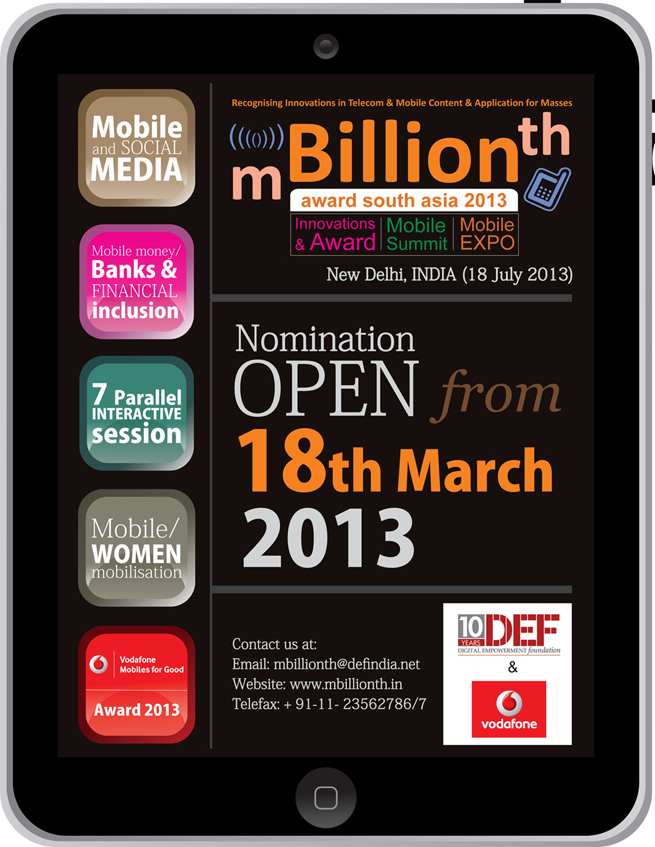
               www.mbillionth.in

Tuesday, March 12, 2013

BPN 1630: The Next Day

The singer David Bowie recently brought his latest record on the market. The title: The Next Day. David Bowie is getting old and eschatological, waiting for the next day, longing for the green grass at the other side of life, I guess.

But at the beginning of the eighties he was very forward, as I found out. I was working for the Dutch publishing company VNU in London. The company had just started a new subsidiary in the UK, specialising in computer publications. Besides printed magazines the company had the intention to start up databasepublishing. It bought a company in Bournmouth with reference books on hardware and software. These books were still produced in an old fashioned way. So new ways had to be developed to put them in a database and produce them more efficiently and eventually put them online. This was still a decade before the start of internet.

I was asked by the management to engage in this development. It meant frequent flights to London and many talks with pioneers in the database and online publishing field such as Mr Patrick Gibbons and David Worlock. They were also wrestling with setting up databases and marketing online services to people who had touched a computer, forget searching for information.

One day I was asked for dinner by a colleague. I was introduced to Don, an American freelancer, who had an assignment to find applications for a new e-mail system of ITT Dialcom. At that time e-mail and online databases were separated. If you wanted to move from e-mail to a database, you had to log on again. The ITT Dialcom system was new in two aspects: the e-mail system was store and forward and the e-mail system was configured back to back with a database system. Don was working on a TRS-80 Model 100, one of the first light weight portables. He was linking up subsidiaries of the worldwide conglomerate with e-mail and a management database for efficiency.

But I also discovered that he was exploring business systems for other enterprises, but he had also rock music bands as clients. He treated this information confidentially. But one day he let slip that one of his clients was David Bowie. In 1983 this singer was reaching a new peak in his popularity and commercial success with Let's Dance, with songs like Modern Love and China Girl. By 1984, Bowie went on the Serious Moonlight Tour. For this world tour Don had developed a report system from the preparation team, the roadies to the stage team with all kind of functionalities such as e-mail and spread sheet system. (Today people would say that system worked in a cloud, given the 32K internal memory of the TRS-80 Model 100). The tour lasted six months with a connected crew. And every time when the last note of the David Bowie concert had sounded, the management knew exactly the revenues of the particular concert and of the whole tour concert so far.

(The contact eventually also worked out for VNU London as in 1984 the company started to publish online the first daily newsletter in Europe, called IDB Online, a blog posting avant la lettre for the computer industry, on the ITT Dialcom system, used by the Telecom Gold service of British Telecom.)

Friday, March 08, 2013

BPN 1629: EVA continues


The European Virtual Academy (EVA) is running spring semester. The original European Virtual Academy (EVA) project funded by EU is over but the project goes on with three courses this spring. For next year the partners prepare a new bid to extend EVA to other fields of education and bring it on the next level. There are many European universities considering to join EVA.


Poster by Emilia Kwiatkowska, EVA-logo by
Alexandra Ostasheva. Both TAMK Media
Programme students


The courses of EVA spring semester are:

Image Interpretation
Babeş-Bolyai University (Romania)
This course is dedicated to the analysis and interpretation of images. Visual interpretations will be performed and the focus of the course is to develop examining skills for any type of images available in the visual culture (from classical paintings to digitally processed images).

Social Media in Communication and Community Building
Tampere University of Applied Sciences (Finland)
After completing the course the student knows how to use social networking, blog publishing, micro blogging services to broadcast and to communicate with targeted audiences. (S)he is also able to establish and moderate online discussion groups and wikis for knowledge and community building.

Interactive Movies
Hochschule Mittweida - University of Applied Sciences (Germany)
The course introduces students to the concept of interactive storytelling and digital narratives. For the purpose of this course the term “interactive movie” will refer to animated, filmed, video game-based and any other kind of movies following a main story but enabling user interaction. Interactive movies implement interactive dramaturgies and typically use technologies to allow users to influence the storylines.

All courses give 5 credits and run until end of May. The courses are open for students of member universities.
 
Announcement copied from http://tamk-artmedia.blogspot.nl/
 
Eva is an initiative of partners who met in the Academic Network Conferences organised by the European Academy of Digital Media (EADiM). EADiM is proud of EVA and congratulates the consortium with the continuation.


Wednesday, March 06, 2013

BPN 1628: Why content is so important?

Tomorrow it is Thursday and I will have to do a presentation for the class of second year college students, preparing communication world. The title of the course is Research in Digital Media and tomorrow's subject is content. Preparing for this class I found a nice A4 article on the Facebook of my friend Tommi Pelkonen, who works for Frantic in Helsinki (Finland). His colleague Taina wrote an article on content.

Content and content strategy have been on people’s lips more and more for the past few years. Yet this thing called content is still rather overlooked in many projects. So, what is this content and what does it do?

Well, let’s face it: content is the reason why websites are created. There are no real websites without any content. Simply put, content is everything you have on the website: texts, images, sounds, videos – all of it. If you have a website with a purpose, there must be some content on it. But you probably already knew that, so what’s all the fuss about? Websites have content, so what. Well, the biggest issue isn’t the content per se, but the quality of that content. And boy, we have a lot to do with that.

When creating a website, you obviously need to have a reason for it. Either you want to sell something, let people know about you or your work or tell a good story – there’s always something to share with the world. And bang, there’s your content. But no, it doesn’t end there, because the way you present the content is equally important.

This is where it all begins. It just isn’t enough to create a pretty website and then dump the texts and images there as an afterthought. Imagine you’ve drawn a box on a paper and then try to fit in all you have to say. Having some trouble? Well no, if you only have a word or two in your mind, but most likely that is not the case. For this, there’s an easy solution: just write the text first and then create the box around it. As simple as that!

So, imagine how convenient it would be to have the content first and then create a website around it. No hassle needed. Unfortunately, in reality this still is quite idealistic, as projects tend to have strict deadlines and life just isn’t very simple and someone’s cat just died and so on. But, to make things easier and to create pretty and functional websites, it sure helps to at least think about the content before you start working on anything else and then keep it in mind throughout the whole process, so that there definitely is a place for every piece of information on the site and that there won’t be any empty or otherwise unnecessary pages or blocks.

What’s more, you should really pay attention to the fine details of your content, especially spelling, grammar and that it’s up to date. It may sound like nitpicking, but hey, the bottom line is that it’s the content people are coming to your site for and therefore it would be nice if the content were clear and current. When you think about an ad or a website that has a lot a typos or old info, does it seem professional and reliable? Well, to me at least it does not. And I’m pretty sure I’m not alone with this. So, don’t forget to take that extra hour or two and check and double-check your content so that you can be absolutely sure that it’s correct and up to date before publishing it.

In the end, if you just think a little about your content before rushing into things (or, let us professionals do the thinking), you’ll probably save some time in the end – and save everyone’s nerves as well, as you don’t have to panic about how to cram all the content to your nice-looking but impractical website.

Author
Tanina is a copywriter at Frantic. She likes reading romantic novels on the train, the smell of rain (but not the rain itself) and finding pretty things. She also believes that good cake can make any day feel a whole lot better.

Monday, March 04, 2013

BPN 1627: WSA 10+ anniversary

 
The WSIS Review 10+ years on, was at the same time an occasion for the World Summit Award organisation to look back to the time that Peter Bruck (right) and Anastasia Konstantinova (left) started up the World Summit Award from scratch. In less than one year they built up a network of 168 experts on the ground in 168 countries out of the 191 UN associated countries and solicited more than 700 entries for evaluation. Negotiations with the emirate of Dubai lead to a first jury session there and by December 2003 the first gala was held in Geneva (Genf) Switserland. With these events the World Summit Award was established. The first jury and the first winners had set the pace.


During the 10th anniversary three first time jury members were present: Osama Manza, the eminent expert of India (right with red head gear), Louise van Rooijen, the eminent expert of Australia(middle), and myself, Jak Boumans, eminent expert on behalf of The Netherlands picture). Louise van Rooijen just happened to be in Paris  for other reasons, but was happy to join in the anniversary celebrations.


Track record of the WORLD SUMMIT AWARD
-        Participation: 168 UN member states
-        Associate partner network: 130 members globally
-        Strategic partners 2012/2013: UNESCO, UNIDO, UN Global Alliance for ICT & Development (UN GAID), ISOC, Mobile Monday
-        Professional National awards: contests in over 50 countries
-        E-Content Summits: Vienna, Hong Kong
-        Road shows: Hong Kong
-        Workshops: Bahrain, Oman

Short history

Year: 2003
Entries: 446
Jury venue: Dubai (United Arab Emirates)
Gala: First session of the World ummit on the Information Society in Genève


Year: 2005
Entries: 743
Jury venue: Manama (Kingdom of Bahrain)
Gala: First session of the World ummit on the Information Society in Tunis (Tunesia)


Year: 2007
Entries: 626
Jury venue: Brijuni (Croatia)
Gala: Venice (Italy)


Year: 2009
Entries: 552
Jury venue: Delhi (India)
Gala: Monterrey (Mexico)


Year: 2011
Entries: 458
Jury venue: Hong Kong
Gala: Cairo


At the WSIS +10 the WSA took care of the following event and workshop

WSA GALA AND RECEPTION February 26th:  The World Summit Award was initiated in 2003 as Austrian WSIS (Follow Up) Initiative, in order to select best practice in e-Content from all UN Member States. For the WSIS+10 review meeting an international jury awarded the 8 Global WSIS+10 champions, out of the 200 WSA winners from the years 2003, 2005, 2007, 2009 and 2011. A Cocktail reception was hosted by WSA, Deutsche Telekom and the Permanent Delegation of Austria to UNESCO.
 
 
Workshop 1: YOUTH 4 ACTION: using internet and mobile for peace and development
By World Summit Youth Award, February 26th.
Using ICT to fight hunger and poverty, empower women or get education to all – these are the agendas and actions of young people who are winners of the World Summit Youth Award. The young people are creative technologists and social entrepreneurs, selected from over 100 UN member states. The session will showcase best-practice examples of using Internet and mobiles to put the UN Millennium Development Goals (MDGs) into action and demonstrate how young people are actually transforming the future with IT.

Workshop 2: MONEY FOR CONTENT: successful business conditions for quality content. By World Summit Award and Deutsche Telekom, February 27th.
The quality of a knowledge society depends on the quality of content and the ability of content producers to earn a living and run sustainable businesses. Public spending has limits in funding, user generation and crowd sourcing has limits in accountability and editorial refinement. What are the conditions for small and medium size business to succeed in the production of quality content and thus to contribute building blocks for the knowledge society?

Besides the WSA Global, other streams have developed: since 2005 the World Summit Youth Award and since 2010 the WSA Mobile.  The latest gala of the WSA-mobile Winners´ Event 2013 was in Abu Dhabi on February 03-05, 2013. The WSA Winners´ Event 2013 will take place in Sri Lanka on October 23-25, 2013.

The World Summit Award has demonstrated since 2003, what politicians have dreamt about. The WSA has showcased the progress from e-Government and Participation & Inclusion to e-Culture and e-Health. The WSA has not just been a travelling caravan, but, besides competitions, juries and galas, also the organiser of e-Content summits, conferences, road shows and workshops.  


Sunday, March 03, 2013

BPN 1626: Information Society after 10 years

The opening of the WSIS conference at the UNESCO Headquarters in Paris was well attended. More than 1000 delegates were present at the opening statements and the keynote address, along with the translations teams. The first review session of the World Summit on the Information Society (WSIS) was on its way. The review is looking at the projects, which have been started up since the start of WSIS since 2003. One of the projects is the World Summit Award, which also celebrates its 10th anniversary.

It is a slow start-up with all kind of technical discomforts: no infra-red pointer and powerpoint page turner for the presenter and the connection with the key-note presenter was riddled with the howling of a Mexican dog (no offence to the Mexican delegation).

So many subjects passed during the conference such as knowledge society, environment, education, freedom of speech and health. These subjects are part of what is called the information society and they all pass the review in the conference. However the funny thing is that the term information society is not yet in discussion. Perhaps the term was not a bad one in 2003, but now it sounds so Gutenberg.

Information has in the meantime a connotation of analogue content being thrown at a target group. Editorial staffs of newspapers threw and still throw a lot of information at their readers every day, but reserved only space for two or three letters from the readers. This has now dramatically changed over the years by internet. Editorial staffs, but also citizens now publish news from a far and nearby through Twitter, Facebook, LinkedIn and blogs. So you can not speak any more about information and information society. Another term should be thought up. Information has become a one-way street for information bits.

Now the society is using a two way street to exchange of digital content. So, what should be the term for this phenomenon now a days. There is a lot of talk of the Knowledge Society. But that is term is of 1962, followed by its later variation of Open Knowledge Society from 1969. Besides this term does not hint to anything digital. So what term? Digital Society is a  packaging term. Wired Society sounds technical. More terms can undoubtedly be thought up. But do they represent the two-way traffic in society? For the time being I prefer the term  Connected Society, one enhanced by technology.

Saturday, February 23, 2013

BPN 1625: WSA's 10th anniversary (2)


The WSA Global Champions

On occasion of WSIS 10th birthday, the WSA archives were opened. A WSA Online Jury, consisting of 48 international jurors, once more evaluated 200 great WSA winners of 5 editions (2003,2005,2007,2009,2011), all of them already WSA Winners in former years, and selected their 8 WSA all time favourites: The WSIS + 10 Global Champions.

e-Annual Report
Producer: Centre of Registers and Infromation Systems
Country: Estonia
Category: e-Government & Institutions
URL: http://www.egov-estonia.eu/xbrl
WSA Winner 2011

Mpedigree
Producer: Mpedigree
Operator: Sproxil
Country: Ghana
Category: e-Health & Environment
URL: http://www.mpedigree.net  / http://www.sproxil.com
WSA Winner 2009

Eureka.In
Producer: Designmate (I) Pvt. Ltd.
Country: India
Category: e-Learning & Education
URL: http://www.designmate.com
WSA Winner 2007

Mini Mundi Tamagotchi
Producer: MilknCookies
Country: Guatemala
Category: e-Entertainment & Games
URL: http://www.mini-mundi.com/
WSA Winner 2011

Twelve Canoes
Producer: Wanted Digital
Country: Australia
Category: e- Culture & Heritage
WSA Winner 2009
 
Videolectures.Net
Producer: Jozef Stefan Institue
Country: Slovenia
Category: e- Science & Technology
URL: http://www.videolectures.net
WSA Winner 2009

KIVA Microfinance
Producer: Kiva Microfund
Country: United States of America
Category: e- Business & Commerce
URL: www.kiva.org
WSA Winner 2007

Deaf Planet
Producer: marblemedia & Canadian Cultural Society of the Deaf
Country: Canada
Category: e- Inclusion & Participation
URL: http://www.deafplanet.com
WSA Winner 2005


Thursday, February 21, 2013

BPN 1624: WSA's 10th anniversary (1)


 At the beginning of the new century the UN General Assembly took a decision to set up a forum, called the World Summit on the Information Society (WSIS), in which multiple stakeholders including international organizations, governments, the private sector and civil society could discuss the opportunities of the new information and communication environment, and also address challenges such as the inequality in access to information and communication that is called the ‘digital divide’.

The official forum was held in two phases. The first phase took place in Geneva from 10 to 12 December 2003 and the second phase took place in Tunis, from 16 to 18 November 2005. The WSIS was the start of the World Summit Award (WSA), which celebrates its 10 years anniversary together with the WSIS in next week’s WSIS Review 10+ in Paris. For the occasion I looked back at the rise of the World Summit Award.

Last century
Forty years ago the first US commercial electronic information services, Dialog and SDC, were launched. Scientists, technicians and financials experts could remotely reach central host computers in United States. In 1991 the World Wide Web was started and penetrated societies all over the world. And despite the Internet bubble of 2000, it was clear that the world was on its way from villages and cities towards a global information society. In 2003 the ITU and the United Nations initiated a platform for discussion and demonstration on this global information society.  One of its siblings was the World Summit Award, a global activity to select and promote the world's best e-Content and most innovative ICT applications.

After the Internet bubble
At the same time as the launch of the World Wide Web, the first industry protocol on multimedia was reached which presented challenges to the new media as well as the personal computer industry. People got used to personal computers as digital encyclopaedias, larded with photographs, graphics and sound, were bundled with personal computers. Business saw new opportunities coming its way such as the merger between AOL and Time Warner, but went into an overdrive with exaggerated visions, which eventually led to a bubble and deflation. However digital information did not fade away.

In fact, digital information increased and started to penetrate the veins of society such as government, business, culture, health and learning. Examples of multimedia applications sprang up all over the world on the desktop computers, portable computers and smart phones and tablets.  Digital information became digital content and mobile content are packaged in apps.

 From 2003 the World Summit Award has been monitoring these examples. More than 3.600 applications from 160 countries have been evaluated in the past decade.

Origin of WSA
When the ITU and the United Nations started the initiative of the World Summit on the Information Society (WSIS), the ICNM (International Center for New Media) in Salzburg (Austria) looked into the UN initiative and started to work out a formula on the basis of its experience with the organisation of the Europrix multimedia competition in Europe. Backed by Europrix jury members, ICNM started up the project World Summit Award.

By the opening of the World Summit on the Information Society (WSIS) on November 23, 2003 had contacted national experts in 168 countries. Through these contacts 700 entries were delivered. These were evaluated by 35 eminent experts during a WSA jury event in Dubai (UAE). During the World Summit on the Information Society (WSIS) 2003 in Genf 40 international winners were honoured during a colourful award event.

2003, First jury in Dubai


Rules
On the basis of the experience of the European competition, eight categories were defined in line with UN goals. The fields have been extensions in the course of events.

e-Business (and Commerce)
e-Science (and Technology)
e-Learning (and Education)
e-Government (and Institutions)
e-Culture (and Heritage)
e-Health (and Environment)
e-Entertainment (and Games)
e- Inclusion (and Participation)

Original categories and between brackets the extensions.

Having constituted the categories, the solicitation of entries was a subject. Having an open submission could be uncontrollable in the amount of entries and jury time. Eventually the Olympic principle was eventually chosen: every country was allowed to submit one entry per country and eight entries in total. In this way also the problem of having to choose from more entries per country was avoided.

Jury
The jury members were chosen from the national experts and a balance was sought between the continents. In total 30 to 40 jury members per jury session were invited. Every jury session should not have more than 50 pct. of jurors from a former jury. So far this has worked and has led to a self-refreshing jury body. Besides the representation was so far a clear representation of the 35 jury members of the 160 countries associated with the World Summit Award.

The jury so far has met in person, usually invited by a country. In 2003 Dubai invited the jury and in 2005 Bahrain was the host, but also Croatia, India and Hong Kong did invite the juries. This presence of jury members suited the jury process in which the jurors reached a consensus on the winners.

 
2013 Jury session of WSA Mobile in Abu Dhabi


The World Summit does not have a slew of winners, ranging from one to three. However the competition has maximally five winners per category, regardless of the origin of the entry.

WSA, the brand
The World Summit Award started out as a bi-annual event, following the two planned sessions of the World Summit Award on the Information Society in resp. Genf (Switzerland) and Tunis (Tunisia). The pattern of the bi-annual event was followed for the consecutive years.

However as the world turn the information society is changing and so is the World Summit Award. Having started out as the World Summit Award Global, multimedia entries on various digital media were solicited: online/offline, internet/CD-ROM or DVD, internet /mobile.

In 2007 the World Summit Youth Award was instituted, a competition for the youth up to 30 years of age promoting the UN Millennium Development Goals. The WSYA is a success as no less than 1150 young social entrepreneurs, web developers, app developers and data scientists from 121 countries have applied for the WSYA 2012 competition. In the meantime a European event, called the European Youth Award has been started in 2012 for the first time. The call for entries generated 35 projects coming from 16 different European countries.

As mobile has become a fast growing medium even overruling internet on personal computers (desktop or portable) it was decided to start up a World Summit Award Mobile. With the support of Abu Dhabi (UAE) a jury and award events have been set up. The soliciting of entries has been successful so far. No less than 435 apps from 102 have been sent in and are online judged by a jury of 50 worldwide jurors.

2013 WSA Mobile gala in Abu Dhabi
 
www.eu-youthaward.org
www.wsa-mobile.org

General trends
The branding of the World Summit Award already indicates that trends are coming up and become important. When the first session of the World Summit on the Information Society was held, multimedia was still important. Compact disc media functioned as packaged bandwidth. On CD-ROM or DVD enough bandwidth was offered to play movies and intricate games as most networks did not yet offer broadband at a reasonable speed.

But as the networks grew in speed, depending on the country, multimedia productions started to decrease, while internet sites increased. Besides social media, such as blogs, second life, Facebook entered the scene.

However as smartphones were triggered by the iPhone of Apple, blogging became micro-blogging, even to the point of a capacity of 140 digits as in the case of Twitter. The launch of the tablets by Apple (iPad) and Samsung (Tablet) created a complete new world of apps, software routines filled with content. Just before the launch of the tablets, e-reader caught on thanks to the nice, non-interlaced screens, holding an amount of books not seen in the Sorbonne university library in 1795.

Content divide
From the first session of the World Summit on the Information Society, the content divide has been an issue. The interest in hardware was greater than the interest in content. This was partly the problem because of the long production time of digital content. So quality products such as games and sites were not available and in great demand.

But when smartphones and tablets started to supersede desktop and portable computers, the content productions started to change. The apps are checked for basic conditions by the store owners of iTunes and Google Play. Although these basic conditions do not guarantee quality products, there is a turn in use. In a continent like Asia the smart phone and tablets are prevalent and working in favour of narrowing the content gap.
 
Author (2nd from the left) with WSA jury members from Egypt, Ghana, Kuwait, Sri Lanka and Hong Kong 

Jak Boumans is principal consultant with Electronic Media Reporting in The Netherlands. He has been with Europrix juries and all World Summit Award juries. He is a World Summit Award Board member and the Secretary General of the European Academy of Digital Media.