Showing posts with label Almere. Show all posts

Thursday, June 30, 2022

Exhibition Water-Polder-Weerwater in new city Almere (The Netherlands)

Press release

The Almere City Archives Department has put together the exhibition Water-Polder-Weerwater (lake in the center of the city).  By means of photographs, design sketches and letters from the collection of the city archive, the special history of the polder, Almere and the Weerwater is told. The exhibition, in Dutch and English, especially for Floriade visitors, can be seen from July 1st to December 2022. 

The name Weerwater explained: When you put the press release through translation software, Weerwater is translated as Weatherwater. But this is not the proper translation. Weerwater means Water again. The city arose from the water of the IJsselmeer in a polder. And in the city a lake was created, so there was water again.

Water-Polder-Weerwater shows step-by-step how in the 1960s land was reclaimed from the water of the IJsselmeer and how, in the middle of the just-drained polder, a lake was created. How do you actually create a polder? And why a lake in the middle of the city?  The exhibition also takes a look at the primeval forest and the Weerwater Island on the Floriade grounds, as well as future developments around the Weerwater. The exhibition also unravels the story of why the Weerwater is not called Central Lake or Placenta.
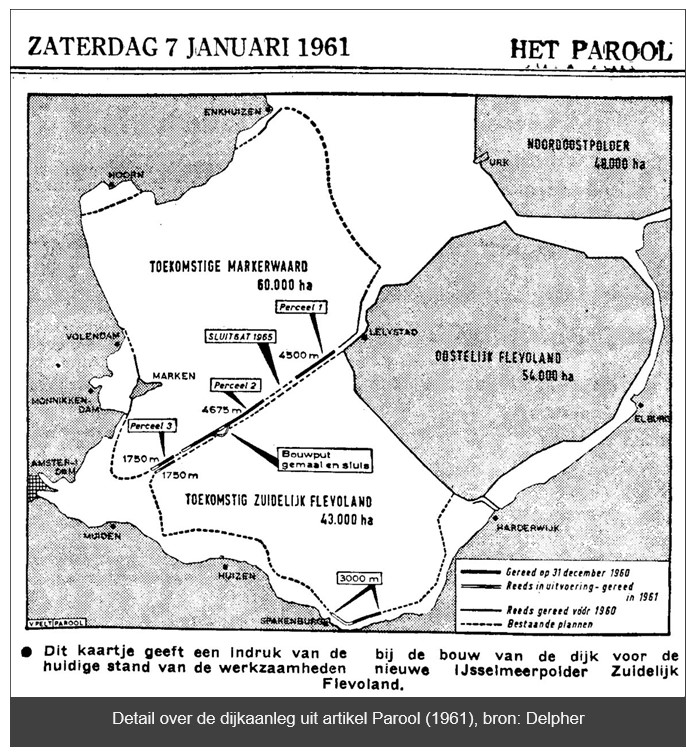
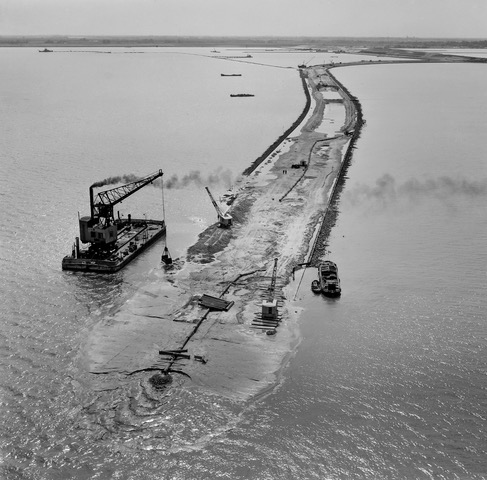
 

The creation of the new city of Almere from the water in four illustrations: the design of the polders, the construction of the dikes, the sketching of the new city, the Weerwater as the heart of the new city. 

During the preparation of Water-Polder-Weerwater, special design sketches by urban planner Teun Koolhaas from 1973 were rediscovered in the archives of the City Archives Department. In addition to a large number of sources from the collection of the city archive, the exhibition also includes photographs from the Flevolands Archief, newspaper archive Delpher, the Bart Hofmeester/AeroCamera archive and Het Nieuwe Instituut (.Museum for Architecture, Design and Digital Culture, where the National Collection for Dutch Architecture and Urban Planning is being preserved). 

Water-Polder-Weerwater is aimed at Almere residents who want to know more about the history of their city and at (Floriade) visitors who may not realise that they are walking and travelling on the former seabed of the IJsselmeer. On the wall of Stadsarchief Almere there will be a mark indicating how high the water would be without the dikes.

The exhibition and the accompanying brochure (32p) are bilingual  in Dutch and English. The exhibition is also accompanied by two videos with teh City's godfather Paul de Maar, policy officer , city ecologist Annemiek Eggenhuizen and researcher/artist Krijn Christiaansen.

Information on the exhibition and venue 

Opening times: The Water-Polder-Water exhibition is open from 1 July to December 2022 on Wednesday, Thursday and Friday from 13.00 - 17.00 and on request at the City Archives venue, Stadhuispromenade 2, 1315 XP Almere, opposite Stadhuis, left side under the library. 

Visit stadsarchief.almere.nl/weerwater for more information and current opening hours. Eventually the exhibition will be available online.


Thursday, June 16, 2022

Growth Dutch new town Almere seen from the clouds

This book is about the new town Almere in The Netherlands. This city does not count its age in centuries, but in less than 50 years. The first eight families got keys to their cabin chalets in 1975 and the 400 first occupants received their keys to the constructed houses in 1976. It is a city that arose from the water, when in 1964 the construction of dykes began and in 1968 the polder Zuidelijk Flevoland was reclaimed. Almere is the newest city in the Netherlands since 1975 and became a municipality in 1984 and is now the eighth largest municipality in the Netherlands with 230,000 inhabitants.

Unique book 

The book Almere vanuit de wolken (Almere from the clouds) is a large and weighty book. The book contains more than 200 aerial photos in landscape A4 format and weighs almost 2 kilos. It is also a unique book, because the 200+ aerial photographs show the development of the new town Almere from 1964 to 2021. Publishing house Watermerk has made similar books of The Hague, Rotterdam and Dordrecht, but Almere can show its entire history in aerial photos.The book was created as a sequel to the exhibition Almere from Above, organised by the City Archive of Almere from August 2020 to September 2021, with aerial photographs of the development of the city, on display at the City Archive and at three other locations in the city. 

The exhibition showed a limited selection of aerial photos from the collection of the City Archive, from old black-and-white photos from the 1960s to recent colour shots. From these, a selection was made for Almere Boven, which together tell the story of the multi-kernel city and its enormous growth over the past 50 years.

The exhibition showed a limited selection of the 25,000 aerial photographs in the collection of the City Archive Almere. But the reactions to the exhibitions asked for more. That was the reason for Michel Langendijk, together with Bart Hofmeester of Aero Camera and Roel Dijkstra, to research material for a book. Michel Langendijk had been involved in the composition of Almere Boven and Bart Hofmeester (1921-2021), who had made aerial photographs of Almere since 1964. Roel Dijkstra manages the collection of Aero Camera since the death of Bart Hofmeester and he made the actual photos of 2020 and 2021. The book contains a foreword by one of the pioneer urban planner Brans Stassen. There is also a short introduction.

The photos do not form just a series of sequential historical photographs, but show the historical photograph with a current photograph, taken from the same point of view. For example, the eight mobile homes surrounded by a wasteland in Almere Haven are shown with photograph of the present buildings. This editorial formula is maintained throughout almost the entire book.

Use 

The book is a nice book for an Almere resident to leave on a coffee table when welcoming visitors, or to give as a present. But the book deserves a wider distribution.

For the early inhabitants of Almere, the book is not only interesting to leaf through and to search for their house (and/or former houses). I had the pleasure of looking for photographs of the Bivak in Almere Harbour with the very first Almere resident, a mobile home owner and police officer Wim Leeman.

(Insert) Mr Wim Leeman indicates where the eight mobile homes of the Bivak were situated; (left) the Bivak, (right) mobile offices.  

But the book can also be used by professionals in urban design and planning such as urban developers, urban planners and architects. For them the book presents the creation and rapid growth of a new town within half a century. The photographs show the development of the city kernels, the green spaces in the neighbourhoods and between the kernels, the infrastructure, the separation of residential areas and industrial estates, the bus lanes and the network of cycle paths. 

Almere from the clouds, compiled by Michel Langendijk, publisher Watermerk BV, Dutch language, EAN 9789078388302, 264 pages, 1853 grams, 39.95 euros


Sunday, May 29, 2022

The algorithmic beauty of plant

Wednesday, June 1, 2022 from 19 - 21 hours in DDAMA (Dutch Digital Art Museum Almere) opening of two new exhibitions that are related to the theme of the Floriade: The algorithmic beauty of plants and Glitched Lovescapes. In the Euro-tower (now Rabo) next to Almere CS, Landdrostdreef 124, 2nd floor, 1314 SK Almere (The Netherlands).

DDAMA has been around for more than five years and is like a young, ever-blossoming plant that has to survive without the care of the municipal parks department. Perhaps it is because of the rarity, the exotic, the newness, there are only a few in the world, that this young striking flower does not yet get the attention it deserves. We, Dutch, cling to our traditional tulips and daffodils or get palms and cacti from afar and have little eye for a spontaneously generated local new variety. Unknown makes unloved.

In the exhibition with the theme The algorithmic beauty of plants local artist Jan Coenen is represented with three works with the subject "growth" and with the theme of the Floriade, "growing green cities", in mind. Two of these works are projections of digital algorithms and the third is a combination of a watercolor of 4.5 by 1.5 meters with a video based on an algorithm. When visiting the Floriade at Almere do come and visit DDAMA.

Growth is change. Growth is becoming, not being 

People, flowers, plants, forests, cities and museums grow.

The artworks on display depict the laws of growth. One can see how simple mathematical formulas underlie the growth of plants, of nature, but also of cities. These mathematical models (fractals), like growth in nature, have the property of repeating endlessly within limits without being the same.

After centuries of development, during which man has freed himself from the whims and dangers of nature, there is now a growing realization that we are part of nature, that we should not spoil nature, that we should not continue to look on from a distance, but that we should merge back into it. The works are also about looking, about perceiving nature and art, about distance and involvement.

© 2022, Jan Coenen


Wednesday, June 17, 2009

BPN 1355 FTMH - UPC lowers internet tariffs

Since Monday UPC in the Netherlands has lowered its internet tariffs drastically. Since it completed its Fiberpower (fibre to the corner) and offers speeds up to 120Mbps, UPC is technically ready to compete with KPN and other ISPs in the fibre networks. The only real difference is that UPC for the time being will compete with FttH networks, while UPC has fibre networks to the corner. The last mile will be a coax link. Another technical difference is that the FttH fibre networks connect subscribers one-to-one to the network, while UPC links a series of subscribers to the head station; with more subscribers on the line the speed will slow down.

Now UPC starts to compete in the market by lowering the tariffs. The new internet subscriptions have six flavours. The cheapest one with a download speed of 5Mbps and an upload speed of 0,5 Mbps will cost 18 euro. For the fastest speed of 120Mbps download speed and 10Mbps a subscriber will pay 70 euro. The other four intermediary speeds are:
- 25Mbps (down)/1,5Mbps (up): 25 euro;
- 30Mbps (down)/3Mbps (up): 30 euro;
- 60Mbps (down)/6Mbps: 40 euro;
- 90Mbps (down)/6Mbps: 50 euro.


UPC starts the marketing campaign by inviting subscribers to change throughout its area. Yesterday I received an offer to pay the same money for a triple play subscription, while the internet speed was raised from 10Mbps to 30Mbps. For 46 euro I would receive 30Mbps, digital TV with DVR with a standard package of radio and TV as well as an unlimited telephony package; mind you the comparable KPN offer would cost me 65 euro. The offer of UPC is good for two weeks.

It is a first shot in the competition to come. There are already areas with fibre coverage. But soon large areas like in Amsterdam, Rotterdam and Almere will be operational. In Almere for example no less than 75.000 homes will have been passed in the fibre network by the end of 2009. A majority of these households still have a subscription to UPC cable, because of the television distribution; only a minority have a triple play subscription. KPN so far is the only provider which can offer a triple play subscription on fibre. Other ISPs have indicated to follow, but have not published their offer and are not canvassing. But also KPN starts to mingle into the fight as it now has a 6 months offer of its silver package of 80 euro (50Mbps download; 5 Mbps upload; > 70 TV-channels; unlimited telephony; free installation) for the price of a bronze package of 65 euro (30Mbps download; 3 Mbps upload; > 50 TV-channels; unlimited telephony; free installation). But this is only a temporary offer with no sight on the price going up or staying the same as the offer.

The Netherlands will go into the holiday mode soon, roughly within two weeks. After the holiday in September the real fight will engage. I guess that the offers will get better by that time. So I will not even consider the UPC offer yet. But it is nice to see that the old cable monopolist is fighting against the incumbent telco. It means competition and lower prices.

Blog Posting Number: 1355

Tags: ,

Thursday, March 05, 2009

BPN 1308 Glass fibre to combat the crisis

At the conference Light My Fibre yesterday, the Portuguese Diogo Vasconcelos was one of the speakers. He is a distinguished fellow in the Cisco Internet Business Solutions Group and works with governments and the European Commission. He had an optimistic message in these days of crisis.

Vasconcelos started out with criticism on many governments and governmental institutions as they are attempting to put right the mistakes of the past rather than prepare for the future. Old industries like the automotive industry are bailed out, rather than to stimulate the SMEs, who are the innovators in business and communities.

Officials are still following the old Keynesian economic mantra of being busy filling up the holes that have been dug in the past instead of digging holes for new infrastructures. They should look more at the Austrian economist Schumpeter, the prophet of innovation, who wants creative destruction. He recommends putting new infrastructures in place and integrating long-term concerns (ageing, climate, diversity and poverty), while promoting structural change which have short-term impact.

Vasconcelos sees excellent opportunities for glass fibre here. The investments for glass fibre do not have to be negotiated as they are shovel-ready. Obama has reserved funds for broadband infrastructure and the European Commission has almost 1 billion euro ready for broadband in the rural areas. It will create many jobs and broadband will increase with the economic and social effects that go with it.

Vasconcelos put down a 10 point manifesto:
1. Fix the future and do not bail out the past;
2. Reshape the recovery plan for the long term;
3. prioritise the sectors for job growth;
4. promote pluralism and local creativity;
5. invest in innovation;
6. bank on entrepreneurs;
7. support new infrastructures;
8. promote social responsibility;
9. reward responsibility;
10. mobilise public creativity.

I really like the first point: fix the future and do not bail out the past. By pushing glass fibre into the community, a lot of activities can be optimised. Contact with the ageing over glass fibre will increase the attention and security for them at home. Working at home will save time for driving between home and work. The Smart working centre in Almere is one of those experiments. Civil servants of the municipality of Amsterdam living in Almere have only to drive maximally a quarter of an hour in order to start working and they can be in contact with their colleagues by video-conferencing. It saves fuel, reduces CO2 and irritation over the daily long traffic jams. Of course glass fibre is not the saviour of the future. But presently it is a fine means to start stimulating new ideas.

Blog Posting Number: 1308

Tags:

Wednesday, October 17, 2007

Almere: a broadband living lab

I had written about Almere and glass fibre already. But now the big news in my hometown is offcial: Almere (skyline of thecity on the photograph) will be the first big city with fibre to every home. On October 3, 2007 the telecom incumbent KPN and the cable construction company Reggefiber. KPN will offer the services on the fibre net and Reggefiber will lay the fibre cables. By 2010 all the households and companies will have a fibre connection at their disposal.

Almere is a 30 years old city, a new town, with 180.000 inhabitants and 70.000 households and it is still growing at great speed. The fibre will be a standard facility in all the new homes that will be built in Almere and in all the exiting districts starting this autumn with the Almere Harbour area. After that district by district will be canvassed. The inhabitants will get tv, radio, internet and telephony and get new facilities like video communication with care institutions.

This fibre project has been initiated and executed by the Almere Fiber Consortium, which consists of the municipality, three housing corporations, Reggefiber and a local entrepreneur D. Zantinge. The crucial question in this type of projects is the financing. Municipalities are allowed to invest under very strict rules; for example the municipality of Amsterdam has invested in its fibre project and is now under scrutiny of the European Commission. But the fray for the Almere fibre project will be born by Reggefiber.

The city of Almere wants to be the first digital city in the Netherlands. The objective of the project is promote innovative developments which will strengthen the economy, education, care, living and culture. Having a fibre infrastructure will make the city more attractive for companies in many ways. Employees can work from home. But also network companies can have a direct backbone connection from the Almere Interchange. This was already reason enough for the academic computing centre Sara to come to Almere. Almere ’s fibre network will be an open network. Any supplier of internet services can deliver its services in a level playing field to consumers and companies. In this way Almere will become a living lab in which internet and communication services can be developed and trialled.

The municipality Almere has already a super fast fibre network in use since the summer of 2006; this connects all municipal buildings, schools and social institutions. Also the industrial areas have been connected to the network. Besides these connections a pilot has been executed linking 1700 households and 500 companies to the network. With the experience of these smaller projects, Almere can start its roll-out of the entire network.

I have not seen more details on the roll-out yet. So I do not know when our office will be connected to the network. But to tell you the truth, I can not wait. The speed will always be more than the present UPC speed of 8Mbps; despite the fact that UPC has shown a speed of 100Mbps on the cable, it has not changed its offer of speeds and tariffs. Perhaps for the time being, I still should change to Alice or Telfort (but I do not like their fair use clause) for an ADSL 20Mbps line at 30 euro, including fixed line telephone.

Blog Posting Number: 897

Tags: broadband

Sunday, March 18, 2007

Aussies and Kiwis sampling Dutch broadband (5)

Especially the civil servant in the Aussies and Kiwis trade delegation were eager to hear about the involvement of the government in the pushing of Fibre to the Home (FttH) networks. The first that they arrived they already upset the program set up by Paul Budde and Fred Kappeteijn. While in Amsterdam they wanted to know everything about CityNet and how do you get it off the ground. Also on Tuesday it remained a subject of interest. And when they were in Almere they still were eager to learn how to set up an FttH network and keep it an Open Net.

Of course Amsterdam is the most interesting case as the city has invested 6 million euro and is now under scrutiny of the European Commission. The municipality of Almere has not put any money in it the FttH network, which will be laid from 2007 till 2010. Also the municipality of Nuenen did not put money in the network.

(c) Elaine Sullivan

The Netherlands is not the only country working on FttH networks. IN Japan 300.000 FttH connections per month will be realised by 2008. In Europe the battle for Paris is on. The Iliad network will go after 1 million homes at 1 billion euro. Neuf Cegetel wants to have 250.000 FttH connections at 50Mbps for 29,90! The incumbent France Telecom starts FttH connections at 100/10 Mbps for 44,90 in Paris, Poitiers, Marseille, Lille, Toulouse and Lyon. Noos Numericable puts in a massive investment. In the department Haute-de-Seine 1,5 million household connections are aimed at as well as 100.000 SME connections at 50 to 70 million euro. All in all no less than 100 broadband projects are under way in France. In Cologne in Germany a broadband project is going on as well as in Schwerte, Norderstadt, Hamburg and Gelsenkirche. But there are also projects in Vienna (Austria) and Zurich (Switzerland), while in Denmark an FttH network project has been taken up by an energy company, which will connect 35 percent of the homes and reach 50 percent of all Danish people. In the UK there is a project in Oxfordshire. In the rest of the UK the slogan is: 12/1 Mbps is enough for all and ever. Of course FastWeb in Milan is the most operational project in Europe.

Essential to the Open Net is the three layer model. There is a point to point connection for an unbundled local loop; this provides the largest capacity for future growth. The active layer has active Ethernet. On top of that is the application service layer. Any service provider can use the application service layer against the same conditions.

In Amsterdam the municipality is represented in the board of network. And Amsterdam has invested 6 million euro. Amsterdam claims that it did so under company conditions. In Almere the municipality is also represented in the board, but it will not invest in the network. In fact the municipality does not have to do this as an investor has been found and an operator, most likely KPN, will take care of the operations.

In all cases people ask, why an open network is the option. The answer comes from economics. A closed network will give a return upon investment of 8 percent, while an open network will yield 10 percent return upon investment.

Blog Posting Number: 696

Tags; ,

Thursday, March 15, 2007

Aussies and Kiwis sampling Dutch broadband (2)

(c) Elaine Sullivan

The trade Australian and New Zealand delegation went to Almere yesterday to hear more about broadband initiatives. Almere is my hometown so I was also eager to hear what is going on.

It was in October 1998 that I organised a review session for the European Commission in Almere. On the wave of internet the municipality had set up a Cyber Centre. But that year also the Institute of Information Engineering of the Amsterdam College was started. The European Union had at that time a programme Information Engineering and it looked a good idea to combine the review with the start of the new department. It gave the review team an opportunity to tell about the European Commission and the programme and it gave the municipality a chance to expose itself. Despite the horrible weather (perpetual rain and heavy winds) the event was success.

But in the meantime the town has moved on. Now the city is about 30 years old and has some 70.000 houses and almost 200.000 inhabitants. And the city still has to grow to 400.000 inhabitants. The space for building houses is there, but the city will have to be less dependent for labour on Amsterdam and Amsterdam Airport. In order to make the city attractive to live and work, there is now a programme Almere Smart City. The programme intends to streamline present situations, attract new high tech companies and make broadband access for business and residents.

The first phase is fully in swing. Computing and broadband activities of public institutes (municipalities, hospitals, health centres and schools) are being streamlined. The computer operation of Almere hospital has been re-designed and now there are two telephone lines instead of 300. And all the 35 health centres are linked to the hospital by broadband. For consultation with colleagues in Amsterdam medical consultants use conference systems, so that no travel is needed. Also in education there was a big change. All schools are now on broadband. There used to be a server park for the primary and secondary schools; this is now centralised and put into the hands of a professional organisation, using UNIX instead of Windows. By centralising, there is less down-time, as all the programs and the content is on a central computer. It saves schools paying for access and takes a lot of computer work out of the hands of teachers. Also the public library and the municipal offices have fibre connections to the backbone.

The key company for thinking up and executing these activities is Unet, a three year old company with 60 employees. They are a broadband company from day one and they demonstrate it. At their offices in the centre of Almere they have arranged a house of the future, fully equipped with all broadband gadgets possible and with Dutch design furniture. Broadband for this house of the future is all Ethernet based.

(c) Elaine Sullivan

Mr Frank Halsema of Almere Smart City explained that ICT was the driving force for Almere. Every four years a new program will be in force. This has been since 2001. The new plan till 2010 is very ambitious. Almere will work in the framework of the Northern Wing, cooperating especially with Amsterdam and Amsterdam Airport, an area with 1 million inhabitants. But as Amsterdam is growing to its limits, Almere can take over some spill functions and start some new initiatives. So it started up an internet exchange ALM-IX next to the AMS-IX. This has been a reason for Sara, the scientific computer centre, to move partly to Almere. But it also has attracted large data centres to the new town such as the European Service Innovation Centre and the Domestic Competence Centre in cooperation with TNO.

The Smart City programme is looking at creating new jobs in Almere. But it is also looking at keeping people from loosing time in traffic jams on their way to and from Amsterdam every day. One of the largest banks, ING, is starting up an ING Telework Centre.

Despite the fact that many new houses are built in Almere, not all new houses have broadband. But before 2010 all 70.000+ houses will have fibre. Presently 1500 houses and 500 companies have fibre connections. This was a pilot from 2003, which required 3,5 million euro. Wiring up all other houses in Almere will take another 80 million euro. An investor has been found to sink 40 percent of the sum in the project. The operator has been selected and the name will be announced in a couple of week; the name of KPN is rumoured.

From 2001 up till now the municipality of Almere has made an investment in broadband developments of 10 million euro. By now it has attracted a 200+ million euro in equity investment. Besides the city has saved itself 5 million euro in 5 years time by centralising the traffic for schools.

Almost 10 years later Almere has grown from a town into a city , but also from an Internet novice into a leader of high technology. And there is still more to come.

========================================
There are three presentations available:
- Amsterdam Internet Exchange;
- Amsterdam CityNet;
- Smart City Almere.
They van be viewed or downloaded from budde.com

=========================================

Blog Posting Number: 693

Tags: