Showing posts with label DDS. Show all posts

Tuesday, January 15, 2019

BPN 1746: Launch Digital City Amsterdam 25 years ago

Today it is 25 years ago that the Digital City Amsterdam was launched. Digital City Amsterdam was a historic project as it meant a breakthrough for internet in The Netherlands, but also an example of a virtual community. 

Breakthrough
By 1993 technical access to Internet was available in the Netherlands. Three ISPs (NLnet, XS4ALL and Knoware) delivered the technical access mostly to companies, but did not offer any other services. They invested hardly any effort in marketing and promotion as most clients found their way to the companies/foundations. This changed drastically in 1994 when the De Digitale Stad (DDS) came online. This foundation was an initiative of De Balie, XS4ALL and was set up in order to form a discussion platform for six weeks for the upcoming municipal elections. It was a success from the start, partly because a visitor got a free e-mail address and free access to other textual information. So far internet visitors had to fiddle a lot with their PC settings in order get contact with the host. But through DDS internet could be reached via a dial-in connection and through public terminals at the City Hall and the debatting centre De Balie.
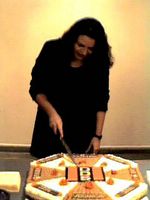

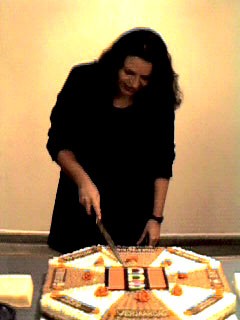
'Mayor' Marleen Stikker cuts the cake in celebration of the first year anniversary


The site
DDS was heavily promoted in the media as well as with citizens and in institutes like old folks homes by the virtual mayor of the digital city, Marleen Stikker. Once DDS was on its way, it got support to continue from the municipality of Amsterdam, grants from the ministry of Economic Affairs and the ministry of Internal Affairs and sponsorship deals. But after a year free access to Internet DDS had to close this facility. In one year DDS attracted 10.000 subscribers and by 1997 DDS had 50.000 subscribers.

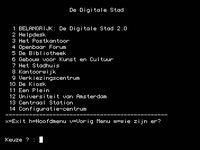
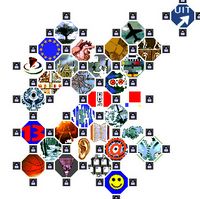

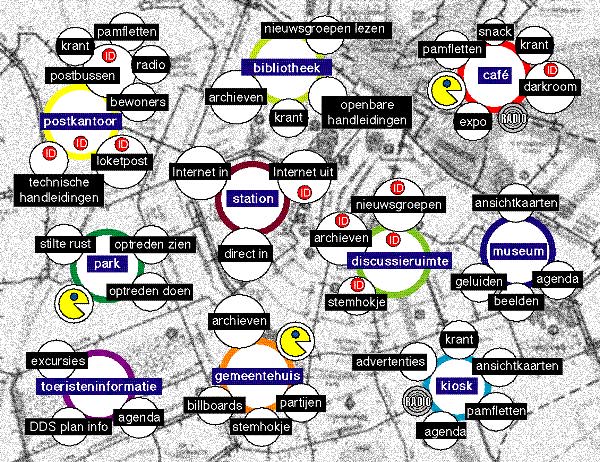
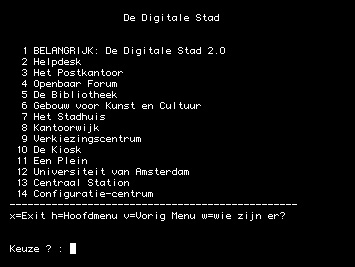
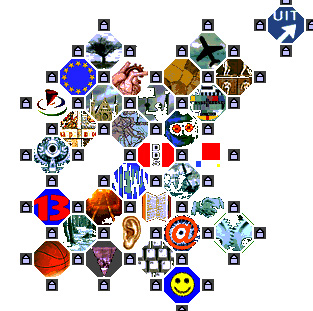
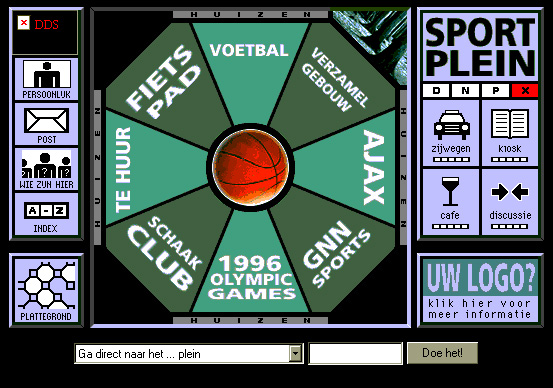
The development of the interface from a first not executed design of the digitalcity (top), the first textual screen (middle) and the first graphical screen (under)

 
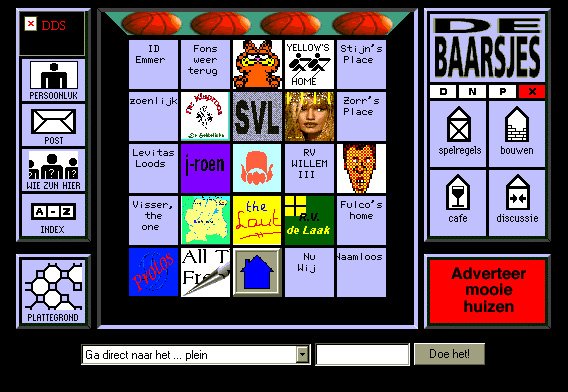
The first version of DDS was a textual interface. But this changed, when on October 15, 1994 the world wide web interface was introduced. This was a bold graphic interface, which brought out the virtual city elements such as squares and buildings as well as homes. By 1997 around 6500 subscribers had an own home, of whom 1500 inhabitants had their own front door. Besides visitors, DDS also had inhabitants, who could build their own house for free with 5Mb; they also received an e-mail address for sending mails in and outside the virtual city. Inhabitants could also accept another fantasy identity, but this could always be checked. They could also see where other people were in the city and talk to them, while in cafes they could chat with each other.


The Sports Square (left) and De Baarsjes neighbourhood with houses in the middle (right)

 
By the end of the millennium DDS did have trouble to cover debts and the board decided to change the foundation into a limited company. DDS became part of the commercial ISPs. This transition solicited a lot of emotions from inhabitants and led to a schism, named the only genuine digital city (DeDS).


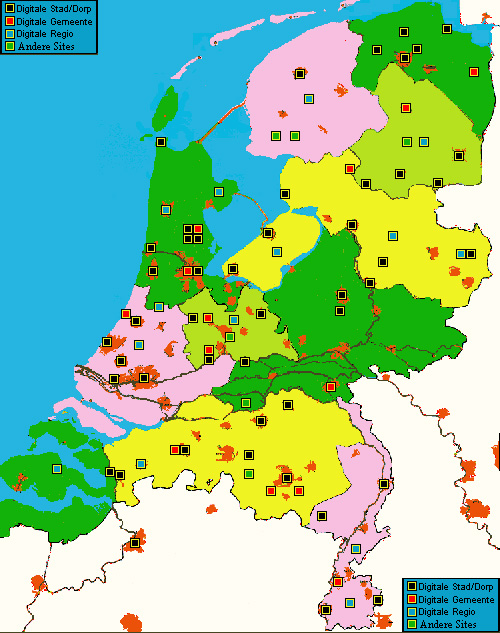
A map of the Netherlands with digital regions, digital cities and villages


Digital cities
DDS was the first digital city in the Netherlands. But soon digital regions, cities and villages popped up like mushrooms and usually died as fast as they came up. In 1986 Wegener and later on VNU Newspapers launched City Online, a project designed by Maurice de Hond. The format looked similar to that of Digital City Amsterdam, complete with houses for inhabitants. It was an expensive project, which was dependent on the goodwill of the editor-in-chief of the printed newspaper in the city or region. City Online never really took off and by January 1, 1988 the project was over. Presently regional newspapers still experiment with digital cities, villages and regions e.g. 010 in Rotterdam andDichtbij (Near) in Enschede.


Web archeology project
An archive of Digital City Amsterdam was created, when the foundation changed into a limited company. But in 2016 the web archeology project, RE: DDS, was set up by De Waag, a foundation operating at the intersection of science, technology and arts, Amsterdam Museum, the Free University and the University of Amsterdam. The recovered digital devices, magnetic tapes and CDs and were able to emulate software even to a presentation level. One of the results of the RE: DDS project was the FREEZE! manifest.


Celebration 
Ther will be a celebration in Amsterdamat the Public Library. The former virtual mayor will speak and address the pressure on the public character of the internet: "Internet companies enter the public space of the city and also put the public character of the Internet under pressure. The digital public space that we saw before us 25 years ago is now a 'market place', where power is centralized in a handful of large companies with a data hunger that seems unstoppable. Can the mores of these companies be combined with the values of our society? And who actually determines the rules, now that online and offline are becoming increasingly interwoven?"


Wednesday, September 05, 2018

BPN 1741: 40 Years ago Dutch consumers learned about online services

Forty years ago, on September 5, 1978, the long march of online public services in the Netherlands began. The public television 8 o’clock news introduced Dutch viewers to online services for the first time. From the exhibition floor of a consumer electronics fair the television reporter introduced the new digital media, showing  Ceefax-like teletext information, transported by television waves, and a Prestel-like demonstration of viewdata*/videotex**, an interactive system by the telephone. With this historical report of 3:36 minutes, Dutch consumers got a first glimpse of a future with digital media.

The technologies demonstrated used the television screen as a delivery station. Although there were already computers, so-called mainframes and mini-computers, these were used in science, in financial services and in administration departments. And the PC had just been developed, but hadn't really reached the Netherlands yet. The publicity preceding the consumer fair therefore generated television-focused headlines such as 'Extra opportunities coming on television' and 'Besides television for watching, there will also be text television'. 

And as with all new services and products, prophecies about the benefits of these new media were made before and during the fair. Services would be available 24 hours a day, 7 days a week (24/7), with information and teleshopping, banking transactions would be handled the same day and school lessons and university lectures would be available at home. The new services would bring about a change in the daily life pattern of the Netherlands, where at that time no bakery was open on Sunday and no Sunday paper was for sale. 

Start of the long march
After the consumer fair, the long march of digital media was started by the state-owned companies as the public broadcaster NOS and the telecom operator PTT. On 1 April 1980, the NOS introduced the Teletekst, moulded after the UK Ceefax service, but of course in the Dutch language. Teletekst was only available during TV transmission hours. On 7 August 1980, the then State Secretary for Transport, Public Works and Water Management, Mrs Neelie Smit-Kroes, launched the first public 24/7 online service, Viditel. It was the second operational videotext service using UK Prestel software in Europe.

The two services have run different courses. Teletekst has been very successful up to the millennium. As many countries like the UK and Belgium have abandoned the teletext services, Teletekst is still operational in the Netherlands. The PTT service Viditel was less successful and was operational till 1989, when it was replaced by its successor Videotex Netherlands. This service worked with a different organisation and has multiple delivery devices (television, PC and Minitel). The service got a wider usage and had. A milestone was reached in 1994 with 250.000 users and 3 million connected minutes. However, Videotex Netherlands was overwhelmed by Bulletin Board Systems (BBS) on PC and  the introduction of the Internet. Videotex Netherlands was officially closed on January 1, 1997. 

Breakthrough
Consumers got a peek of internet with the launch of consumer services by XS4ALL on May 1, 1993. A real breakthrough came with the opening of The Digital City (De Digitale Stad, DDS) on January 15th 1994.This Amsterdam initiative drew much attention and subscribers to the service. After six weeks the service registered more than 10.000 users. DDS sparked commercial ISP competitor like Euronet*Internet, Planet Internet and World Online. Now after fourty years, the long march for online has reached the milestone of 98 percent of Dutch households online with internet via PC, telephone or tablet. 

*Viewdata was the generic term for interactive services with teletext-like screen presentation over the telephone, which was later replaced by videotex.
** For the demonstration, a link-up was made with the Waterloo computer of the British Post Office (BPO).


Monday, November 20, 2017

BPN 1736: Manifesto FREEZE! Save and preserve digital heritage


The project group The Digital City Revived consisting of of the Amsterdam Museum, Waag Society, University of Amsterdam and the Netherlands Institute for Sound and Vision has presented its final results of: FREEZE! Save and preserve our digital heritage. The Digital City as a case study for web archaeology.
The final results of FREEZE! contain three parts:
• Do It Yourself Manual for Web Archaeology (Dutch language);
• Feasibility Study Presentation (Dutch language);
• FREEZE! A manifesto for safeguarding and preserving born-digital heritage.


Version 1 – November 2017

Aims
Finding ways to preserve born-digital heritage has become a matter of urgency and growing concern. Websites, games and interactive documentaries each bring specific challenges that need to be addressed. It takes three to tango: Ensuring that our digital lives and digital creativity are not lost to future generations requires a joint effort by the principal players: creators, heritage professionals and policy makers. This manifesto lays out the actions they need to take today to safeguard born-digital heritage.

Creators
Digital products are at risk of being lost from the moment they are created. Creators are therefore part of the preservation process - whether by writing code, editing digital content or by creating some other form of digital expression. We encourage creators as follows:
• Invest time to describe your work carefully, whatever platform you use to store and manage your work. Provide at least a minimal set of metadata (who, what, where, when). Always include versioning data and information about the rights status of the work.
• Document your work as copiously as possible. Documentation enables future users
to understand and reuse your work more easily. Describe the technical specifications of your work, for example the hardware and software used to create the work.
• If possible, assign open licenses (such as Creative Commons) to your work. This enables content to be reused. Reuse will help to ensure the longevity of your work.
• Where possible, use open-source software and open-source hardware. Your work will withstand the test of time better, since open means: independent of proprietary technology and vendor lock-in, and transparent availability of the source code and building blocks of your work.

Heritage Professionals.
Digital material presents several challenges for heritage professionals. For instance, the sheer amount of material created, dispersed among diverse platforms, hardware and domains makes selection a daunting task. There is little standardization of file formats and environments that supports these. Norms for describing and managing this complexity are inadequately developed. The tasks involved in collecting, preserving and making digital materials accessible fall into three categories. We encourage heritage professionals as follows:

Policy
• Identify vulnerable digital heritage in your area of activity and find out which forms of digital heritage your organisation develops, manages or intends to manage (in line with collection policy plans). Create a convergent digital landscape by harmonising collection policies with other institutions. To ensure success, avoid overlaps and gaps in the combined collections.
• Develop policies for acquiring and keeping born-digital material accessible sustainably. Use existing models, as described in the ‘DIY Handbook of Web Archaeology’.
• Obtain legal advice regarding storage and reuse. Act responsibly when using, managing and making personal data or information accessible.

Implementation
• Where possible, cooperate with (fellow) institutions and industrial partners to find collective solutions. Choose robust –preferably open - technical infrastructures and operating systems.
• Assume that your current technology will need to be updated regularly. So prepare your exit strategy: can you move data from system A to system B easily?
• Use well-documented, open standards, e.g. for storage formats and exchange protocols. Non-dependence on suppliers ensures your archive material remains interchangeable in the future.
• Agree clear guidelines for delivery of acquired and transferred born-digital material: when, why and under what terms. Outline the rights and obligations before and after material is transferred. If accessibility is an objective, organise this when the acquisition is realised: lay down terms for accessing the collections.
• Ensure copious metadata records are kept of digital objects so that the context in which these were created is clear for future users. E.g. record the hardware and software environment in which objects function. Document data in the form of descriptions, photos, screenshots, screencasts, videos etc, and establish conservation procedures.
• Ensure collections can be used and reused, that digital objects can be found, accessed, interoperated, reused and stored in a sustainable manner. Use and reuse by a large group of users increases awareness of the importance and need for preservation.

Knowledge sharing
• Exploit the power of the community. Introduce your team to the original creators, inventors and users. Organise meetings to share expertise.
• Keep track of developments in amateur communities involved with digital works. Much can be learned from bottom-up initiatives by amateurs who keep older digital cultures alive.
• Invest in your co-workers’ increasing expertise and keep track of developments by following blogs, seminars and participating in domestic and international expert communities, such as NDE (Digital Heritage Network Netherlands) or iPRES.
• New born-digital products require new instruments and new research queries. To keep pace with rapid changes in technology, be prepared for new ways of working and new ways of cooperating.

Policy makers
You hold the key to creating a sustainable policy that ensures sustainable digital heritage. We encourage policy makers to do the following:
• Stimulate cross-domain collaboration and use of collaborative instruments. Value hands-on expertise. Encourage the experts who love tracking down bit rot, annotating ancient code and building emulators. Put them in a position to share their knowledge and obtain recognition for their contribution.
• Bring the need to develop sustainability policy and preservation policy to the attention of institutions.
• Stimulate the emergence and use of open and collective services to ensure that as many heritage institutions in the Netherlands as possible will be able to guarantee long-term access to the digital collections they manage. Encourage collaboration within the Digital Heritage Network, based on the National Strategy for Digital Heritage.
• Encourage copyright reform to facilitate the preservation, availability and reuse of born-digital heritage.

Invitation
There are many ways to advance the aims outlined here. We are the steering committee of the DDS project, realised in 2016 and 2017 with support from Mondriaan Fund, National Coalition Digital Preservation, Digital Heritage Network, Prince Bernhard Culture Fund, Creative Industries Fund NL. We welcome your feedback regarding this version of our manifesto and are keen to learn about other activities designed to pursue these goals. We encourage others to join us to help further the overarching objective of preserving born-digital heritage.

Judikje Kiers Amsterdam Museum
Julia Noordegraaf University of Amsterdam
Johan Oomen Netherlands Institute for Sound and Vision
Marleen Stikker Waag Society

More information: http://hart.amsterdam/freeze

This material is licensed under Creative-Commons-Licence BY 4.0 International: http://creativecommons. org/licenses/by/4.0/

Tuesday, July 12, 2016

BPN 1724: First Dutch Digital City of 1994 will be resuscitated


There was a special session at the Amsterdam Museum, where a preview was given of the restoration of the site The Digital City (DDS). This historic site was the internet site that kicked the Dutch consumer on January 15, 1994 into the internet era. It was a project, based on the US free-nets, and started by the political-cultural center De Balie in Amsterdam and XS4ALL, the first consumer internet ISP. It was started at the beginning of the municipal elections  of spring 1994 and expanded the public media debate range from the local television, radio and print media to internet. The metaphor of a virtual city was chosen to emphasize the character of the public domain of DDS.  

First Dutch digital city
At first the information and communications services were presented in texts, but from October 15 onwards the interface became graphic. The organization received a grant from the city of Amsterdam to set up the site. The initiative received a lot of public attention on radio and television and in the press. Marleen Stikker was the  virtual mayor of DDS and the media spokesperson. And the initiative did receive a lot of attention. In fact thousands of potential online users were clamouring on the gates to get in and get a dial-up connection through DDS. After six weeks, the project already had more than ten thousand registered users. Not only internet provider XS4ALL was surprised by the interest, but also line provider PTT Telecom. 

Virtual experience 
The initial enthusiasm of DDS caused a rise and fall. DDS became an ISP, but eventually could not manage to stay in business and disappeared from the internet scene. The remains were buried with the other archives of Amsterdam Museum (the first Dutch museum to recognise digital heritage).  

Until he original files were found back in the Amsterdam Museum Archives. This led to the project ‘DDS resuscitated’ sponsored by he Amsterdam Museum, the Waag Society, University of Amsterdam and Sound and Vision. Computer science students from the University of Amsterdam and the Free University found a file of 10Mb on a hard drive. This drive had been stored for 20 years. The students restored the file in two versions: one with all data and one replicate. On June 30th, these were demonstrated as DDS version 3.0. 
In the fall DDS version 4.0 will be shown. It will be an emulation completely programmed anew "to create a modern, stable and secure functioning site”. In this version users will be able to select an avatar and can move through the city from bar to post office and library using the subway. It will bring back some of the first feelings, experienced at the introduction of DDS. As one can still walk through Pompeii in Italy and experience the Roman city as it was, so users will also be able to visit and experience the first Dutch virtual city of 1994, complete with map and guide. 

10+ years back in time 
"DDS resuscitated' is a first web archeological project in The Netherlands, which offers a view of internet as it was between 1994 and 1996. It will allow users to look back a little over a decade. Hopefully the project is a first incentive for more online projects like the first online Dutch public service Viditel 1980. It would be great to recreate this service and make it available online. It could bring back the feeling of how users digested information through the Prestel based videotex system. Perhaps the former PTT museum, now named the Museum of Communication, or the successor of PTT Telecom still might have a few tapes in their archives.

Friday, January 03, 2014

BPN 1675: 2014: already a memorable year

The new year has only just begun. Yet, for me 2014 is already a year to remember. It is 20 years since the Internet for consumers made ​​her entry in the Netherlands. On January 15, 1994 the ISP launched The Digital City ( DDS ) in Amsterdam.

The Digital City ( DDS ) started on Saturday January 15, 1994 with an television interview in the eight o'clock news. DDS was an internet project, intended as a discussion forum in the run up to the municipal elections of March 1994. The project was designed by netactivisten (Hack -Tic), the municipality and partly inspired by Marleen Stikker, the virtual mayor of the city. The town was based on community networks ( free nets) in the U.S. and Canada. The model of the city was chosen as a metaphor.

First DDS interface text without graphics (DDS Archief)


DDS Interface 3.0 DDS Archief)


DDS was a great success. In six weeks, 10,000 people applied for access to the city. By visiting the virtual mayor of organizations, but also to institutions, the project received much local attention, as the mayor visited organisations and institutions. And it were not only people coming from Amsterdam, but also people from across the Netherlands. After the project DDS went on as an Internet service provider. DDS actually opened the doors for Internet consumers by January 1994 and by January 1, 1997 the Netherlands  had registered 1 million internet consumers.

The success of DDS was surprising. There used to be an online and multimedia industry in the Netherlands. Online databases such as Kluwer Legal Database were used for scientific, technical and business research. Electronic messaging services like Memocom were separate, mainly business services. For consumers, there was the information service Viditel, followed by Videotex Netherlands. And for amateurs, there were the Bulletin Board Systems ( BBS ). Furthermore, there was there a beginning of a multimedia industry with text CD-ROMs, multimedia CD- ROMs and CD -i titles as well as a few electronic books. But this industry was only 100 million guilders ( 45 million euros) great in revenues and the consumer share was very low.

Internet, however, developed separately from this industry, mainly through the academic network SURF. As of 1990 there were ISPs and by the end of 1993 there were approximately 295 companies connected to the Internet. In May 1993, XS4ALL opened an Internet service to consumers. Although in the first two days, 500 consumers were registered, the number of subscribers grew slowly. DDS, however, was the driver and was a resounding success.

In retrospect, a number of factors accounted for this consumer success.
a. The number of households with a PC in the Netherlands had increased from 7 percent in 1985 to 34 percent in 1994.
b. People wanted to do more with the PC than gaming, word processing, accounting and consult encyclopedias on CD - ROM.
c. Internet came as a disruptive technology. Existing online and multimedia technologies had to adapt or eventually disappeared, eg videotex and CD-i. Out of the concrete mixer containing different technologies, eventually only Internet and email survived. Teletext and CD - OM stayed on, but played no important part anymore.

 
 d. Consumer internet was cheap compared to online databases. Moreover, the Internet technology was user-friendly thanks to hypertext, had more graphic opportunity and had greater potency multimedia ( text, image, video and sound). Besides, Internet combined with email.

e. Internet did not developed within the existing online and multimedia industry, but within the bosom of universities and scientific institutions. Companies that had internet installed proved attractive to students after completion of their academic studies.

For those interested, Reinder Rustema wrote a doctoral thesis on the Digital City in 2001.