Today it is 25 years ago that the Digital City Amsterdam was launched. Digital City Amsterdam was a historic project as it meant a breakthrough for internet in The Netherlands, but also an example of a virtual community.
Breakthrough
By 1993 technical access to Internet was available in the Netherlands. Three ISPs (NLnet, XS4ALL and Knoware) delivered the technical access mostly to companies, but did not offer any other services. They invested hardly any effort in marketing and promotion as most clients found their way to the companies/foundations. This changed drastically in 1994 when the De Digitale Stad (DDS) came online. This foundation was an initiative of De Balie, XS4ALL and was set up in order to form a discussion platform for six weeks for the upcoming municipal elections. It was a success from the start, partly because a visitor got a free e-mail address and free access to other textual information. So far internet visitors had to fiddle a lot with their PC settings in order get contact with the host. But through DDS internet could be reached via a dial-in connection and through public terminals at the City Hall and the debatting centre De Balie.
'Mayor' Marleen Stikker cuts the cake in celebration of the first year anniversary
The site
DDS was heavily promoted in the media as well as with citizens and in institutes like old folks homes by the virtual mayor of the digital city, Marleen Stikker. Once DDS was on its way, it got support to continue from the municipality of Amsterdam, grants from the ministry of Economic Affairs and the ministry of Internal Affairs and sponsorship deals. But after a year free access to Internet DDS had to close this facility. In one year DDS attracted 10.000 subscribers and by 1997 DDS had 50.000 subscribers.

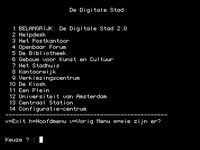
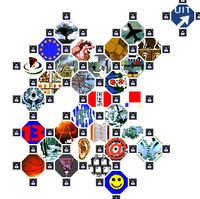
The development of the interface from a first not executed design of the digitalcity (top), the first textual screen (middle) and the first graphical screen (under)
The first version of DDS was a textual interface. But this changed, when on October 15, 1994 the world wide web interface was introduced. This was a bold graphic interface, which brought out the virtual city elements such as squares and buildings as well as homes. By 1997 around 6500 subscribers had an own home, of whom 1500 inhabitants had their own front door. Besides visitors, DDS also had inhabitants, who could build their own house for free with 5Mb; they also received an e-mail address for sending mails in and outside the virtual city. Inhabitants could also accept another fantasy identity, but this could always be checked. They could also see where other people were in the city and talk to them, while in cafes they could chat with each other.


The Sports Square (left) and De Baarsjes neighbourhood with houses in the middle (right)
By the end of the millennium DDS did have trouble to cover debts and the board decided to change the foundation into a limited company. DDS became part of the commercial ISPs. This transition solicited a lot of emotions from inhabitants and led to a schism, named the only genuine digital city (DeDS).

A map of the Netherlands with digital regions, digital cities and villages
Digital cities
DDS was the first digital city in the Netherlands. But soon digital regions, cities and villages popped up like mushrooms and usually died as fast as they came up. In 1986 Wegener and later on VNU Newspapers launched City Online, a project designed by Maurice de Hond. The format looked similar to that of Digital City Amsterdam, complete with houses for inhabitants. It was an expensive project, which was dependent on the goodwill of the editor-in-chief of the printed newspaper in the city or region. City Online never really took off and by January 1, 1988 the project was over. Presently regional newspapers still experiment with digital cities, villages and regions e.g. 010 in Rotterdam andDichtbij (Near) in Enschede.
Web archeology project
 An archive of Digital City Amsterdam was created, when the foundation changed into a limited company. But in 2016 the web archeology project, RE: DDS, was set up by De Waag, a foundation operating at the intersection of science, technology and arts, Amsterdam Museum, the Free University and the University of Amsterdam. The recovered digital devices, magnetic tapes and CDs and were able to emulate software even to a presentation level. One of the results of the RE: DDS project was the FREEZE! manifest.
Celebration
Ther will be a celebration in Amsterdamat the Public Library. The former virtual mayor will speak and address the pressure on the public character of the internet: "Internet companies enter the public space of the city and also put the public character of the Internet under pressure. The digital public space that we saw before us 25 years ago is now a 'market place', where power is centralized in a handful of large companies with a data hunger that seems unstoppable. Can the mores of these companies be combined with the values of our society? And who actually determines the rules, now that online and offline are becoming increasingly interwoven?"
Breakthrough
By 1993 technical access to Internet was available in the Netherlands. Three ISPs (NLnet, XS4ALL and Knoware) delivered the technical access mostly to companies, but did not offer any other services. They invested hardly any effort in marketing and promotion as most clients found their way to the companies/foundations. This changed drastically in 1994 when the De Digitale Stad (DDS) came online. This foundation was an initiative of De Balie, XS4ALL and was set up in order to form a discussion platform for six weeks for the upcoming municipal elections. It was a success from the start, partly because a visitor got a free e-mail address and free access to other textual information. So far internet visitors had to fiddle a lot with their PC settings in order get contact with the host. But through DDS internet could be reached via a dial-in connection and through public terminals at the City Hall and the debatting centre De Balie.
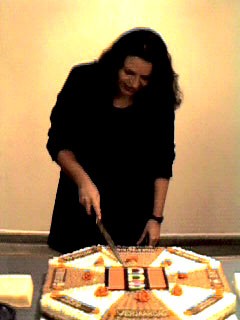
'Mayor' Marleen Stikker cuts the cake in celebration of the first year anniversary
The site
DDS was heavily promoted in the media as well as with citizens and in institutes like old folks homes by the virtual mayor of the digital city, Marleen Stikker. Once DDS was on its way, it got support to continue from the municipality of Amsterdam, grants from the ministry of Economic Affairs and the ministry of Internal Affairs and sponsorship deals. But after a year free access to Internet DDS had to close this facility. In one year DDS attracted 10.000 subscribers and by 1997 DDS had 50.000 subscribers.
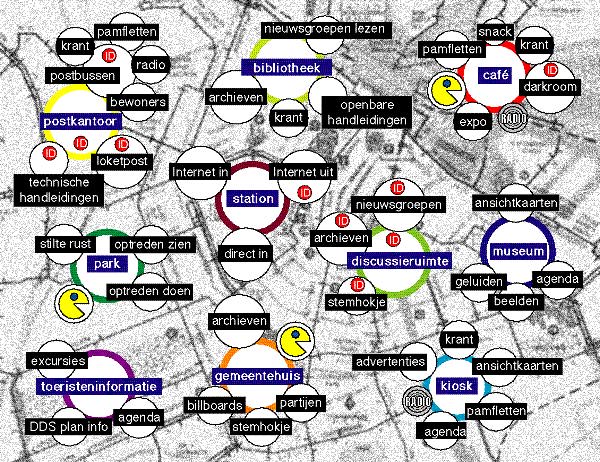
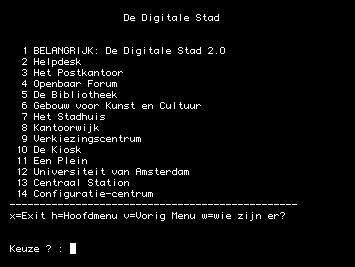
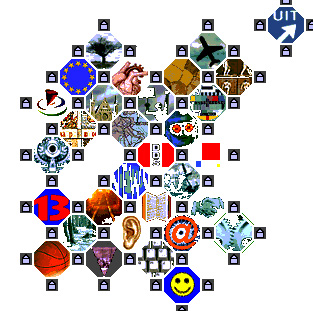
The development of the interface from a first not executed design of the digitalcity (top), the first textual screen (middle) and the first graphical screen (under)
The first version of DDS was a textual interface. But this changed, when on October 15, 1994 the world wide web interface was introduced. This was a bold graphic interface, which brought out the virtual city elements such as squares and buildings as well as homes. By 1997 around 6500 subscribers had an own home, of whom 1500 inhabitants had their own front door. Besides visitors, DDS also had inhabitants, who could build their own house for free with 5Mb; they also received an e-mail address for sending mails in and outside the virtual city. Inhabitants could also accept another fantasy identity, but this could always be checked. They could also see where other people were in the city and talk to them, while in cafes they could chat with each other.
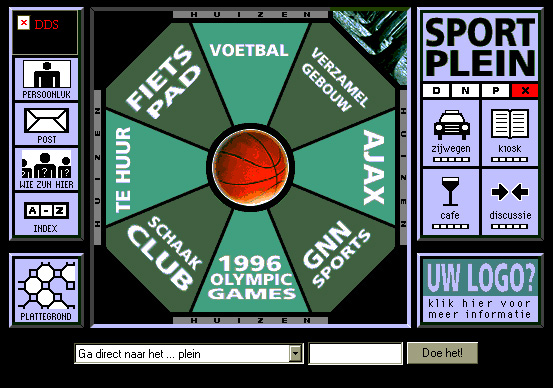
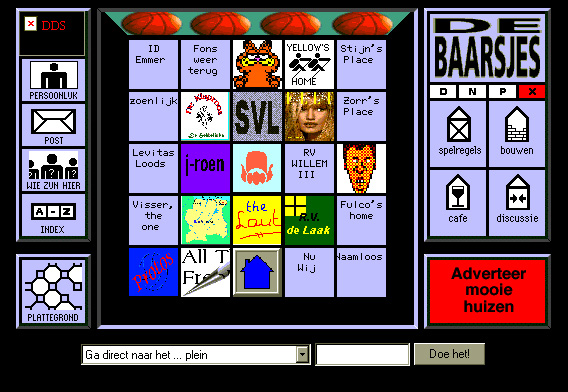
The Sports Square (left) and De Baarsjes neighbourhood with houses in the middle (right)
By the end of the millennium DDS did have trouble to cover debts and the board decided to change the foundation into a limited company. DDS became part of the commercial ISPs. This transition solicited a lot of emotions from inhabitants and led to a schism, named the only genuine digital city (DeDS).
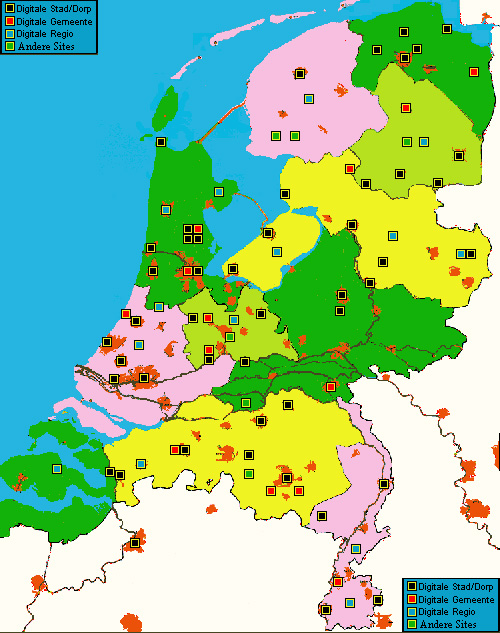
A map of the Netherlands with digital regions, digital cities and villages
Digital cities
DDS was the first digital city in the Netherlands. But soon digital regions, cities and villages popped up like mushrooms and usually died as fast as they came up. In 1986 Wegener and later on VNU Newspapers launched City Online, a project designed by Maurice de Hond. The format looked similar to that of Digital City Amsterdam, complete with houses for inhabitants. It was an expensive project, which was dependent on the goodwill of the editor-in-chief of the printed newspaper in the city or region. City Online never really took off and by January 1, 1988 the project was over. Presently regional newspapers still experiment with digital cities, villages and regions e.g. 010 in Rotterdam andDichtbij (Near) in Enschede.
Web archeology project

Celebration
Ther will be a celebration in Amsterdamat the Public Library. The former virtual mayor will speak and address the pressure on the public character of the internet: "Internet companies enter the public space of the city and also put the public character of the Internet under pressure. The digital public space that we saw before us 25 years ago is now a 'market place', where power is centralized in a handful of large companies with a data hunger that seems unstoppable. Can the mores of these companies be combined with the values of our society? And who actually determines the rules, now that online and offline are becoming increasingly interwoven?"


