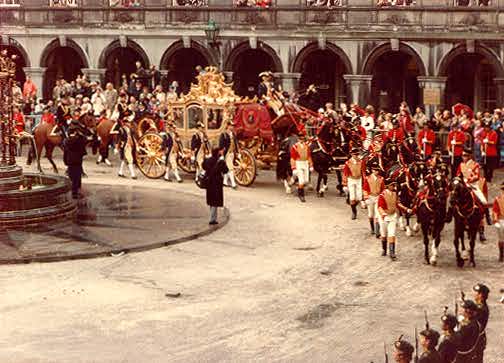
The Dutch government has reserved 154 million euro for the next seven years on the new budget in order to digitise and conserve 285.000 hours of movies and television programmes as well as 2,9 million photographs. This boost is based on the project plan Visions for the Future.
In the Netherlands there are public and private movie and television archives which date back for one hundred years. These are entertainment movies, documentaries, radio- and television programmes of more than 700.000 hours. A plan written by representatives of the Institute of Vision and Sound, the Film Museum, the National Archive, the Central Discotheque Rotterdam and the Association of Public Libraries as well as Holland Knowledge Land have presented a plan to conserve and digitise 285.000 hours of movies, video and audio and 2,9 million photographs. The material will be made accessible for educational and creative applications. A distribution infrastructure will be developed and a base collection will be available either without any copyright or under Creative Commons licenses. A cost-benefit analysis shows that the project will have a social effect of 20 to 60 million euro. Exploitation revenues, which might total 80 million euro, will be ploughed back into the project.
Such a project looks like a real boost for the audio-visual sector, but it contains several flaws:
A program of digitising and conserving is not new. In the past 10 years the Institute of Vision and Sound has already digitised and archived parts of broadcast programs for the public broadcast companies and for third companies and has received grants from the EU in the past. The Dutch film museum has already collected and digitised material for its most important parts of the collection in the past 25 years.
In the project plan no lists have been published of what will be digitised. It is also unclear whether private collections will be included.
The composition of the project consortium is lopsided; all institutes are subsidised semi-governmental institutes. An institute like Holland Knowledge Land has no knowledge or experience in the field. Not one commercial company such as a movie restoration company or a marketing company has been included.
The project has as objective not only to conserve, but also to exploit. But there is no exploitation plan; this seems to be a Dutch disease. In the past years the Dutch had a mega-billion project in the transport sector; when it was launched it was said that the railway line (Betuwelijn) would be profitable with assignments from the transport sector. The same type of philosophy is now used in this AV project, saying that it will yield 80 million euro, if education and the creative industry use the archives.
The project should not be called off, but it certainly needs a better foundation. The consortium should consist of public institutes and private companies. Public and private collections should be part of the project. Desk research should be done to establish the principles on which material should be digitised. More marketing expertise should be drawn in.
Tags: broadcast archives, heritage
Blog Posting Number: 522














 I came to think of the newspapers today as the Dutch national library KB has started a project to digitise newspapers from two centuries ago. They will scan 8 million pages of national, regional and colonial newspapers. The series will start with the Courante Uyt Italien Ende Duytslandt, dating back to 1618. The project will link the digital papers which are archived these days with the newspapers of the past. Many of the newspapers have converted the paper versions to microfilm, but searching in microfilms is a tedious job. In the Netherlands in the late seventies VNU started an experiment with Philips to convert newspaper images to laser disk. But as online and CD-ROM were introduced, newspaper started to build up a digital archive (in the Netherlands we started almost 10 years later with digitising newspapers than in the US, where the NYT already started to digitise in the sixties). So in 2008 we will be able to search online in a newspaper archive of almost three centuries.