Saturday, May 20, 2006

Silence around Quaero

The EU assignment in Brussels ended last night and I could take the train home. This had been a week of going back and forth to the hotel by metro; the new stations of the metro are very arty with such nice stations as the station Eddy Merckx. But it had also a week in which I missed my lunch with an EU official as he caught the flu. However I met after almost 11 years Ana from Sheffield University; at that time we did evaluations on multimedia projects in Luxembourg. This time we were not in the same evaluation team. So with the weekend ahead I could back into the normal rhythm, get my administration done and start editing and writing again.

Looking back at the assignment I can little say about as I have signed a confidentiality declaration, which forbids to disclose anything about the proposals; and rightly so. What is known are the themes of the proposals as the call closed last month. The major areas were: advanced robotics; ambient Assisted Living (AAL) in the Ageing Society; advanced search technologies for digital audio-visual content; accompanying actions in support of participation in Community ICT research; international cooperation.

Of course a lot of attention was going to the advanced search technologies for digital audio-visual content. For this part of the programme some 30 million euro had been set aside. Everyone expected of course that the called would be jammed with proposals which would cover a part of the development of the European search engine Quaero. But as I was talking with an EU official he told me that Quaero was a matter he could not talk about. The Commission had asked the officials to forgo any comment as the matter is very political with the players in France and Germany. So it is safe to believe that no official applications for Quaero were entered in the section advanced search technologies for digital audio-visual content and will be diving into the EU money coffers. On the other hand this will not say that the EU is not considering co-funding such a project. For the time being Quaero is a project of French and German industries with research funded by the countries’ governments. When and with how much the EU will step into the project is still unclear. But the embargo of the officials forebodes an EU involvement.

Tags: ,

Blog Posting Number: 382

Friday, May 19, 2006

Editing the manuscript (6): Exploring Value Networks

One of the last articles to edit is an article by Harry Bouwman, Edward Faber and Erik van den Ham of the Netherlands.

The abstract of their paper reads:
Designing business models for mobile services is a complex undertaking because it requires multiple actors to balance different requirements and interests. A business model can be seen as a blueprint of four interrelated components: service offering, technical architecture, and organizational and financial arrangements. Although little attention has been paid to how these components are related, we need this knowledge to enhance our understanding of what constitutes a viable business model. In this paper we explore the connections between two of these components, namely service offering and organizational arrangements, i.e. network formation. Our focus is on services with which mobile workers can access back office information systems. We present two case studies exploring the dynamic relationship between service offering i.e. access to back office databases, and the organizational network that enables access. Both cases indicate that the shift from the development of a service to its exploitation is an important step in organizational network formation. One important issue to consider is scalability, both from a technological and an organizational point of view. Furthermore, existing relationships and trust between organizational partners play a significant role. Network formation is an important part of the development of a business model for innovative mobile services. The organizational network should match the service proposition.
Tags: mobile content


Blog Posting Number: 381

Thursday, May 18, 2006

Editing a manuscript (5): mobile tourist services

The title of the next article to edit sounds very catchy: Post Disney experience paradigm? Some implications for the development of content to mobile tourist services. The article was written by Lars Bojen from Danmark.

This is the abstract of his paper:
This paper presents and discusses a conceptual framework for a location based mobile ICT system for a visitor destination in the near future. The issues presented originate from ideas and intentions in a specific Danish tourism project “Mobile Digital City and Nature Walks - development of content and software for a mobile tourism device”. The article gives an introduction to the background and intentions in the project, where focus is on content and sustainable tourism. And to outline how mobile ICT services can add value to the tourism experience and to the visitor destinations in the proposed project, the article present first a user scenario and then some implications for the development of content for mobile tourist services regarding: a) the good tourism experience according to the industry and b) experiences from qualitative studies of tourism. Finally the paper outlines main challenges in the project in terms of content development, technology and tourism industry. The contours of a new experience paradigm, when convergent and pervasive technologies have been implemented in 5-10 years, are also presented.

Tags:

Blog Posting Number: 380

Wednesday, May 17, 2006

Editing a manuscript (4): It’s time to play a game

One of the nice articles in the manuscript is an article by Maja Pivec from Austria. Maja wrote an article on innovative learning by games.

Although games are part of children grow up and formal education, digital game-based learning is a novel approach in the area of Universities and Lifelong learning. In search for new positioning of the universities in the changing setting of lifelong learning, gaming is becoming a new form of interactive content, worthy of exploration. One of the European Projects, exploring this topic is Minerva project UniGame: Game-based Learning in Universities and Lifelong Learning. Goals of the UniGame project were as follows: to promote digital game-based learning in Europe, to test different educational games within different subjects in various European countries and to focus on social game forms that include virtual communities and collaborative learning.

Digital game-based learning can be applied as additional option to classroom lecturing. Intention of digital game-based learning is to address new and ICT based didactical approaches to learning and at the same time to provide learners the possibility to acquire skills and competencies later required in the business world. By means of educational games learners should be able to apply factual knowledge, learn on demand, gain experiences in the virtual world that can later shape their behavioral patterns and directly influence their reflection, etc. More details on aspects on game-based learning and educational games are provided in[Dondi et al. 03], [Pivec et al. 03], [Prensky 01].

To illustrate possible applications, we present two examples of the game usage. A teacher, who wants his /her students to reflect actively upon interdisciplinary consequences and ethical behaviour of engineers, defines a game-theme called Tunnel building. The aim of the game is that 4 teams are competing to make the best offer and technical solution to build a tunnel on the defined location. The solution should consider different parameters like financial frame, time deadlines, technology applied, ecological acceptance, etc. During the game teams can “buy” knowledge from other experts. Teams are also expected to be able to react on unexpected new conditions e.g. new emission law, or the law regarding an area near the tunnel location, that was declared a natural park, etc. Teams use the preparation time of the game to elaborate their solution. During general discussion different important subjects should be discussed and a consensus on which solution is the most appropriate should be achieved.

To experience Multicultural differences another game-theme could be defined. In this game students worldwide can form teams. There are various possibilities: multinational teams or each nationality builds own team. Teams should work on the same task e.g. to design a multicultural website. Within the team session teams should work on their proposition, research similar web-pages in different cultural environments. Teams should publish their ideas and propositions about functionality and design of a page. Within the general discussion teams have to discuss the subjects and to reach a consensus (e.g. about features of a web page, which design would be the best, which parameters should be considered for cultural adaptation, etc.).


Tags: ,

Blog Posting Number: 380

Tuesday, May 16, 2006

Editing a manuscript (3): Bio-multimedia

As if I was talking about the devil this morning. I was definitely going to edit the manuscript. And one of the first articles was a rather controversial article on Bio-Multimedia. And whom did I walk into this morning entering the elevator of the grant factory: the author himself, Mr Arhur Lugmayer, an Austrian living in Finland. Just a coincidence.

The paper, written by Lugmayr of the Digital Media Institute in Tampere was an exploration beyond ambient multimedia. The researchers left user-interface design, high-quality video and audio, ubiquitous computing, pervasive designs, and advanced input devices behind them and jumped over multimedia and its related fields from ‘integrated presentation of information in one form’ (multimedia), to ‘computer generated simulated environments with its peripherals’ (virtual reality), ‘the surrounding and user is the interface’ (ambient multimedia) to a novel and newly introduced field of bio-multimedia: ‘integrated human capacity’. Lugmayer uses the definition: “Bio-Multimedia integrates human capacity for spanning a bio-space for leisure content. Human capacity convolves perceptive senses, bio-signals, and interface capabilities with machinery. A bio-space is a biological inspired generated realistic environment where human capacity is integrated with peripherals.

Multimedia and its derivates span a cyberspace for connecting people in an imaginary space for creating virtual communities, experience virtual sex or dive into virtual environments for the purpose of leisure. Bio-multimedia as factor for integrated human capacities in a Bio-Space has the same purpose: provision of leisure created on top of biological metaphors. The goal of this multidisciplinary scientific work ranging from the discipline of theoretical computer science, bioinformatics and systems biology, medicine, to multimedia is a substantial factor for the development of a world-class concept for the transition between ambient multimedia and its next generation: bio-multimedia. The underlying question is simple. Its answer lays far in the future - beyond current bio-technological possibilities. Which challenges, possibilities, and facilities are provided by bio-technology to span a bio-space for the creation of leisure content? The focus of this research is the creation and introduction of bio-multimedia as new branch of multimedia.

When the paper was presented it caused some uproar: multimedia as an extension of your body. Glorianna Davenport of MIT Mediawho was present objected to the implications and called for an ethical approach. In the final version the authors say “The quality and content of this paper highly benefited from the discussions with her, her email conversations and patient revision of this paper”.

Tags:

Blog Posting Number : 379

Monday, May 15, 2006

Editing a manuscript (2): Trends

To get in the right mood for editing the book I started to read the introduction by Prof. Dr. Peter A. Bruck. According to him the digital content industry is facing a number of new changes and issues which are worth recounting at the beginning of this book:

- The Wiki Movement: Users are challenging established ownership and distribution arrangements, whether through P2P networks or open access/open archive publishing conventions, or through new mass distribution and inter-community trading. Network availability and broadband applications create possibilities for new forms of expression by users. See the success of Wikipedia where users are content creators for an entire encyclopaedia.

- Different sectors react differently: Scientific, technical and medical publishing has gone towards full digitisation and digital delivery. In the games sector a new on-line segment has developed. Intellectual property and copying issues remain crucial.

- Three modes of pay: subscription, pay per use/view and access charges remain the key ways for generating revenues. Companies survive if they are able to generate positive revenue feedback cycles when growing numbers of paying users foster the marketing, development, and distribution of online content and services, which in turn might draw more paying users.

- Content Gap and Economic Issues: The creative ICT and digital content industries are challenged to develop innovative contents adapted to broadband, mobile or fixed; to co-operate and change roles among value chain players (in particular between content owners, network operators, Internet service providers, hardware and consumer electronics suppliers); to fight digital piracy and deal with the role of file-sharing; Major concerns are the role of intellectual property in protecting ownership in both products and services, the enforcement of copyright in a digital world, defining and monitoring fair use and the boundaries of legitimate use, and the interaction between competition law and copyright; to create a regime for digital rights management and customer authentication; to put into place efficient payment methods (especially for micro-payments).

- Content Gap and SMEs: Operating in the new digital content industries is highly complex and challenging: legal issues are critical, the definition of software and application products complex and licensing negotiations often more lengthy and complicated due to intricate technical issues and differing legal regimes across platforms and countries. In addition, oligopolistic content markets with a strong role of market leaders, exclusive access to content or networks (network access gatekeepers) make it very difficult if not impossible for SMEs to stay in the market in the longer run and deploy broadband applications and content.

- Financing Cycles: The climate for private investment in the creative ICTs is a-cyclical to the technological advance: Three to five years ago money was readily available, but the technology mostly narrowband; today rich media (DVD-Offline) and broadband (Online and Mobile) could deliver new contents and innovative services, but the investors have been burnt away. Often, investment in digital content and digital delivery has to be sustained by margins derived from traditional market activity. Very few successful new ways of generating revenue have emerged.

- Moore’s Law is working to increase Content Gap: Performance increases and productivity gains increase functionalities and reduce prices for users. Often, these gains require structural changes in content creation and delivery industries. On the supply side the new generations of ICTs are leading to changes in the market structure of telecommunications, information services and content firms. Essentially, all the players must reinvent themselves. Network operators need to generate revenue to support investment in next-generation networks and replace loss of traditional business (see: Triple Play). For intermediaries, the market churn is very high and there are few winners.

- Market complexities increase: New sets of business activities and new roles emerge in the creative ICT and content industry: content design and aggregation, marketing of publishing offers, rights acquisition / management, packaging and distributing content, content protection, management of emerging publishing services, design and sale of interactive advertisement spaces, profiling users, integrated billing management, payment management, customer relation management, security/control services, access management.

Tags:

Blog Posting Number: 378

Sunday, May 14, 2006

Editing a manuscript (1)

Today I will be leaving for Brussels. Another assignment of the EU (see the list), working in the grant factory. Another week living in a hotel. My favourite hotel, Hotel du Congres, was booked up, so I had to look for another one. It is further away from the grant factory than the Hotel du Congres, but it is at the end of the metro line and will be only 15 minutes by metro, so the site says.

Usually the evenings are no fun, unless you know other people from the crew. Then you will go for some good food and talks. But otherwise you can have a pizza and watch television. I have planned to get a major assignment done: the editing of a manuscript. Every night two chapters and by the end of the week it will all be done. I will start tonight editing in the train to Brussels.

I hope to be able to report on the chapters during the Brussels days. I am not sure whether I have access to a wifi in the hotel.

EC involvement
2006 : EC assignment
2005-06: Vocinet project, co-finded by EU MEDIA

2005 : project evaluations in the framework of the IST programme
2004 : project reviews for the e-content programme
2004 : Teacher INYOP cross-media movie project, co-funded by EU Media
2004 : Teacher X-Melina cross-media project, co-funded by EU MEDIA
2003 : Teacher X-Melina cross-media project, co-funded by EU MEDIA
2003 : Rapporteur on Open Source proposals
2002 -2003 : partner INFORM project
2002 : Work package leader 2 in IST project ACTeN
2002 : Work package leader in MEDIA project X-Melina
2002 : project reviewer EC projects on multimedia content
2002 : evaluator e-Content proposals
2001 : contributor to IPPA report; evaluator and rapporteur IST KA 5, III
1999, 2000 : evaluator and rapporteur IST KA 5, III
1995, 1996, 1997 : rapporteur TAP Information Engineering
1993 : author of the IMO working paper on CD based media
1987-19921992, 1993, 1994: evaluator IMPACT II, sector multimedia publishing
1991 : part of the Brokerits study team on multilingual thesauri
1989 : evaluator IMPACT I, sector intelligent interfaces
1988 : part of the Dutch research team for the HERMES document delivery system by satellite
1987 : study on the economics of electronic information with the French research institute IDATE
1986 : co-researcher in the study KIOSK with French company Quadrature
1983-85 : DOCDEL programme, launching the first European daily online newsletter

Tags:

Blog Posting Number: 377

Saturday, May 13, 2006

Content management

This week I have been working on content management in the framework of a guest lecture. I put some time in it as I think that too often and too soon people translate content management into content management systems (CMS) and even more specifically into CMSs for text systems.

Of course first the definition for content and e-content should be set. I am using the definitions set by Andrea Buchholz and Ansgar Zerfass in the book e-Content: Technologies and Perspectives for the European Market. Basically it is information put on a medium. Analogue content uses print, video, broadcast TV and radio, while digital content uses carriers as CD-ROM, DVD Internet, Digital radio, digital TV, mobile. Offline content is stored on floppy disc (if they still exist), CD-ROM, DVD, IPods and memory sticks. Online content will be delivered via a network (Internet by telephone or satellite) and allows for interactivity and especially feedback routines.

The content industry is complex as is clear from the following scheme, taken from the book mentioned above:


It is clear that media and context are important. Distributing a message originally produced for internet with a picture needs another process than sending the same message by SMS or by digital television. A clear analysis will have to be made of the input processes, the conversion to an independant general mark-up language such as XML and multi-output media.

But content management requires more. Accessibility of content by metadata, for example. Of course the 15 fields of the Dublin core show up. But for example in the Netherlands the government sites carry 20 fields. But to make content more accessible thesauri, taxonomies, ontologies and semantic webs can be used as tools.

Content Management Systems differ accordingly to their outlets. Text based systems vary most. But there are also content management systems for video. Besides many production companies commercialise and sell their own systems. Of course as in usual software there are proprietary and open systems.

Tags: ,

Blog posting number: 376

Friday, May 12, 2006

A new Dutch film festival announced

Today there is a press conference in Nijmegen, a city in the East of the Netherlands. There will be an announcement of a new film festival, which will be held in Arnhem and Nijmegen from May/June next year onwards.

It will not just be a movie festival with movies being played in the local theatres, awards and a big party. This festival will be a festival for the whole region named the Festival of KAN (Kunst Arnhem Nijmegen, Art Arnhem and Nijmegen). The intention is to reach deep into the region beyond the main cities of Arnhem and Nijmegen. Besides events at the movie theatres, there will be portable movie events, movie events for mobiles and fiber events. The festival intends to promote digital movie making and projection.

The portable movie event will be sensational. With a Hummer, festival people will drive to surrounding villages, set up a portable LED wall screen (in half an hour) and start playing movies. Barco will deliver this type of support. But also movies on mobiles will be available and movies via broadband.

Besides the events there will also be symposia on movie production and developments. In these sessions aspects of digital movie production will be treated. The organisers have contacted for example Michela Ledwidge to present a workshop on remixable movies.

The film festival will be organised from the historic Arsenaal, a new cultural centre for literature as well as image and sound in the centre of Nijmegen. In the building are located the European Joris Ivens Foundation, the association DFILM, Dziga and Mooves.


Tags:

Blog post number: 375

Thursday, May 11, 2006

The text iPOD

It was a disappointment last month when the message OPENING WEB SHOP DELAYED! appeared on the site of iRex Technologies, the manufacturer of the digital paper reader iLiad for newspapers and books. Problems with the implementation of the Web Shop caused some unforeseen technical problems the opening has been postponed from April to May 2006.David Rothman of Teleread blog got a message from Angel Ancin at iRex Technologies, saying: We are delayed. The new date is expected throughout May. Main reason for delay is e-commerce problems (technical delays in the webshop itself) and inclusion of additional software goodies to be announced. (Unfortunately, I can not disclose yet) Most likely around May 10th, we will (finally) start actively using our website for communication.
We will confirm the list of countries and launch dates soon in that environment.
Please check regularly www.irextechnologies.com from the first week of May onwards.
Yesterday the site still carried the message, that the opening of the webshop was still delayed.

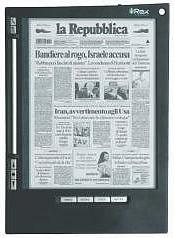
I am pretty sure that the excitement will be great. Many of the Dutch newspaper people (Wegener, PCM, Telegraaf and NDC) have been looking out for the iLiad and in some quarters the reader is already in use. The Belgian newspaper De Tijd has 200 readers to experiment with their newspaper. This experiment got even more glance, when the newspaper announced to have an electronic edition on Monday only. So the owners of an Iliad can have a truly electronic experience once a week. It is interesting to see that around the world the iLiad will be experimented with. The newspaper organisation IFRA will use the iLiad worldwide in one of its projects. Recently the Italian newspaper La Repubblica announced the use of the iLiad.

It is a good sign that there is excitement among the newspaper people. In this way iLiad will get far reaching publicity. This is a good thing, as every medium needs a promoter. Radio was a media promoter for the discman in the eighties. And e-book had never a real media promoter. There is of course also a danger to all this attention. If the iLiad fails it will be written to death by the same journalists. At the launch of Philips CD-I there was some excitement, which soon turned into a negative atmosphere; eventually CD-I died a silent death.

The iLiad has another advantage. It does not only depend on newspapers, but can also handle e-books. So there is a multi-functionality present. On trip your luggage can become lighter; you probably are going to replace the weight of the Da Vinci Code book with something else. But the argument that you have more than one book with you at almost no weight is also a good argument.

A functionality which has not been stressed much yet is that you can write on the electronic paper. With the stylus annotations can be made to an article in the paper or the book. These can be stored. I am wondering how many people are going to try to use it for taking notes in lectures and presentations. You go back to the office and can download them onto your PC to work out you scribbles or just to forget.

Will the Iliad be a success? I am personally convinced that we are closer to the tipping point for digital paper/e-books than ever. We are moving from difficult to read screens to a near paper quality of electronic paper. We have moved from the offline e-Book of Sony in 1991 to the online downloadable e-book in 1997. The fact that everyone is downloading music and videos through iPods should make it easier for the iLiad and other readers to come (Sony, new Amazone device, Philips rollable paper). Introducing the digital paper reader as the text iPod will position the iLiad easier in the market.

Tags: ,

Blog posting number 375

Wednesday, May 10, 2006

Launch first Dutch MBA Cross Media

The venue was perfect for the launch of the first Dutch MBA Cross Media: a beautiful estate in the East of Holland in the midst of a park with nice sunny weather. The MBA is an initiative of the Lemniscaat School of Management, Conclusion and companies active in the cross-media chain. The course will start in September 2006.

There was an interesting mix of people from media industry such as the newspaper and book publishers (PCM, Wegener, Sanoma, Telegraaf, Audax, Bertelsmann and Springer) as well as the new industry (Endemol, Vodafone, Versatel, T-Mobile, MTV Networks, Voipster/Backstream). Problems for all these companies is to attract professionals who understand the new media landscape, but also make the future with new challenging projects. The educational program will be produced by academics, media consultants and industry experts.

In the afternoon small break out session were planned. The role of the shop floor, was one subject. Cross-media applications for clients was another session as well as changes in the chain. I had been asked to introduce the subject of consumer generated media. This solicited a discussion from the start between the media and content people. Were we talking about media produced with content of consumers such as a blog newspaper or a television program with video and cam input from the consumers? Or were we talking about user generated content and the influence on the traditional and new media? The discussion also touched on the legal minefield of copyright and creative commons.

It was an impressive group of people, that the organisers had brought together under the denominator cross-media. It was clear from the discussions that there were different interpretations of the cross-media, with a heavy stress on cross-channel. The denominator is wide enough in order to cover the developments in the media chain from content creation to cross channel distribution, but also to cover the media from print to internet, mobile and digital television. For those who want to know my ideas about cross-media, please download the e-Content report of ACTeN on cross-media.

Tag: ,

Blog posting number: 374

Tuesday, May 09, 2006

Summit for the Future (4)

The Asian Media Boom is coming

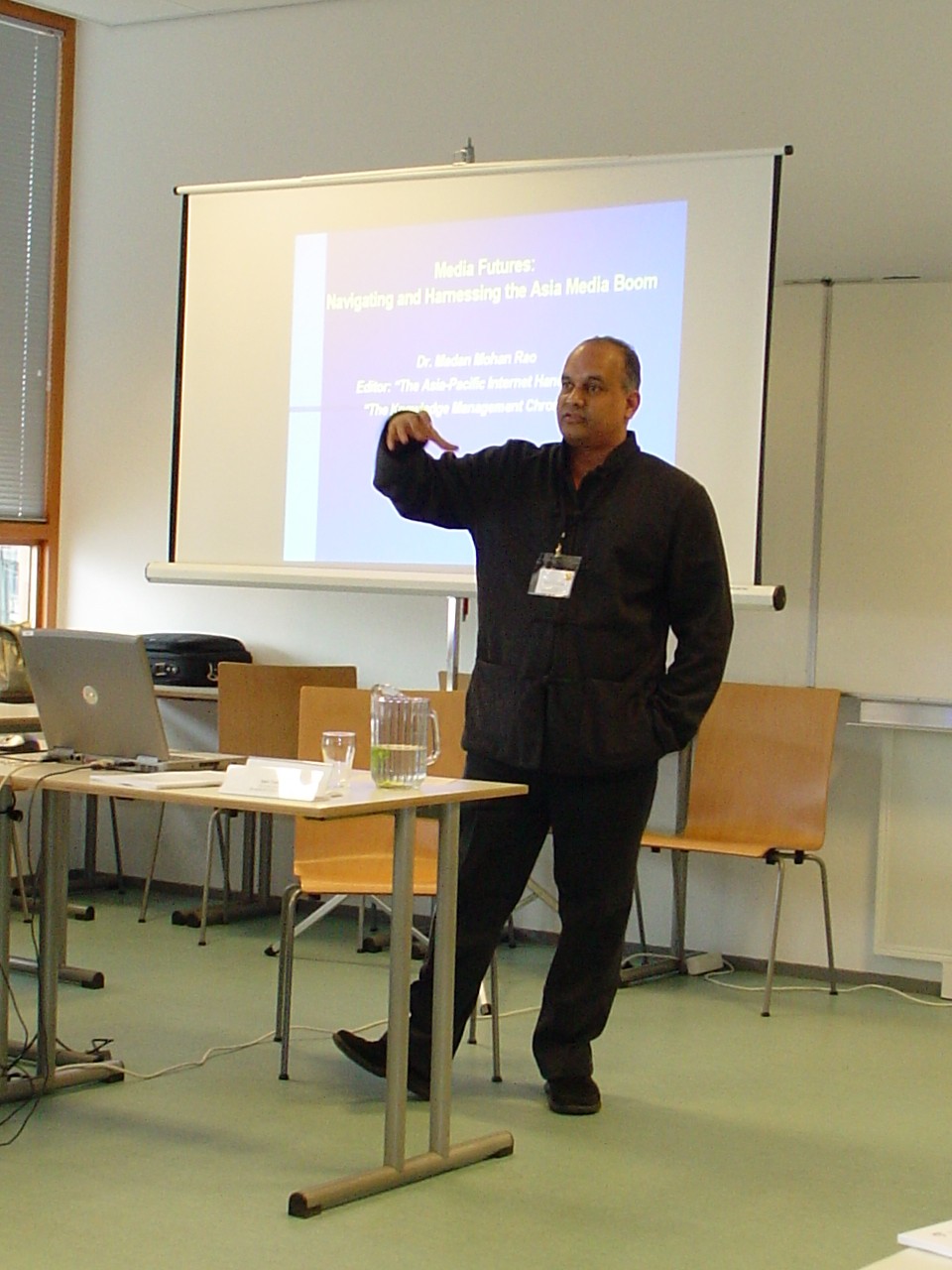
At the Summit of the Future I met Dr. Madan Mohan Rao. I knew his name from e-mails and books on telecommunications. He is the editor of The Asia-Pacific Internet Handbook and The Knowledge Management Chronicle. But when he came over to the exhibition booth of the World Summit Award, we knew in a minute that we had a common friend, Osama Manzar from New Dehli. We got to talk about him and of course about his name. I told Madan of our last meeting at the airport Malpensa in Milano before the World Summit in Tunis. Osama and his nice wife were lugging the books e-Content: Voices from the ground around, when I noticed them. So without giving it any thought, I shouted Osama. When I was finished it was silent all around me and people started to move away, which they would have never done if they had met Osama Manzar in person.

Madan held a speech on the Asian Media Boom. Presently the Europeans looked with some scare to Asia and in particular to India and China. Economically these countries are growing faster that the USA and Europe. In fact Madan mentioned that there are more millionaires in India than in the whole of Europe.

Madan spoke on Asia's Winning Card as a risk. In his program abstract he wrote: South Korea hopes to become the gaming capital of the world. Bangalore is becoming a leading software development hub. Goodness knows what exactly China is becoming, but already the mobile market in China is the world's largest. Has this happened because Asia countries are willing to take risks by nature? Or is their business culture fundamentally different from the rest? Yet while some countries are willing to take risks in the IT business, their media remain very closed and conservative - by some "Western" standards. What are some of the scenarios for the preferred futures for media and entertainment in Asia, home to 2/3rds of the world's population? We also know that groups that isolate themselves from the rest of society quickly radicalize. What do media need to do to keep them in the conversation?

In his lecture he treated several aspects of the Asian Media Boom. Personally I found very interesting his classification of the various countries. He first presented the new media dimensions: new media as instrument, providing affordable access to ICTs, local language content/tools, sectoral benefits (news, education, healthcare, environment, business, government) and new media as an industry, boosting digital content industries, venture capital, stock markets, technical skills, regulation, global alliances. Taking these dimensions he made a classification of the information society in various Asian countries. His range went from restrictive to advanced:

Restrictive eg. Myanmar (former Birma)
Embryonic eg. Afghanistan
Emerging eg. Nepal
Negotiating eg. China
Intermediate eg. India
Mature eg. Australia
Advanced eg. Japan, South Korea

It is clear that Asia is not a monolithic media continent, but we will be seeing countries like China and India, together they are larger than the USA and Europe, move up into a mature or advanced stage over the years.

BTW At the closing of the summit there was an exercise. Every delegate was asked to contribute a keyword characterizing the summit. These keywords were typed in and formed together a cloud of opinion, a tag cloud. It will be analysed on the words, the synnyms and antonyms and their associations. It was an interesting exercise, but I reserve my judgement and I am anxious to see the result.

Tags:

Blog posting number: 373

Monday, May 08, 2006

Summit for the Future (3)

Social software


Pursuing the theme of social software and user generated content, it was nice to meet Igor van Gemert again. He is a very motivated man. His company Innergy Creations BV (IC) is one of the business partners of the Summit for the Future. This innovative company develops new Internet and Multimedia driven products and services. Innergy Creations initiates and implements innovative business cases. We believe that business innovation is all about balance. Balance of vision, ideas, creativity, business, marketing, technology and the management of it.

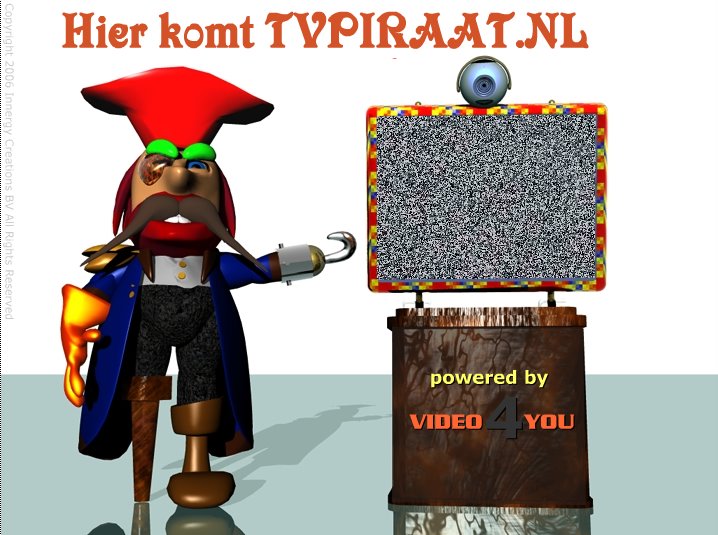
Among the various projects he and his team are working on the launch of TVPiraat, a vlog channel with a business model. The channel is based on the principle that everyone can start his own TV station. IC will help the people to get online. You can compare it to Blogger, but than for video. Interesting is Igor’s opinion that the channel will blow traditional TV stations out of the water.

Igor believes that there is a TV producer in every one of us. I think that he is speaking for his generation which is more image and video prone than my generation, which is more text oriented. But the basic idea is that everyone can upload his movies or television program(s) onto the internet aggregated service. So if someone feels like a TV producer he will regularly upload his/her program. And as this service grows, people will start to look for new videos and shows on this service.

But Igor also realises that his service is going costs a lot of money due to the use of bandwidth. So he has to think about business model. On the conference floor of the Summit for the Future, he explained to some delegates that his business model is a bestseller model. People can step in for free, but as soon as they have success in terms of unique visitors and/or used bandwidth, the ‘producer’ will have to pay up or find money somewhere.

TVPiraat has not yet started it service yet, but it will be interesting to see its impact. Years ago the slogan: everyone can be a publishers’ was waved away by traditional publishers, but now there are more internet pages by bloggers than pages from traditional media. Also traditional television stations should closely keep an eye on this development. Of course the videos and shows will be rudimentary and primitive at first, but people are learning fast as is clear from Your Tube. And of course replacement of television shows do not happen overnight. But given triple play in the home it will be easy to switch from television shows to internet shows.

Tags: ,

Blogger posting number: 372

Sunday, May 07, 2006

Summit for the Future (2)

Digital Life Aggregator

The Media and Entertainment Knowledge stream started out with a nice interactive meeting. Marc Canter, presently the CEO of Broadband Mechanics, but better known as the founder of MacroMind in 1984, the later MacroMedia company, known by its multimedia platform Director, turning Flash, gave a Powerpoint presentation. On every slide there was a statement which provoked discussion. His opening was: No human sees the difference between PCs, game machines, TV and cell phones. They are all digital, yet everyone knows that they are different industries. So we need to connect the Living Room wit school, the office, on the road, with mobile devices and our friends, families and groups. In order to do so, we have to take risks, invest time, help others, and contribute to the community

Blogging has been instrumental in this. It has empowered millions of people to start blogging and move into blogging media (podcasts and vlogs). Canter is now working on the development of a Digital Lifestyle Aggregator, a social software product, which brings together all of the aspects of digital life, shares aspects with your friends, manage your children’s exposure and connect families together. Besides there will be a rating, commenting and linking facility in the software.

It is clear that the development of social software is only starting up. User generated content is overtaking push information of the official media. But in order to get user generated content placed and protected new software other than Blogger and Movable Type will be needed. And here I see a link with Comet, the new password controlled blog software of SixApart. This software initially intended for companies might become family software, where relatives and friends are given access to the content. But it might also become a group software, where like minded people get access to.

To me the problem with this family or group model will be the business model. But several models are being toyed with. There is the free start model for vlogging; people can start showing their movies, but will have to pay up when they are successful and have for example 1000 viewers. Another model might be the pyramid sales model: you buy access and sell on access to others. Of course there is the old advertisement model, but certainly with vlogging product placement might become another model to be used.

Blog: ,

Blog posting number: 372

Saturday, May 06, 2006

Summit for the Future (1)

Taking risks

From Wednesday till Friday the Summit for the Future was held at the HES college in Amsterdam. The Summit for the Future is an initiative of the Club of Amsterdam, a think-tank on the future, and was held for the second time. The Summit brings together international Thought Leaders to discuss significant, global challenges and opportunities. This year the theme was the role of risk in innovation and global growth. Delegates were lured with slogans like Ready to take Risks and Risk is O2 of innovation.

After the opening event there were workshops, which were organised in five parallel Knowledge Streams, followed by five Interdisciplinary Streams:

5 Knowledge Streams
Life Sciences
Media & Entertainment
Trade - Asian Leadership
Healthcare
Corporate Governance

5 Interdisciplinary Streams
Innovation as Risk Taking
Knowledge based Risk Management
Values and Spirituality
Cross-Cultural Competence
Creative Leadership

This was a rather interesting format of having two types of workshops.

It was a different kind of crowd than I am used to meet. Usually I am in a homogeneous group of people which a generally working in the field of new media, telecoms or publishing. But here you meet a speaker who introduces himself as a futurologist or an ethics expert. At the same time you meet people from the software business. But they are usually not the regular software developer or hardware salesman.

The subject on risk was introduced by Sir Paul Judge. He spoke on risk and enterprise and sketched how perceptions of risk by the general public in matters of safety and health can be considered an indicator of overall modern attitudes to risk. He started out to bring some relativity in the perception of death by putting a lot of statistics together, concluding that since last year at the utmost two people of the audience would have died, but give the age most likely none; this while we read daily about people dying in the newspapers. So the perception is either exaggerated or lopsided. These unclear perceptions affect people's approach to new endeavours, whether in exploration, art or business. However it is also true that new ideas have to be implemented if society is to remain competitive. But many attempts to reduce risk are bound to be counterproductive because humans will continue to want to explore and push the boundaries. It was an interesting start of the conference. While not being guaranteed that you will be alive at the next conference, you have the assurance that there is a good chance. So why not take a risk and start something drastically new.

I was there on behalf of the World Summit Award, the global multimedia content competition which was started at the World Summit on the Information Society in 2003 and which was held for the second time in 2005 and which will be held for the third time in 2007. The Summit for the Future and the World Summit Award see each other as complementary as the World Summit Award presents through its competitions visions of the future.

I will be reporting in another three blog posting on social software and Asian trade.

Tags: ,

Blog posting number 371

Friday, May 05, 2006

The M-word

On Tuesday my American friend Andy Carvin has launched another blog. Andy is for me a pioneer in the blogosphere. I met him for the first time in 2003 in Dubai, when we were there for the Grand Jury of the World Summit Award (WSA). From there he was sending blogs, sending postings by mobile, photographs and podcasts. When we were together in Hong Kong in 2004, he was blogging from the conference floor. And at the World Summit on the Information Society in 2005 he had put together a bloglist with postings of many of his colleagues and friends. I must confess, I have been jealous of him, as he does it all with such an ease. And given the amount of days a year he is on the road, the postings must serve as a contact with the home base.

Andy has many interests, but subjects as e-learning and digital divide fits his bill. Last Tuesday he has launched the new blog. This blog will focus on the intersection of Internet culture and K-12 education. One of the primary goals is to help guide educators through the ins and outs of what's often referred to as "Web 2.0," including blogging, podcasting, vlogging, RSS, social software and community networks. He is planning to explore some of the creative ways students and teachers are using interactive technologies to improve learning, as well as dissect the controversies that often occur when classroom culture and online culture collide.

His opening is a cliff hanger at the same time. He basically says that if you live in Texas and are in the network of a school district, you might read his posting probably one time. This is due to all the filtering these school districts do. These days it is the M-word. This time it is not the prudence police falling over the word m*sturbation and neither is it the open source lobby banning the word Microsoft. No, this time it is the URL MySpace.com. To officials of some school districts in Texas MySpace is a perverse meeting place. So even for teachers articles with the M-word are purged. In order to get around this bloggers are writing the URL backwards, use all kind of signs to separate the letters and even make an illustration of the name and voila, it fools the filter.

His focus is going to be interesting as media literacy is becoming a subject teachers will have to be trained in during their college period or, when they are teaching, after school. Of course it does not help when resources are blocked. Media literacy is fast becoming a subject covering the use of new media in school and in class, developing critical, analytical and creative skills towards new media, educating children with a sense of safety regarding new media. I guess that this new blog of Andy is going to be a resource for media literacy.

Tag: blog

Blog posting number 370

Thursday, May 04, 2006

Blogonomics 06 (7)

Louïc Le Meur is one of the founders of SixApart. This company developed the blogging software Movable Type, Type Pad and Live Journal, which is now in use with 15 million people worldwide. He started out to make a remark about blogging in Europe. There are 7 million people in France blogging. The Germans do not like blogs; they better like wikipedia.

He also signalled a change coming up in professional blogging. Blogging is replacing Intranets. Not just blogs, but password protected blogs. This is already happening in Alcatel and Nokia. Analogue to this professional blogging software, SixApart will launch Comet, a private blog software with password protection at various levels. Can you imagine: you the blogger is given privileges to some people, while refusing reading to other people.

Louïc believes in professional blogging. But he thinks that a company should not have employees blogging for them; a company should use external bloggers. He illustrated his belief with an example from the cosmetic company Vichy. They started a blog, which drew a lot of criticism: a photograph of a model and a text from a copy writer leaving out any criticism. It was so obviously wrong that Le Monde put an article on it on its cover. Vichy apologised and asked help from the bloggers. It turned criticism into a constructive discussion with a positive feedback. In fact it selected in the end a small group of some ten bloggers and asked them to run postings.

Tags: blog

Blog posting number: 369

Wednesday, May 03, 2006

Blogonomics 06 (6)

Politicians have discovered blogs and podcasts. In the Netherlands we have a ministers of justice, Mr Donner, who spasmodically attempts to reach the youth and have a podcast and even start to rap. More naturel is politician Jan Marijnissen. Who has blogged and podcasted now for over a year and gave a moderate annual report on thes communication activities. As he could not be present at the meeting of Blogonomics, he had made a vlogcast. (Photograph of the vlogcast of Mr Marijnissen borrowed from Krijn Schuurman).

He has started his blogging activities after a deal with podfather Adam Curry. Curry would help Jan Marijnissen with podcasting and Adam Curry would become member of the political party SP. Whether Curry has become a member of the party is unclear, but one thing is sure, that Jan Marijnissen is online; his party even has a vlogging studio.

In 2005 he had a lot of success, as he was one of the few politicians producing podcasts. In 2006 the other political parties are in a hurry to get into blogging and podcasting. But Marijnissen still has 10.000 unique visitors daily and in the time of the municipal elections in March he could count on 16.000 unique visitors. He is also the link master with the highest percentage of links.

What he likes about the blogs and podcasts is that he can react emotionally to the subjects, but also produce interviews with people he meets. On the other hand he can use the web for polling and opinions. In order to draw attention, Marijnissen believes that you need to be surprising, inviting and challenging.

Tags:

Blog posting number: 368

Tuesday, May 02, 2006

Blogonomics 06 (5)

He was the odd man out in the company of bloggers and Podcasters: he had a dog collar. As I studied theology/philosophy at Notre Dame Seminary in New Orleans (La.) years ago from 1966 till 1970, I was very interested to hear what priest Roderick Vonhögen had to say at Blogonomics 06.

He started out comparing operating systems to beliefs. In hardware you belief in PCs and Macs an in software in Windows or OS X and in Western religious circles you believe in Catholicism and Protestantism. One of his statements was stunning: the world is my parish. And of course his iPod is the virtual pulpit. With his podcasts he attracts 15.000 listeners, which is much more than the parishioners he sees during the week.

Vonhögen runs the podcast Catholic Insider, a podcast on the Roman Catholic Church. It started all with death of Pope John Paul last year April and the election of pope Benedict. While many broadcast companies were sending their reports from Saint Peter’s Square in Rome, Vonhögen was reporting events on the burial and election of the new pope, explaining procedures and interviewing people.

His philosophy is rather simple. The Roman Catholic Church is a global community. Using an IPod he can reach many members of this community, in fact more than his usual parishioners. He shares his personal experience and does not have to worry about time and place.

In the meantime he has started a daily breakfast show, a light program about Roman Catholicism, culture, books, movies and mythology. He tries to establish a dialogue with the audience. Presently Vonhögen is developing the tool Castblaster together with Mark Versteeg; this software reduces the time for editing a podcast.

Tags:

Blog posting number: 367

Monday, May 01, 2006

Blogonomics 06 (4)

Today it is one year ago, that I started the blog Buziaulane. Since May 1, 2005 more than 365 postings have been published on various subjects in the field of new media with a focus on electronic publishing and more precisely content strategy. A good occasion to evaluate.

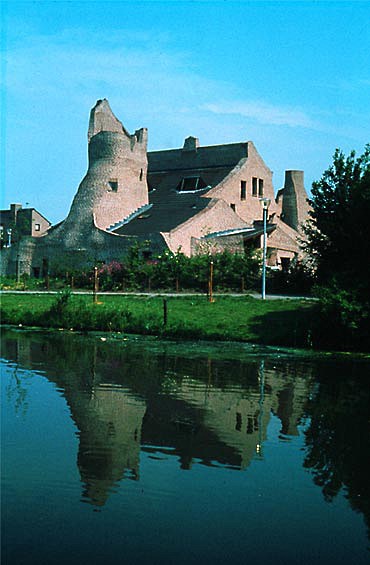
This tower at Buziaulane in Utrecht (The Netherlands) has been my virtual outlook for one year now

Some evaluation tools were handed to me by Erwin Blom, a digital pioneer working for the VPRO public broadcast company. He is a rather new blogger on the block, but one with a view, which he presented at Blogonomics 06.

As a radio, television and internet producer Erwin Blom is busy with projects. For the final results of the radio and television programs, he usually has a lot of material and insights, which he can not use in the radio and television programs. For Erwin Blom a blog is a fit platform to share ideas with other professionals. The blog is also a communication platform to talk with and to interested people. He even sees the blog as a knowledge sharing platform, which can be used to share ideas or even claim ideas. He has a daily frequency in posting blogs. His postings have an informal tone. Erwin Blom thinks blogging is worthwhile if you have 100 or more readers.

Looking back at my year of blogging, I can say that I have seen it as a professional activity. It is for me formulating my desk research and digesting new developments. It is also a communication platform for me, communicating with people I know in the Netherlands, with friends and experts of the EUROPRIX Top Talent Award circuit and the European Academy of Digital Media (EADiM) as well as the jury members and nominees of the World Summit Award (WSA). I have posted every day one posting. I attempt to launch the posting daily around 8 o'clock (Amsterdam time). I have no idea of how many people read my blog. I would love to know how many page views I have, but I have been unable to put a counter on the blog (any advice welcome). It is one of the down side point I have about the Blogger program. The other downside points are: instable logging on with the username and password (part of the password moves over to the username) and the wysiwyg of the editor (compose and preview). I have not found either the facility to put the postings of my mini-series together. Despite these downsides, Blogger is an easy package to start up a blog and keep it going for 365 days. In the beginning I have not allowed reactions from readers; now I have a moderated form for reactions. So far I am not impressed with the reactions as 95 percent have been spam reactions. Besides if people want to react to a posting or write they either have my e-mail address or can find. Does the Buziaulane blog have disadvantages? One big disadvantage is the language.

What is the outlook for the second year? I will continue the blog on a daily basis. I see some disturbance coming up in June and July as I will be moving. It presents me still with another problem. The blog name has been borrowed from the street where I live now; should I change the name to the street? Personally I think I will not do so. Why change an established name after one year. I will also keep the monthly blog of the Content Market Monitor going as it has now 2100 free subscribers in 100 countries. Having chosen to write the Buziaulane and Content market Monitor blogs in English, it is difficult to comment on particular Dutch situations. I would have to start up a Dutch blog for that and perhaps I might do so, but then after the move. But as this is still some months off and only for people who read Dutch, please come back for another year of Buziaulane.

Looking back at the moment I started the Buziaulane blog one can ask whether I stepped in late in the blog business. To be honest it was not the earliest moment, but it was a moment of returning. In 1981 I started to deliver contributions about European online developments for the Online Chronicle, a fortnightly electronic newsletter on the Dialog host/server. In 1984 I started for VNU Business Publication in London the IDB Online newsletter. Every working day it was published. In fact it was the first electronic daily newsletter in Europe. In 2003 I attempted a blog on the site of Telecombrief; it failed due to technical and organisational problems. But Buziaulane has now succeeded for a year and fetches a fantasy price of almost 8.000 US dolloars (one-off, a month, a year ?), according to Business Opportunities Weblogs.


My blog is worth $7,903.56.
How much is your blog worth?


Tags:

Blog posting number: 366