Monday, November 21, 2005

Tunis: WSIS and WSA, part 9

I am going to close the series on Tunis, looking back at the WSIS and the WSA. Was the WSIS the summit of solutions? Did WSA make any impression?

Politics
The WSIS was dubbed the Summit of Solutions. The Dutch ministry of Economic Affairs had indicated that the Summit should address three areas:
a. Governance of Internet.WSIS recognises the effectiveness of the existing arrangements for Internet governance in making the Internet the highly robust, dynamic and geographically diverse medium that it is today. The WSIS recommendation includes a proposal for a new forum for multi-stakeholder policy dialogue - the Internet Governance Forum.
b. Freedom of speech. This subject was a non-issue from the beginning.
c. Bridging the digital gap. In the first leg of the WSIS in Genf (Geneva) the president of Senegal Abdoulaya Wade proposed a special fund. However this fund never came about and was replaced by a private fund, initiated by the city of Genf. But in Tunis no progress was made on the fund nor on the intention of the fund to stimulate bridging the gap.

Our Dutch minister of Economic Affairs Laurens Jan Brinkhorst thuoght that the Summit was successful as after Genf it is realised that Internet is no longer a toy of the rich countries. This observation might be true, but both Summits have cost a lot of money which could have been spent on the infrastructure of an African or Asian country.

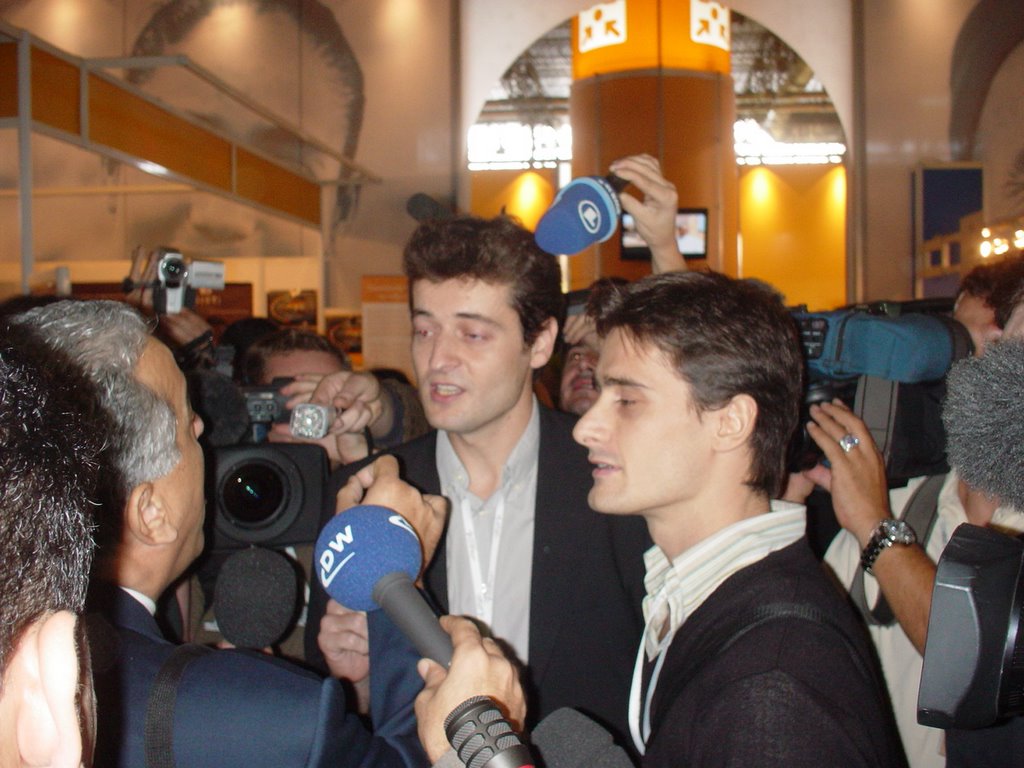
So, politically the WSIS has come to an end. The two Summits were not a success nor will they deliver anything concrete, but awareness. In my estimation, this year’s LifeAid has had more effect than WSIS and the 100 dollar PC caught more media attention than the Summit debates.

Exhibition
The exhibition was larger than in Genf. This time more commercial companies participated and tuned their booths and themes to social responsibility and sustainable entrepreneurship. It is good to see that big companies are taking responsibility for the information society.

World Summit Award
- For the World Summit Award the WSIS in Tunis was the end of a two-year process, culminating in the Gala. All the effort of finding national experts, identifying national best-practices, evaluating these best-practices by an international Grand Jury came together at the Gala.
- It was great to see WSA Grand Jury members of 2003: Alexander Felsenberg, Andy Carvin, Suzanne Stein, Jan Bierman, Effat El-Shooky, Marcelo SantÍago, Gagarin Chugaszyan, Osama Manzar, Kresimir Lugaric, Christian Ruppand Grand Jury members of 2005: Manar Al-Hashhash, Alejandro Jaime, Marcelo Hector Petrich, Ilyas Naibov-Aylisli, Cid Torquato, Ana Serrano, Winnie Tang, Helene Abrand, Sepehr Dehpour, Alfredo Ronchi, Rudi Vansnick and Izzeldin Osmanas well as the board members Cai Melaskoski, Gregori Popescu, Paul Hoffert and Christine Maxwell. It was also good to see the team of ICNM with Peter Bruck.
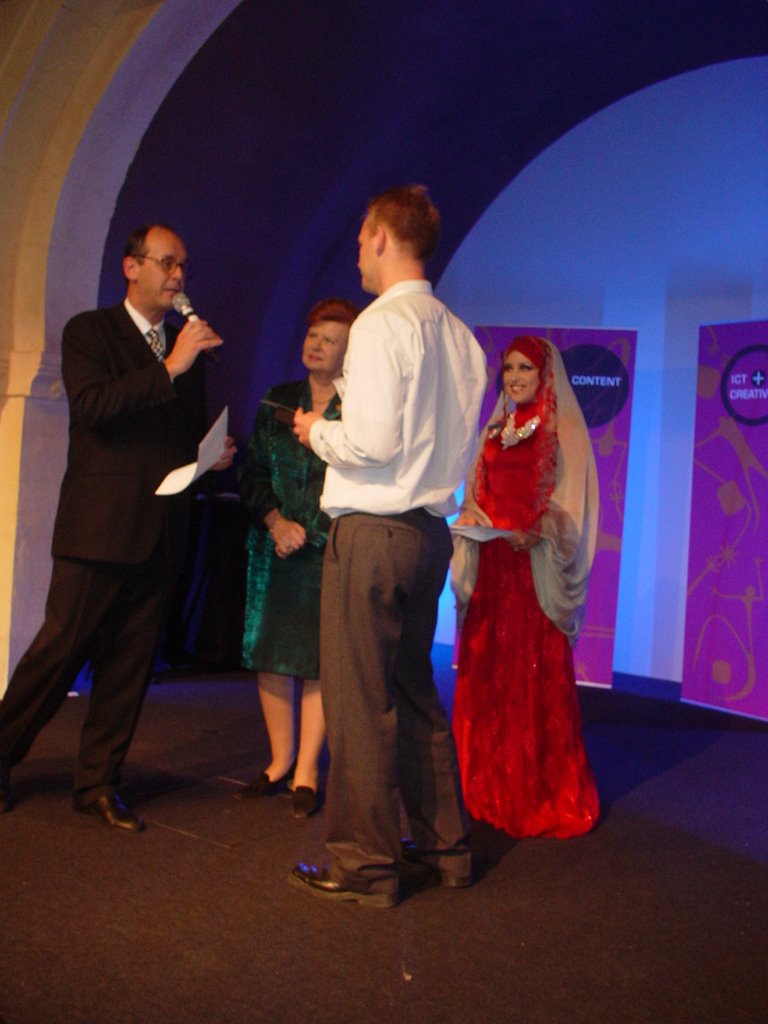
- The Gala was a success with 6 head of states, EU commissioner Viviuane Reding, 5 ministers and 2 UN officials (UNIDO, UNESCO) and ISOC's president Lynn St. Amour. Especially the last presentation of the WSA category on e-Inclusion with South African president Mbeki was impressive. In the plane home, I sat next to two people who thought that Gala was a good performance, presenting best-practices from all over the world. It was hard not to get involved in the discussion.
- The presentation of the book e-Content: voices from the Ground: The Sequel 2 was another milestone. For the second time Osama and his lovely wife Shaifali pulled it off to have the book ready for the Summit.
- WSA as an organisation was able to establish deeper relationships with countries like Egypt, Armenia and Malaysia.
- The good news is also that the WSA will continue, where the WSIS is going to stop. The two years’ cycle will be set in motion again. Croatia will welcome the Grand Jury in Dubrovnik in 2007, while Senegal will host the Gala.
- From Tunis onwards the WSA will start with the Roadshows and Content Summits again. A Summit in Armenia is in the planning already. A roadshow in New Zealand is on the drawing table.
- Christine and myself will work out a proposal to produce a best-practice and case database of the WSA products of 2003 (803 products) and 2005 (742 products). It is a pity to let no less than 1545 products rot in a computer somewhere.


Here I am signing the 40 certificates of the World Summit Award Winners. As for the series of Tunis, I am now signing off (I see now that my tie was matching the colour of the Austrian pavillion)

Sunday, November 20, 2005

Tunis: WSIS and WSA, part 8

e-Content: Voices from the Ground: The Sequel 2.0, edited by Osama Manzar and Peter A. Bruck, is a sequel to e-Content: Voices from the ground Version 1. The book was presented during the WSIS in Tunis. The first version of the book was produced for the UN World Summit on the Information Society in Genf (Geneva, Switzerland) in 2003; now the update has been produced for the UN World Summit on the Information Society in Tunis. In 2003 the book was produced by the jurors of the World Summit Award Grand Jury in Dubai, in 2005 it has been produced by the WSA Grand Jury of Bahrain. In 38 interviews the national WSA experts and Grand Jurors present their view on the content situation in their country.

The book differs from the last edition as this new edition contains more than 400 examples of best practices across the 8 categories in the countries of all six continents; e-government, e-culture, e-business, e-learning, e-entertainment, e-science, e-health and e-inclusion.

The book is a result of the strong networking of WSA through which there is access to e-content experts in 168 countries. It is an exercise of finding "what is happening in each of these countries in the area ofs of digital content development". The production was started right after the Bahrain Grand Jury on September 15th, 2005 and has ended with the presentation of the book on the even before the opening of WSIS in Tunis, on November 15th, 2005. It has been hard work for Osama and his wife Shaifali. The book has been printed and bound in India.

In his preface Peter A. Bruck writes: "Over the last 50 years, Information and Communication Technologies have become exponentially more powerful and radically cheaper and smaller. E-Content does not keep up with with technology in term of speed and developemnt, economies of scale and simplicity of consumption. This results in a dynamic structural gap. This gap widens as we move into the Information society.
The content gap is not just one of the technological versus human capacity. The nature of economic and social structures and general awarenesss are also important detreminants. There is an imbalance of pay and an inequity of investment. Post-industrial societies spend enormous sums of money on equipment, gadgets and "tech things'. They invest far less in quality stories, knowledge and insight."

I would like to add that post industrial societies consider e-content as a commodity, which can be traded and be bought, while in developing countries the production of quality e-content is a matter of available money and political will.

e-Content: Voices from the Ground: The Sequel 2.0, edited by Osama Manzar and Peter A. Bruck, has been published by the Digital Empowerment Foundation and the World Summit Award.

The book costs Euro 15 or USD 20 and can be ordered by e-mail: osamam@gmail.com or osama@manzar.info

In part 3 I talked about Negroponte's 100 dollar PC. My friend Andy has put up a movie of 8 minutes about the chanllenges of the 100 dollar PC. The PC was presented on Thursday, but the PC is not commercially available. The distribution will be done by bulk consignments through ministries and government agencies. So it will not be a threat to Dell and other PC manufacturers. My friend Andy Carvin has produced an 8 minutes movie on the challenges of the 100 dollar PC.

Saturday, November 19, 2005

Tunis: WSIS and WSA, part 7

I have left Tunis. After the check-in at the airport counter I had to pass through the special WSIS customs section, had to get my luggage x-rayed and had to pass the security gates to be frisked again. Ever since entering Tunis, I have been going through the rituals of security checks every day. This should give a sense of security. Also the obvious presence of military, police and tourism police should strengthen that sense of security. In three kilometres around the airport and around the Kram Expo, there was a policemen at every 250 meters and the closer you got to the Kram Expo, there were even policemen on horseback and special forces. Tunesia must be a country with more policemen than inhabitants. In front of every official hotel was a policemen with a stengun and in the hotel secret service people were just chatting as natural Tunesians, while in the meantime checking potential contacts with Tunesian dissidents. Transport from the Kram Expo to the hotels was tightly organised with special buses; taxis could only reach a parking place near the Kram Expo, but from there the delegates were bussed to the entry gates with the unavoidable automatic badge check, x-raying, passing the security gates and being frisked, if you happened to have a Belgian 1 euro cent piece on you. The Sheraton Hotel on a hill looked like a bastion. There were roadblocks, soldiers with stenguns and a lot of people apparently just hanging around. Altogether the atmosphere just gave a false sense of security while it was a perfect cover to keep tabs on the local and foreign crowd.

On last Wednesday there was just that incident on the exhibition floor that the organisers had tried to avoid. Like a mobimob, there was at once a crowd of people at a crossing near the Austrian pavilion, complete with TV camera teams and photographers. A few people unfolded a map of the world took the protective paper from the adhesive and taped the map on the exhibition floor. In a minute everything was done. And the map was in a strategic spot as it was on the crosspath to the central a hall of the exhibition floor were that night the World Summit Gala would take place.
The map contained the text: THE INTERNET'S BLACK HOLES. Of course, Tunesia was one of the black holes as Internet and traditional media are censored.

The mobimob was immediately joined by Tunesian secret service people who tried to get hold of the pasting people, while another older man started a debate with the (foreign) TV journalists, of course denying any censorship. This incident lasted for a quarter of an hour. Eventually people disappeared leaving the map pasted to the floor. The next morning the map was not there anymore; most likely the carpet had been replaced overnight.

Friday, November 18, 2005

Tunis: WSIS and WSA, part 6

This is really mobile. I am at Tunis Cathage airport and I can wi-fi for free at a decent speed. I can upload the photographs of yesterday afternoon and last night. It turned out to be a very busy day.

In the afternoon the signing of a Memorandum of Understanding with Egypt was on the roll. My Egyptian counterpart Sheriff and myself had been working on this and the PR lady of the Egyptian government suggested that we would sign the MoU during the Egyptian reception. That turned out to be a fabulous suggestion which caught the attention of media and of the ministers present.

Minister Tarek Kamel witnessed the signing. In the talk with the signatories he has indicated that he happily supports the idea of setting up and academic content institute as long as it is on a 50 pct matching basis. This is going to be great. Straight after the signing, we talked with a big mobile player who wants to support the idea and put money in it. So this is going to be a project starting today. The Egyptian agency with Sheriff is going to be in charge on the Egyptian side.
But the signing had also an unexpected effect. The same afternoon WSA was asked to have another MoU by the Armenian government. They want to have an e-Content Summit next year. And at the Egyptian reception the Malaysian minister was present and recommendd to the Malaysian Development Corporation (MDC) to obtain an MoU, which will be signed in the presence of the minister this afternoon. Pity I have got to miss that. This MoU is a prestigious one as it is signed with the people of the superhighway project in Cyberyaja (love the name of that city).

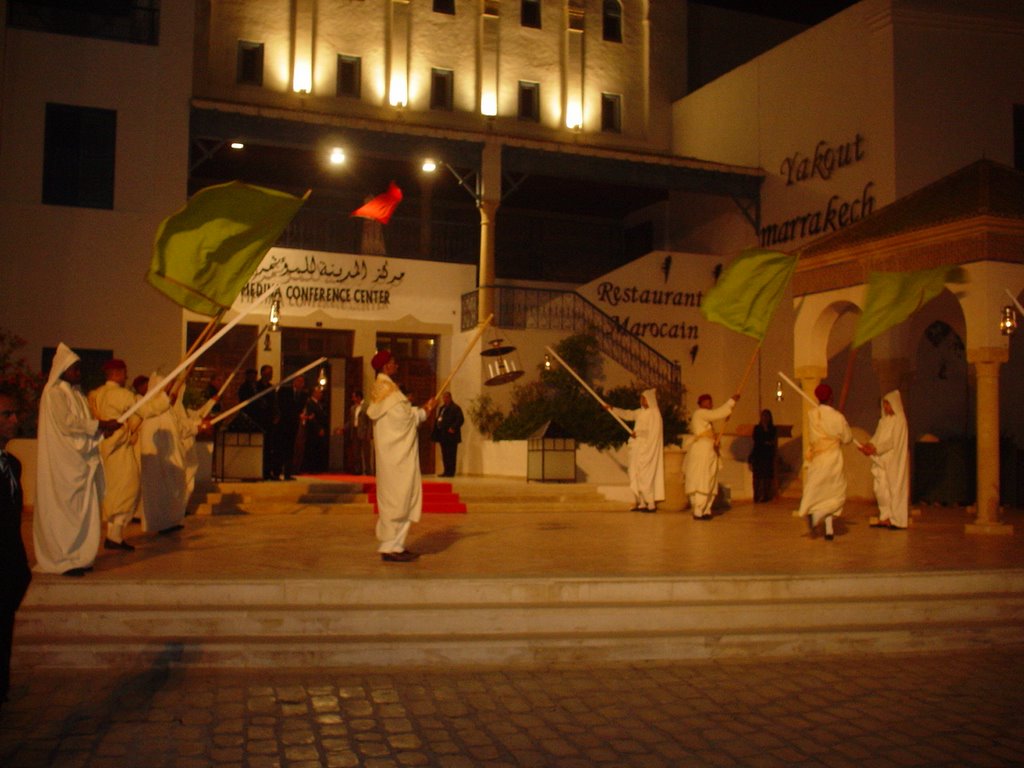
At night we went to Hammameth, a one and a half hours busride from Tunis, to attend an official dinner of the Tunesian busienss club. It was held in the newly built market place (medina) there. After a walk through the shopping street, we were welcomed by a reception commission with candles, dancing girls and a snake charmer. The dinner was laid out for some 500 people. Faouzi, our Tunesian juror had insisted on our presence. By two o' clock we were in the hotel again. I guess that WSA can look back at a very sucessful day after the Gala.

Thursday, November 17, 2005

Tunis: WSIS and WSA, part 5

The WSA Gala was overwhelming. It was presented by Peter and Manar, the national expert for Kuwait, and a WSA Grand Jury member of 2005. At 25 years, she owns her own company Dot design. She presents a computer program on Kuwait television and set up a program to familiarise school pupils with computers and internet. She did a fine job with the show. The hall was crammed with people and as the hall was connected to the exhibition floor, there was a steady flow of people moving in and out.

When the e-Government category came up, the Dutch winner Noterik Multimedia was on stage with the president of Latvia, HE Vaira Vike-Freiberga. Of course the Noterik people made a video of the occasion. After the Gala the Dutch winners and myself had a nice dinner close to the hotel (no wine, no beer; just water or water with bubbles.
Telecom Austria recorded the Gala, streamed it and archived the video.


This morning I had breakfast with Christine Maxwell, one of the former ISOC chairpersons. She is a colleague of mine on the board of World Summit Award. She in fact was the founder of the first search engine on Internet, Magelhaen, a real intelligent system, that could not sustain the labourintensive workpractice. But she will be back with a search engine next year; one that is not based on Boolean operators (and, or and not) like Google is, but on semantics. As for the search potential, she said, it can blow Google out of the water. So keep tabs on her and her companies.

Christine (in the middle) listening to a presentation

I also asked her about the WSIS as a process. On the issue of governance she is rather explicit. Do not let politicians get their hands on internet. The present cry to move governance from ICANN to the UN, in casu the International Telecom Union (ITU), is not a good idea, she said. First of all, the present attitude against the States is due to its present people in power and their policies. Having ITU overlook internet also means that politics comes into play. Thirdly, China and Brazil are not after internationalising internet, but after controlling the in- and outflow of information. She is very strong on keeping ICANN in place.

Wednesday, November 16, 2005

Tunis: WSIS and WSA, part 4

Yesterday afternoon there was a session on e-Business. We had a selection of six speakers, of which two World Summit best-practices: Tejari, an e-Business best practice of 2003 and Web telegram, an e-Business best practice of 2005. Tejari is an e-Business portal in the United Arab Emirates. It has been very successful and is doing well. Also the people of the Tunesian Poste were present with their application of Web Telegram. At first sight you would think that the application is rather simple: the mail offices exchange telegrams, the mailman brings it to your door and that sit. But in Tunesia, the telegram is often a confirmation of a money transaction and as such it is part of the banking system. By sending web telegrams the Tunesian Poste is now able to track the telegram from sending to reception by the receiver.

In the session we also had a kind of an ugly duck as far as the subject was concerned. It was a project concerned with user-generated content. You expect a story on the project, how they organise the production of the content. And that is what the audience got. Buntes Fernsehen (Colourful TV) enables the user and the community not only to watch, but also to be seen. As a member of a club or an institute like the fire brigade wanting to show the local community how interesting, exciting or funny club life can be, Buntes Fernsehen provides all the necessary tools to does so. In the first Buntes Fernsehen community Engerwitzdorf, a town in Upper Austria, TV from Engerwitzdorfers for Engerwitzdorfers was initiated. The passive user has become an active creative consumer. So users no longer consume only, they also contribute to the community.The story was begging the question as to business models. How are you generating revenues from user-generated content?

This morning I caught an early bus, which did go straight to the Kram. Again we had to go through all the ID- and security checks: matching the badge, sending your bag through the X-Ray machine and being frisked electronically. As I was early, I missed the long rows and the predictable collapse of the security system. The security is absolutely tight. Police in front of the hotel. Lines of military three kilometres around the venue. Police on horse back and the special forces. This all for the safety of 20 heads of states and of course for the participants.


The award winners got up early for their day of celebration

This is the World Summit Award day. Two years of efforts come to an apotheosis in the Gala, celebrating creativity and ICT products. Producers are honoured and creativity celebrated with the award ceremony and performances tonight.
In the meantime there is more WSA news coming in. Abdullah from Bahrain shows the WSA catalogue of Arab WSA nominations. Gagarin from Armenia presents the national catalogue, completely in the style of the worldwide catalogue. So we see spin-offs coming about.


Minister Tarek Kamel (right) and the director of Cultnat (left)

But it does not stop there. As I recently was in Egypt for the national award and spoke with organisers about cooperation, we continued the talks about co-operation. This afternoon we concluded talks on a Memorandum of Understand. WSA will have a partner in ITIDA agency and RITSEC. Together we will work on the local competition and stimulation of content and knowledge dissemination. When minister Tarek Kamal of Communications and Information Technology walked in the draft was ready. Tomorrow the MoU will be signed in the presence of minister Tarek Kamal. Mission completed; next mission starts.

This blog comes to you with compliments of the Austrian pavillion

Tuesday, November 15, 2005

Tunis: WSIS and WSA, part 3

Yesterday I started my trip to Tunis yesterday at 15:00h from Utrecht. At Milano Malpensa airport I met my friend Osama with his lovely wife. He was lugging around bags full of the book. He allowed me to have a copy for inspection. E-Content: Voices from the Ground, The Sequel 2 looks really great. In the meantime Osama and his wife get some routine in producing books in a short time. Again the book was produced between the Grand Jury, which was in September and the WSIS opening; in less than 40 days 38 contributors wrote their country profile on content, Osama and his wife edited the book, his wife designed it and did the lay-out and it was ready for the printer and binder. They must have worked very hard.

By 23.30 we arrived at Tunis, where we had to go through the usual formalities. We were not allowed to take a cab to transport the books to the hotel. But we had to go with a bus of the organisation and were brought to our hotel after many stop-overs. The hotels are closely guarded and there are a lot of policeman around. I have been in Tunis years ago and I recognised some of the buildings and places we passed.

In the morning we got up early in order to beat the queues at the registration desk. After that formality we were bussed to the Kram Expo hall. Osama and his wife were still lugging their bags with books through the exhibition hall. At the exhibition the audience awaits a weird collection of exhibitors. The big companies as Nokia and Microsoft, HP, Cisco they are all there. They of course are less commercial over here; they are audience sensitive. So Intel, for example, shows low power consumption applications for ruggedised computers (always handy in the desert, the US HQ must have thought) , while Hitachi shows two products out of its product range, a motor and a portable. The rest of the exhibitors look more like missionaries, be it for a non-religious cause. With Nokia you will know what they sell, but with the missionaries you have to get sucked in into their message first, as you can not see from the outside what their message is.


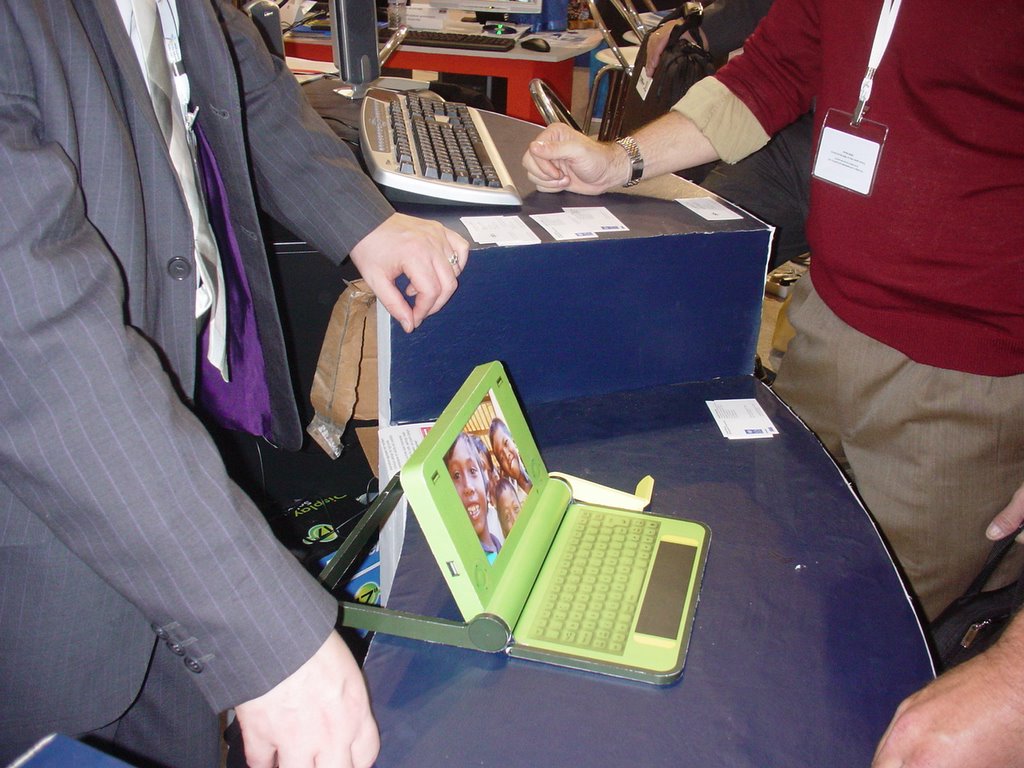
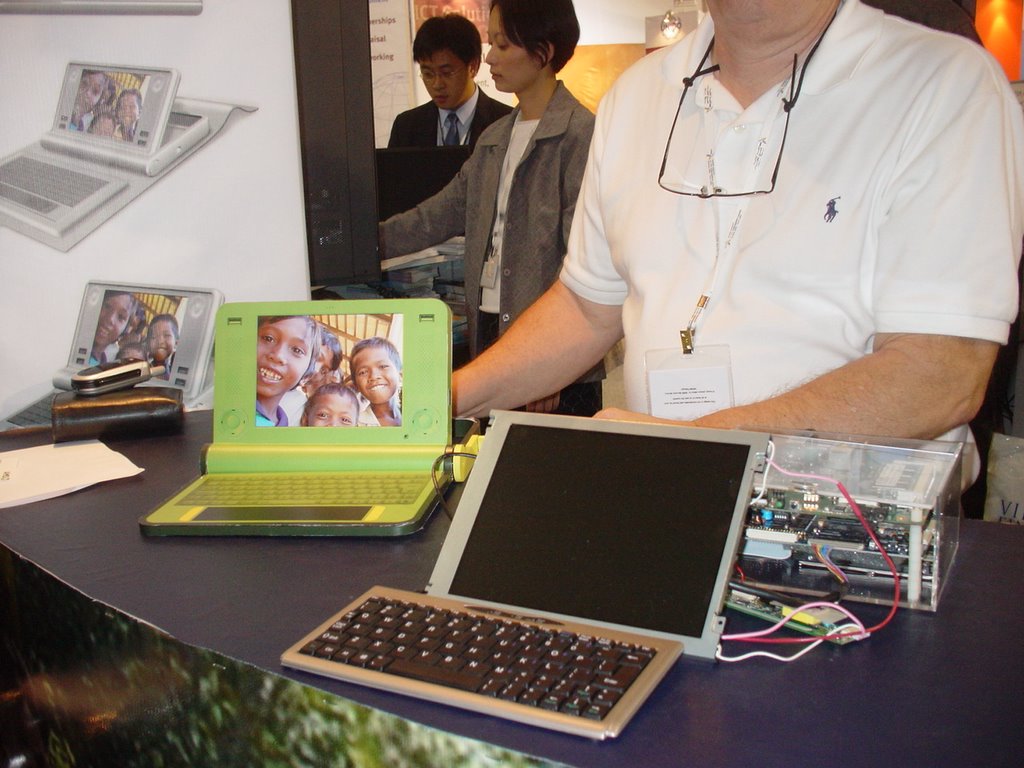
On my way into the exhibition hall my eye caught a mock-up and a prototype of Negroponte’s 100 dollar computer which will be catching more media attention than the politicians, I guess. The pay off of the campaign is: every child a computer. Want to know more about the 100 dollar computer, just google it.


A mock-up and a prototype of the 100 dollar computer

Monday, November 14, 2005

Tunis: WSIS and WSA, part 2

There is commotion about the UN World Summit on the Information Society (WSIS) in the Netherlands. The Dutch newspaper Volkskrant brought the story today: Dr. Cees Hamelink, advisor to UN secretary Kofi Annan will not go to Tunis. Dutch news radio copied the story for at least 12 hours. So far no foreign newspaper (Guardian, The Times of London) has the story. There are two questions: who (the hell) is Dr. Cees Hamelink; what was his advisory role?
Hamelink was for years professor at the University of Amsterdam teaching communication; now he is a professor at the Free University of Amsterdam, teaching globalisation, human rights and health care. He has written extensively. One of his works is The ethics of Cyberspace, published by Sage in London.


As to his advisory role, Hamelink had been asked by the UN secretary to co-organise the UN Summit on the Information Society after the first leg of the WSIS in Genf (Geneva). He and the other advisors got complete freedom to give citizens a voice and put human rights on the agenda.

This Summit should have been different from the Genf one, which was not exactly a Summit with firm decisions. Governments and citizens should sit at one table. It never happened. Human rights were a no-no topic. Afraid that the Chinese would leave the room, the US and Europe remained silent on the subject.

In order to clear up the Babylonic confusion of tongues on the concept of Information Society, Hamelink had organised a panel with language scientist Noam Chomsky and a scientist on peace question Johan Galtung. This panel should talk about small newspapers and radio stations in Latin America and Africa, which are under repression of the government. Issues should have been: censorship, property of international media, privacy and intellectual property.

Besides the WSIS was going to be held in Tunesia, which is not know for human rights and freedom of speech.

So after two years of preparatory work, Dr Cees Hamelink is disappointed and has decided to stay at home. He does not believe in reform from the inside: the 12.000 participants from 175 countries should stay home; that would send a message to the participating governments and especially to Tunesia.

Is the professor communication sending the right signal at the right time? I doubt it. First of all he knew all the way that the second leg of the WSIS was going to be held in Tunesia. So why did he accept the invitation? On the eve of the opening of the WSIS he seeks the publicity and calls for the participants to stay home. Can you imagine that 12.000 participants will send the plane tickets and hotel reservations to the waste paper bin? I personally think that despite his astute publications, Dr. Cees Hamelink must be a naïve academic. If he really had looked for effect, he should have announced his absence at the preparatory meeting in Genf in September and sought international publicity.

Sunday, November 13, 2005

Tunis: WSIS and WSA, part 1

Monday evening I will travel to Tunis. The second leg to the UN World Summit on the Information Society (WSIS) will be held there. It is highly questionable whether anything important will be reached. The UN put out a press release saying: "The second phase of the World Summit on the Information Society, taking place in Tunis next week, will bring together political, business and civil society leaders to take action to bridge the digital divide, so that the benefits of the information society can be shared by all.
The Tunis phase is the Summit of solutions", said Yoshio Utsumi, the Secretary-General of the Summit and Secretary-General of the International Telecommunication Union (ITU), the United Nations agency in charge of the event. "It aims at transforming the digital divide into digital opportunities for promoting peace, sustainable development, democracy, transparency and good governance."
Summit of Solutions sounds omninous; I think the last Live Aid will prove more effective than the second leg of the WSIS.

The Dutch ministry of Economic Affairs summed up the most important issues on the agenda in Tunis:
a. Internet governance;
b. freedom of speech in the new Information Society;
c. bridging the digital gap.

Ad a. Governance of Internet is presently still with the US. In practice the US governs through ICANN the root zone file, the domain names and IP-addresses. India, China and Brasil have objected to this dominance and proposed to make Internet governance multi-lateral; it should be put under a intergovernmental body. This opposition did the European Union change in its attitude. The Union now strives after internationalisation of Internet governance.

Ad b. Freedom of speech. It is interesting to see that the second leg of the WSIS is held in Tunesia, a country known for repressive tolerance and censorship. But I guess that during this week the Tunesian censors will be having a break and go to Monastir or other resorts.

Ad c. Digital Divide
In the first leg, held in Genf (Geneva) the Digital Divide was also a theme. President Sukusekou of Mali proposed to set up a UN fund. This suggestion did not make it. A private fund was set up by the city of Genf (Geneva) and Milano. But the coffers are full of promises of governments and companies and little money has been collected.

Yet 12.000 people from 175 countries will come to Tunis with high hopes and expectations. By next week we will know, whether WSIS has become the Summit of Solutions.

Linking to the theme of Digital Divide, is the World Summit Award (WSA), a best-practice competition in the digital world, especially e-Culture, e-Business, e-Government, e-Entertainment, e-Learning, e-Science, e-Health and e-Inclusion. The best-practice competition was set up to counterbalance the many political speeches and documents, full of references to the new future. WSA shows 40 products and services and 25 special mentions, representing the width of the present Information Society.

WSA has a booth at Kram PalExpo in Tunis, a Gala will be given on the first day honouring the producers of the awarded and selected services. There will also be smaller meetings on e-Busienss etc. organised by WSA. Osama Manzar will present the second edition of e-Content: Voices of the ground, version 2. It will be a busy time.

BTW I will be in Tunis not as part of a government or NGO delegation. I will be a WSA participant paying my own way and hotel.

Saturday, November 12, 2005

A Finnish Week, part 6

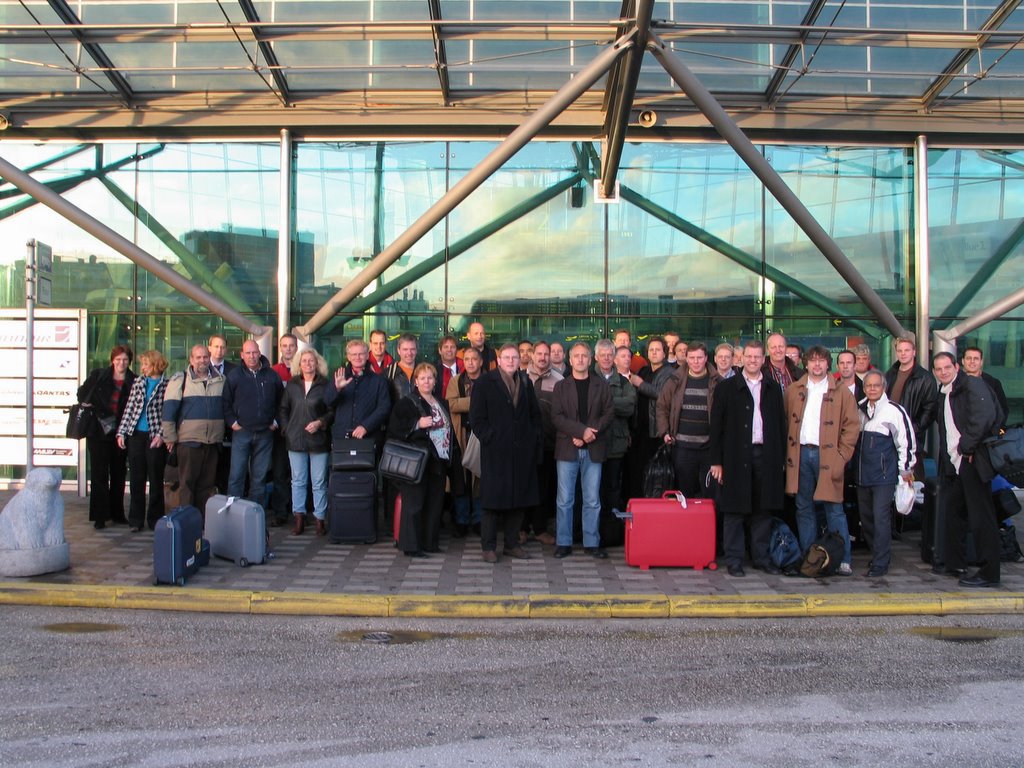
The party of 38 participants at Helsinki airport. In left of the red suitcase in blue jeans Pietrer Diphoorn of Syntens, the co-organiser, and left to him in black coat Hans Sleurink of the news service Media Update, co-organiser and my co-inspirator of the trip. (photograph published on the Syntens weblog)

Yesterday at 1 o’clock I sent off the Dutch group together with the Finnish co-organiser Mikko. 38 participants went back to the Netherlands. In the schedule there was enough time for the check-in at Helsinki airport. In the morning all the tickets of the participants were re-confirmed; a habit I have not done since the pre-pricefighting airline era. But I caught Hans, my partner in this event, just before he went to the plane; just to make sure that nothing had gone wrong.

So now we can start looking back. Did the trip bring what we had promised? Were the participants happy about the trip? Was the hotel okay. Was the social program okay. How bad did the splitting of the group thanks to KLM influence our score? Of course I look to more signs than only the feed back survey, which still has to be distributed. I have seen already the Syntens blog (in Dutch) and one of the participants has promised me his vlogs with video-interviews. According to the Syntens blog the trip has been a success. Also one of the participants, Hille Meetsma, stated that his mission was a success as he had picked up a lot of contacts and was asked to give a presentation about health software at the University of Tampere; it was an accidental contact he picked up during the big MindTrek Award party! But again this is opinion of two participants and there were 38 in all.

For other blogs on the trip to Finland see:
Syntens (Dutch)
Gerrit Visser (English)

I will not get too much time to look back to the Finnish week as I will go to Tunis on Monday. My mailbox has been flooded with mail of the UN World Summit on the Information Society (WSIS) and the World Summit Award (WSA). I saw that Andy Carvin, a first generation WSA juror, has composed a WSIS superblog with all writers about WSIS. I better start reading my mail in order not too miss essential mails like the access papers/visum to Tunis.

Friday, November 11, 2005

A Finnish Week, part 5

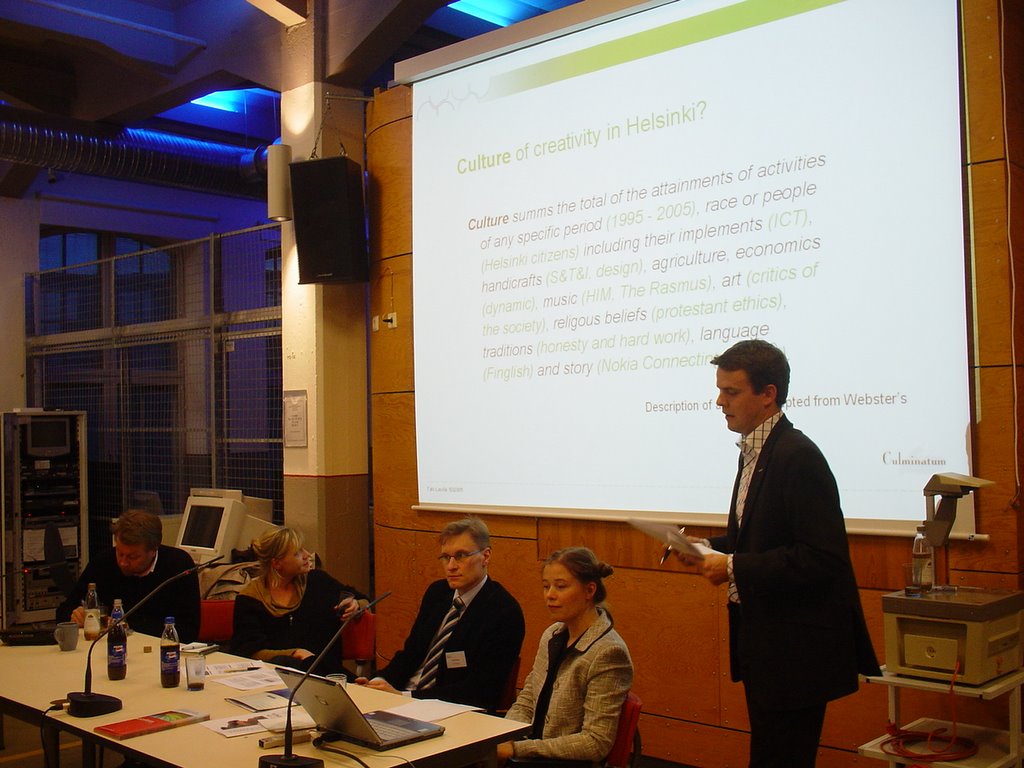
Yesterday afternoon there was a panel on innovative cities, a subject which drew much attention also from the Dutch participants. Many of them came along on this trip as they hope to her more about the much praised Finnish innovation model. The organisers had planned to get a speaker on the subject, but did not succeed to fix him or even a replacement. That was a pity. But looking back at the speeches and especially the one on innovative cities, it became clear that the model is no longer on the top of the list.

The panel on Innovative Cities:
- Tatu Laurila (standing up), Helsinki Region of Centre of Expertise;
- Jarmo Suominen (left), Future Home Institute;
- Minna Tarkka, m-cult (left from the middle)centre for new media;
- ?
- Paula Tuurnala (right), Helsinki University of Technology.

The Finnish innovation model has a history, which started in 1991. The Berlin wall had fallen and peresjtroika was all around Russia. As Finland shares the border with Russia and influenced the economy with Russian orders, it became clear to the Fins that they had to do something and find new orders in other parts. It also meant that the structure of the industry and of the collaboration model between government, universities and industry. So industry started to organise itself more competitive by cutting away the clay layers in the organisations and making the organisations flatter. The model between industry and universities became more intensive. The government is offering money to universities and industry to get students involved in industry from early days in their study. Students at the Tampere School of Art and Media are present at the school for 50 per cent of their time; for the rest of the time they work in companies, usually with a government grant. But the Fins themselves are realistic about their Finnish innovation model. Our Nokia host Juha Kaario said: What innovation model; just start working. He made clear that innovation in Nokia means coming up with attainable ideas, researching them, developing them into products (as Nokia has no services yet) and moving the products over to the business side completely with the research and development groups.

Innovative cities is a hot subject. It ties in with Richard Florida’s book on creativity. In cities there should be places for creativity, which triggers innovation and leads to competitiveness. In order to develop a strategy for this Culminatum has defined four pillars of innovation strategy:
1. improving international appeal of research and expertise. Finland needs foreigners!
2. Reinforcing knowledge based clusters. In Helsinki the Forum Virium was formed to bring together TV, multimedia, interactive TV, radio etc.
3. Reform public services with innovations.
4. Support for innovative activities.
Culminatum has produced now 26 action proposals.

Universities are an integral part of the innovative city. One of the panellist, working in Boston, indicated that MIT in Boston is not an accident, but is integrated in Boston. The French science park Sophia Antipolis is for example the wrong place. The parc is outside Nice, near the Mediterranean Sea,m it has glass boxes, it has its own campus and its own incestuous structure. A good example is the integration of city with campus. Besides the school, there is a theatre and there are more than 20 bars and restaurants.


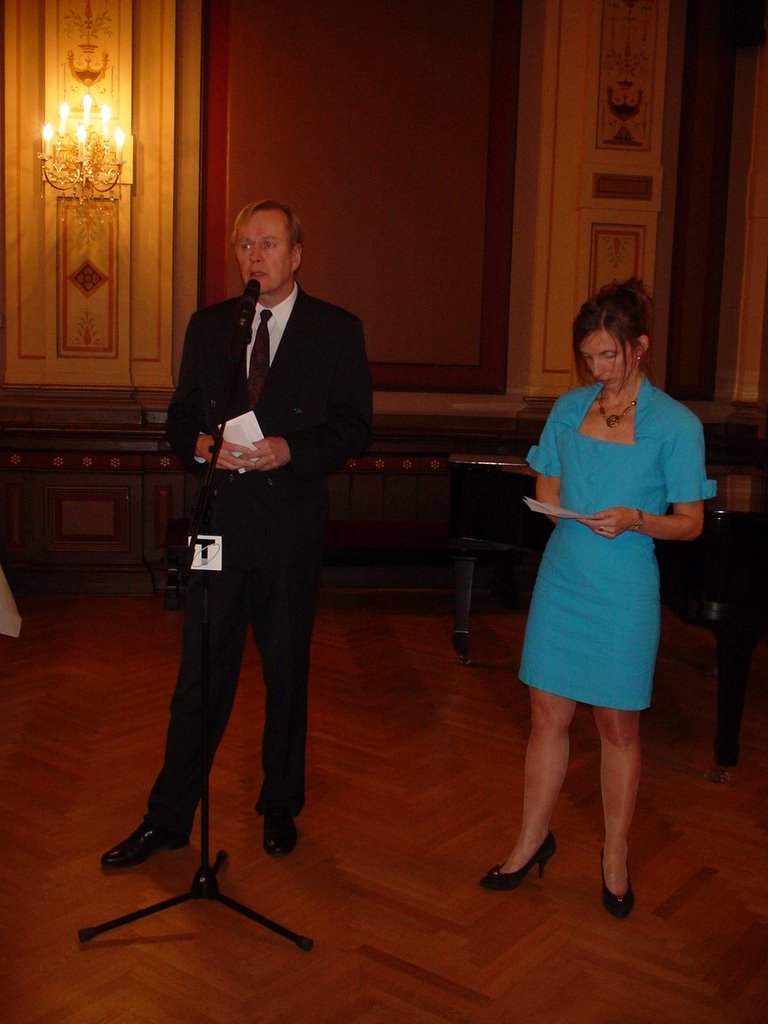
The two diva's, Maria and Irina, opened the MindTrek night event in style


At night there was the big MindTrek event, the annual awards were presented. The winner gets more than 20.000 euro as prize money. This year the winner was a historic production on the Second World War, from 1939 till 1940. Of course the usual points of design and interactivity were quoted. But the production became a winner as the production is a commemoration to the veterans. The prize money is intended as a stimulus for the sequel from 1941 onwards to this production.


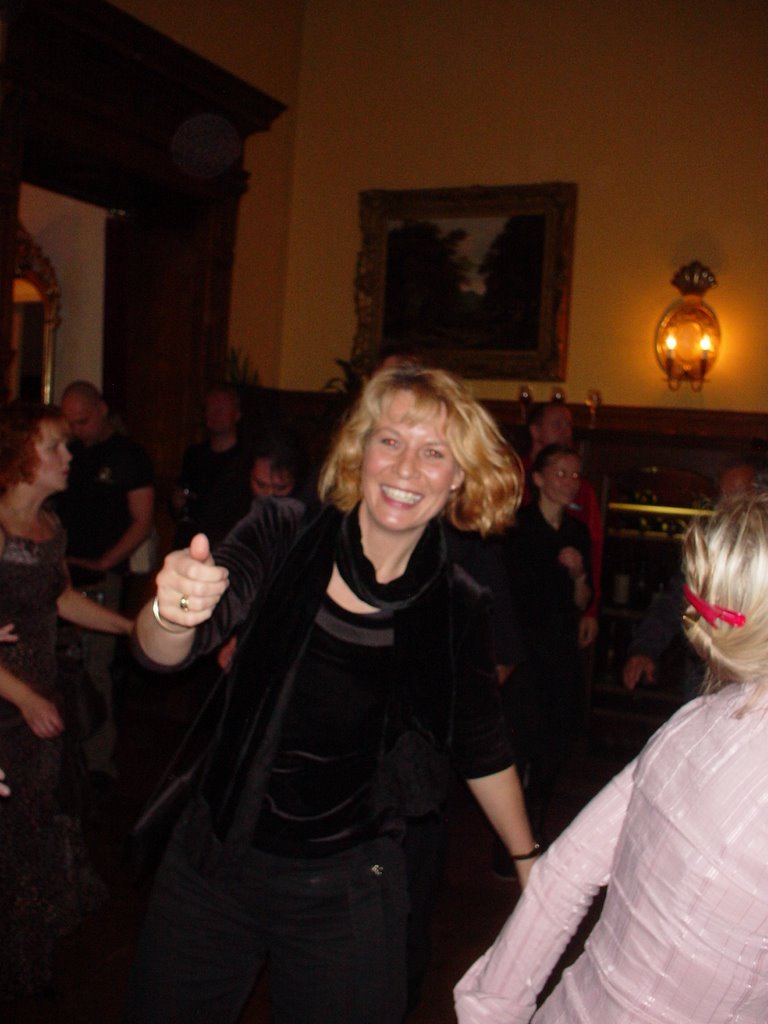
Dance on


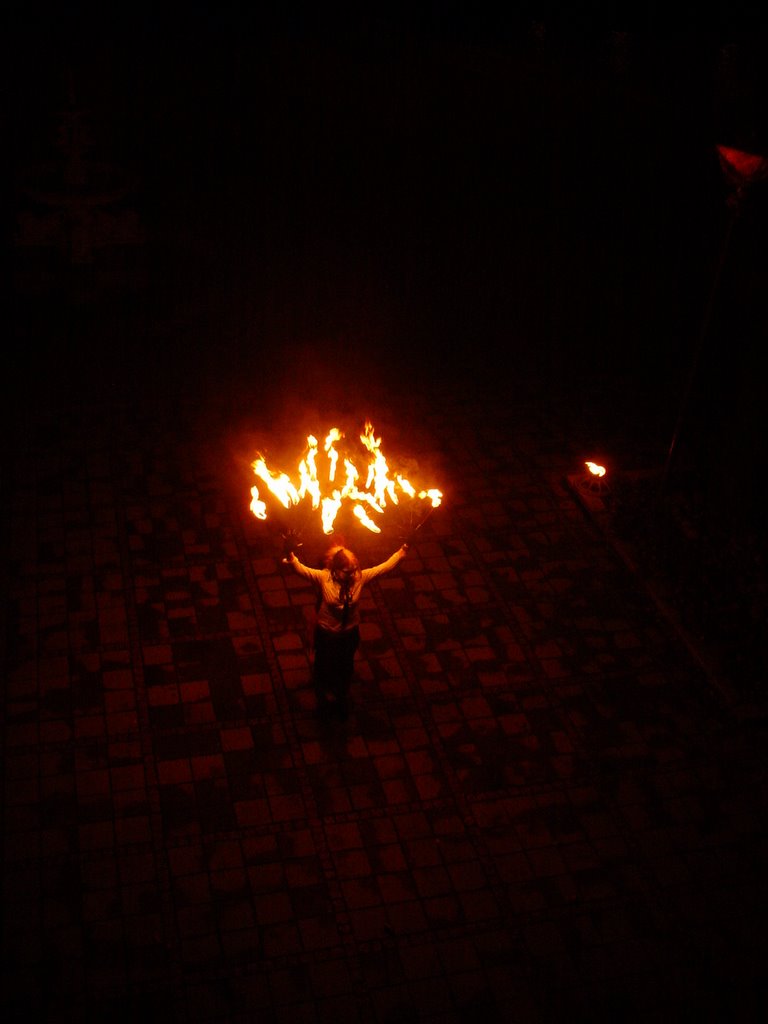
The day ended with a dinner and dancing as well as a flame demonstration. It was a perfect end of a beautiful evening.


Final act of the flame artists

Thursday, November 10, 2005

A Finnish Week, part 4


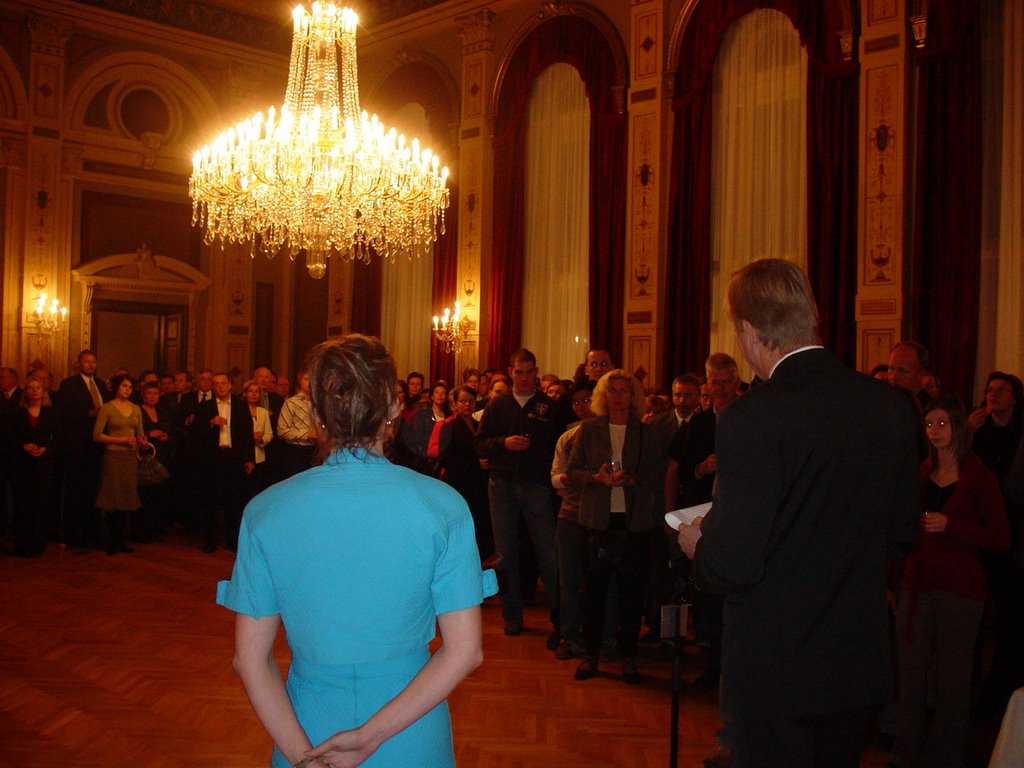
The city offcial and Maria (left); the audience in the restored hall with chandelier (right)

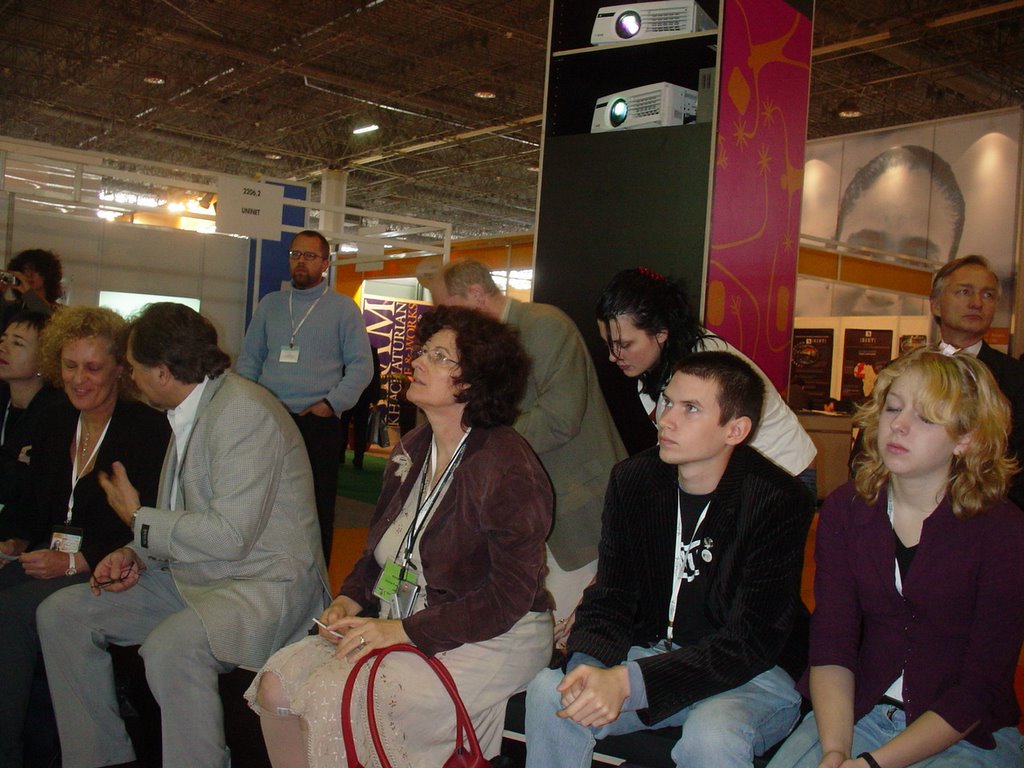
Last night it was party night. After the lectures there was a reception in the old town hall. It has recently been restored. The city of Tampere welcomed all the participants to MindTrek week and especially all foreigners. For that reason the chief official of the town, comparable to the function of mayor, had decided to do his speech in English. This short his speech remarkably. After the welcome of the chief official, Mária, the chairperson of MindTrek week, was welcoming all the participants as well, also in English and also short. After townhall we went to Hotel Tammer for an evening of entertainment: jazz by the Gilda jazz band. In another room of the hotel, Chris Hales was entertaining the crowd and getting them involved in interactive movies, letting the crowd decide what was the funniest joke by booing the real bad ones.


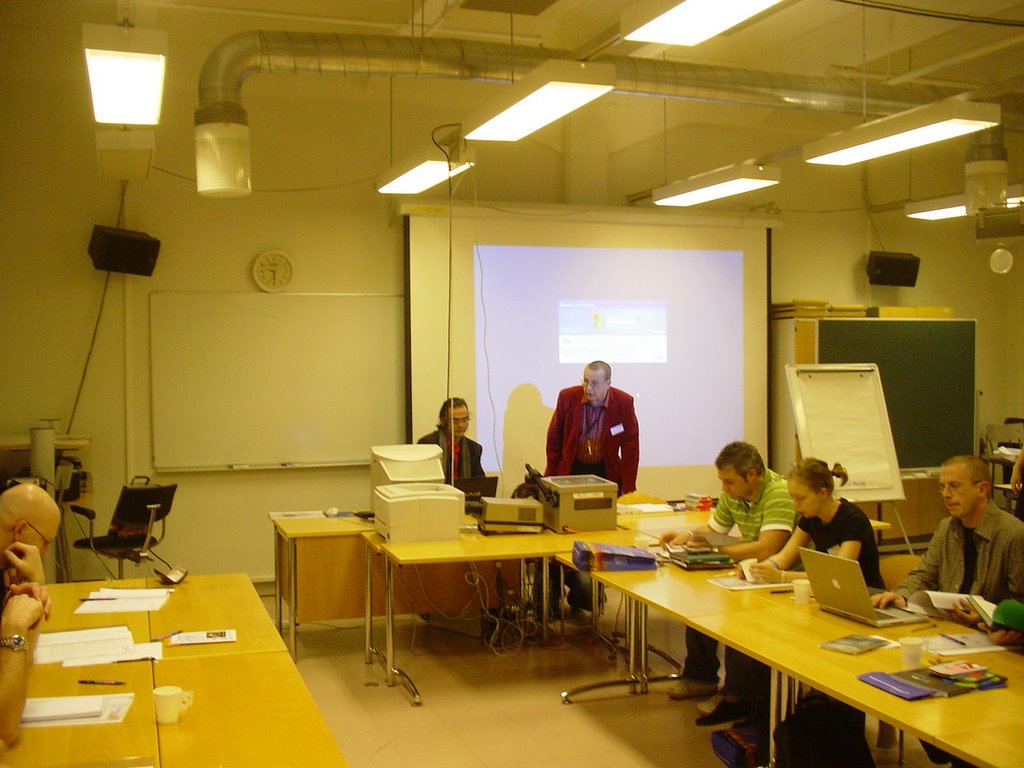
Frank (left) and Cai preparing for the start of the second Vocinet Workshop


Today is a complex day. In fact many events are going on. The Vocinet workshop, a project of the Instructors’ Network, will start. It is the second workshop in the series of four. The first one on Digital storytelling has been held in Salzburg and the second one in Tampere is on Project management and design. The workshops are intended for multimedia instructors (teachers, lecturers and professors) to update themselves and exchange methods with other instructors. There is quite a geographical spread present: Poland, Lithuania, Hungary, Germany, the Netherlands, Brits and of course Fins. Although the subject did not look to me to be that sexy, I was surprised by the first two presentations. Frank Alsema, a Dutch new media director of 4M and part of the team of the Blackbeard Connexion cross media game, showed the tension between the creativity and the complex tissue of new media, while Tommy Pelkonen of Santama showed how a middle seized company handles the principles of project management and design. The presentations will be available for registered users of the Instructors’ Network.


Dutch entrepreneur telling about her company during the MindMarket event


In the meantime the Mind Match between Dutch companies and the Finnish companies was going on. For the entrepreneurs there were presentations of Finnish and companies organised. Some matching work was done beforehand and it looked that this was going to be fruitful. I saw a presentation of one of the Dutch participants, who told the audience about a project she had done with the Dutch Youth Council. It looked like she had brought that institute from the feather into cyber age.

Wednesday, November 09, 2005

A Finnish Week, part 3

The trip to Helsinki yesterday was very unfortunate, thanks to KLM. We had gotten the advice to check in as a group. So when the group was complete, we checked in and found ourselves at the end of a long queue with only 5 counters manned. Having informed an attendant that we were with a group of 39 people and had to leave within three quarters of an hour there was no reaction, but the remark that we had to be in time at the at the check-in. After that her shift ended and she left. By the time that half of the group had checked in and half were finally at the counters they were told that the gate had been closed. Also the floor KLM management declared the gate closed and 16 people were checked in and could fly, while the rest had to stay behind for the late afternoon flight. I have never seen such rudeness of company that says that it is caring for its customers. So by midnight the whole group was re-united again in Tampere, at the extra expense of two bus coaches instead of one and a ruined welcome dinner. And of course with 39 people who will remember this incident with KLM whenever they book a flight next time. They know that they have a choice to fly with a more courteous airline.


De eerste groep bij het welkomsdiner


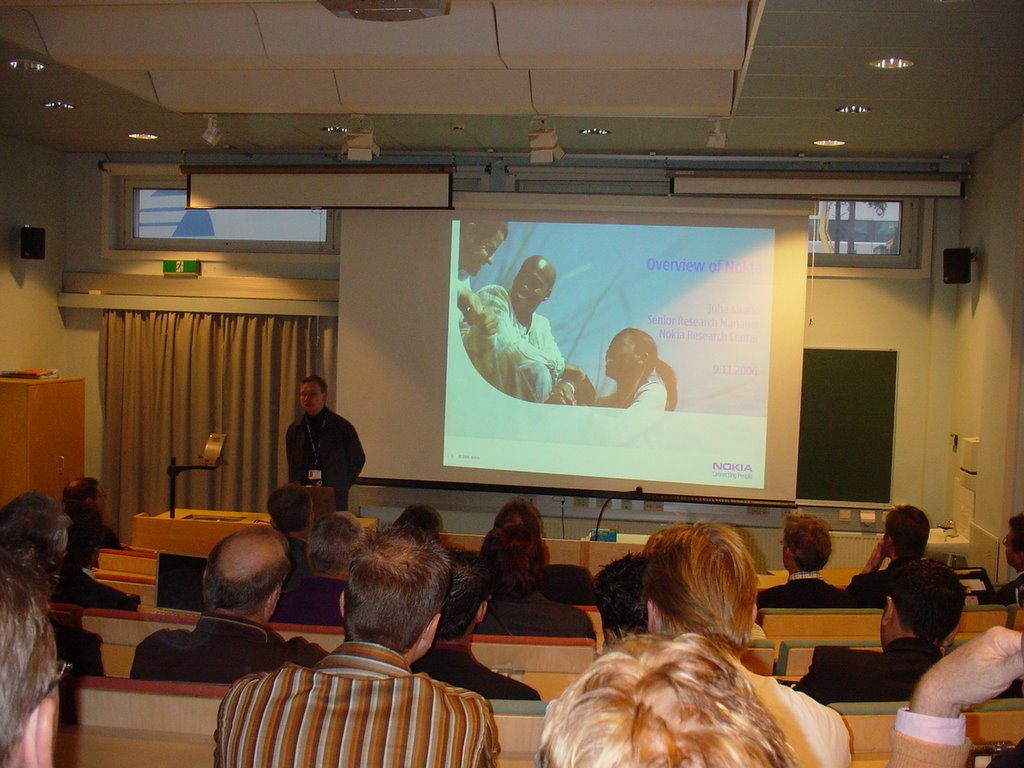
In the morning we boarded a coach for our first stop: Nokia Research Centre in Hermia, half an hour from Tampere. It took half an hour. With the group we sat in an auditorium , which reminded many of their college years. Juha Kaario started the presentation on Nokia and their research centres around the world and then got into the mobile game research Nokia is doing in Hermia. His colleague went into the subject of serious gaming and especially into gaming in healthcare. There were some remarkable points they brought up. On the platform business the researchers indicated that they are using Linux as middleware language. And I noticed later during talks in the cafeteria that Nokia is preparing a shift on their game distribution policy. Now they sell their mobile phones with games through telephone companies and through third parties like Electronic Arts. But if I sense it right Nokia will distribute games in the future themselves. This will be a major shift for them. Of course they are a brand, but so far telephone companies own the buyers of Nokia equipment. If this presupposition is right, it will mean that Nokia will turn their game research into a commercial activity.


The Nokia Research lab venue in Hermia (left); Juha Kaario of Nokia presenting

Presently Nokia is involved in a big Integrated Project on Healthcare, dubbed MyHeart, with the European Commission. In the projects games are developed to prevent cardio-vascular diseases and to help people with obesities. It is a project of 15 partners, commercial companies like Philips, but also universities. The basic question is of course: could games be of help in prevention. So far they have produced a game Life for Quest a dungeon multiplayer adventure game with a diet program. The more life forces are gathered, the higher you can go in level. Another game is Sneakers, a location-based collectible and card game. Teenagers are asked to collect items in a diameter of 100 meters, photograph them and put them on their mobile. They can be exchanged with other people and after a while the players gains more terrain to collect items and go from 100 meters to 200 meters. Of course this game is to get teenagers walking. A third game is Peer support, a game for building a virtual community with group features and chat. These games are only exercises for the development of mobile phones with sensors. By having textiles with woven-in sensors, the heart condition can be measured and transmitted by mobile. And why not have a mobile with a step-o-meter?

Tuesday, November 08, 2005

A Finnish Week, part 2

Today we will leave for Tampere by plane: 39 people in all, 21 entrepreneurs, education people of two junior colleges and officials/regional stakeholders. The objective of the visit is the exchange of knowledge and matching with Finnish companies. The trip is made possible with a grant of the European Commission.

We will have a packed program. Just look at the flyer with activities. The real program is more extensive.

Most of the time will be spent in the Finlayson area, the place of the old Cotton Mill. This area has been restored and remodelled into a media centre. The Polytechnic School of Art and Media is located there as well as a cluster of ICT- and media companies, restaurants, musea as well as conference rooms and halls.

You can have a look of Tampere by looking at the web cams in the various parts of the city. Of course it is only a few hours a day that you can really see the locations in Tampere as there is only 6 to 7 hours of daylight, between nine and four o’clock.

Monday, November 07, 2005

A Finnish Week, part 1

This week will be an all Finnish week for me. Tomorrow I will travel to Tampere in Finland in the company of 39 Dutch entrepreneurs and educational people for a business trip.

What started as a trip with a small group of 15 people has grown into a business mission with 39 people. The idea started in August with a request of the Finnish company Culminatum. During the multimedia week in Tampere, called MindTrek, they would like to organise MindMatch, a meeting with people active in creative ICT and multimedia. While my colleague Hans Sleurink of the Dutch newsletter Media Update and I were working out the ideas, the North Netherlands division of the business innovation institute Syntens adopted the idea of the business trip and got involved themselves. While Hans and I organised the program, Syntens facilitated the organisation and promotion, including a TV crew of the regional broadcast station RTV Drente.

You want to know why we go to Finland? I guess everyone has his own motives. But analysing the motives it is the attraction of how a country with 5 million people can be so innovative. Besides, Culminatum and Media Update took care of a matching process; so the entrepreneurs did not have to search and select companies themselves; now talks have been arranged with Finnish companies in their line of business. Another attractive feature is the visit to the research lab of Nokia. You look up a flyer on the activities.

The education people will have their special program. They will visit the Tampere School of Art and Media, where my friend Cai is teaching, the Hypermedialab, where Jarmo is doing research, and Tampere University.

Talking about innovation. Last night I was preparing the 31st edition of my newsletter Content Market Monitor. It will be published today. I picked up the following newsitem:
Handset maker Nokia and music label EMI have started a project to let coffee shop customers listen to music sent to their phone via Bluetooth. As well as music, customers will be able to get hold of ringtones, wallpaper, video clips and vouchers. The first free tests of the service will be in three Robert's Coffee cafes in Helsinki and three FreeRecordShop music stores in the city. While in the shops, customers will be able to select and listen to tracks sent to them via the short-range radio system.
Trialists must download software to their handsets that will let them browse the tracks on offer. The service is designed to work with Series 60 Symbian phones (such as Nokia's N90 and the Siemens SX1) and Nokia Series 40 phones (such as the 6060 and the 8800).
The trial service, dubbed bFree, will be free for those taking part. But Nokia and EMI expect to charge for access to the playlists if a commercial system is rolled out. EMI has yet to say which artists will be available on the trial playlists. EMI represents such artists as Robbie Williams, Goldfrapp and Gorillaz.
This is an interesting trial (tap a beer and Robbie Williams). It is good to see that the Finnish subsidiary of a Dutch music retailer Free Record Shop is involved.

Sunday, November 06, 2005

DVD on Rembrandt

This week a press release was published on a commemorative DVD production of the Dutch painter Rembrandt van Rijn. Next year it is 400 years ago that Rembrandt was born in Leiden. The DVD is a co-production of several institutes, which study Rembrandt’s works such as the Rijksmuseum, The Rembrandt House, the Maurits House and various foreign musea. On the DVD the life, the artefacts and techniques of Dutch painters will be made accessible.


Rembrandt belongs to the greatest painters ever. The DVD shows why. The era of Rembrandt, the Golden Century, comes alive. On the DVD one has a look in the private life of Rembrandt, his parental home, his youth, his time at school, his masters, his studio, his turbulent love life and his years of glory in Amsterdam. More than 100 paintings, etchings and drawings are shown and explained. Special attention is paid to the Night Watch also dubbed The Company of Frans Banning Cocq Preparing to March. What is the secret of Rembrandt technique? A restoration expert shows the paintings with the help of an X-ray machine. The DVD is available in 9 languages.

The DVD is published in co-operation with CD-ROM Print studio. With this application 49 works of Rembrandt can be reproduced. Not only paintings, drawings and etches, but for example also the public notice of intended wedding with Saskia van Uylenburgh.

The Rembrandt year will be an international event. Many expositions are planned in various cities in Europe, America and Asia.

The DVD has been published by Capital Interactive Publishers in ’s-Hertogenbosch and will be available through bookshops and shops in musea.

In the press release the publisher hails the DVD as the first interactive production on Rembrandt van Rijn. It is indeed the first DVD on Rembrandt and the publisher is right in as far as the entire life and works of the painter. But he has obviously not done his home work as far as interactive productions on Rembrandt are concerned. In 2001 the CD-ROM Rembrandt the Printmaker, a co-production of Softmachine and the Rembrandt House, was entered in the Europrix competition and was awarded a nomination in the category Knowledge, Discovery and Culture.

Saturday, November 05, 2005

Dutch pre-Tunis meeting

On Thursday there was a pre-Tunis meeting in The Hague, Fill the Gap III, organised by Hivos. There was a conference and a fair. The event attracted some 130 people and 20 exhibitors. I was there, telling about the World Summit Award and handing out the WSA catalogue. The catalogue was much liked.

The meeting existed of four parts: two keynotes, a discussion on the exhibition floor and a panel discussion. The theme centered around internet governance and more specific about the freedom of speech through internet. That freedom of speech through internet is not a right for everyone was demonstrated at the meeting, as flyers were distributed protesting against censorship in Tunesia.

The discussion on the exhibition floor did not sparkle. The Dutch internet journalist Peter Olsthoorn, chairman of the Dutch section of internet journalists, was asked what irritated him most on Internet. He indicated that he hated anonymity the most on internet; the fact that people did not show a face. When the audience was questioned on this position, only a five people agreed with him. The ensuing discussion went into details and eventually petered out without a real conclusion.

At the meeting I met also the people of Incommunicado 05. They had produced a book on their conference. The Incommunicado Reader is a compilation of lectures and discussions. The reader has been edited by Geert Lovink and Soenke Zehle. The reader, including CD-ROM, can be ordered by sending an e-mail to: info@networkcultures.org.


Cover of the reader

Friday, November 04, 2005

Dutch public library launches music download service

Tonight at 18.00h (Dutch time) all 3 million members of the Dutch public libraries can start downloading more than 35.000 music pieces (songs and albums) for free on www.muziekweb.nl. They can listen to them with Windows Media Audio.

The Central Discotheque Rotterdam (CDR) of the Rotterdam Public Library coordinates the service on behalf of the 800 public libraries in the Nethrlands. The department has already a history since the sixties in music loans and has a collection of 300.000 CDs and DVDs for hire.

The department has developed this service with two music distributors. The label Naxos offers classical music and labels Challenge and Chesky present jazz. The rights have been coordinated by BUMA/STEMRA the collecting body and the national Library body. A DRM company has taken care of the technology. The music distributors hope for more sales.

Every body with a fast PC and a broadband connection can download the music. They need to be members of a public library; trial accounts can be made. Once a person is registered he has to download a program for searching, downloading and playing. There is a limit to the times the music can be played: either one week or 70 times. The service is for free, while the experiment of one year lasts.

The music download service is interesting. The libraries hope to get more members this way. The department hopes to convince other music distribution companies to participate. The rights body is happy; in the past the Dutch libraries have been in year long fights over copyrights. The range of choice is for the time being limited to classical music and jazz, but this will undoubtedly change, when the repertoire is extended.

Thursday, November 03, 2005

Analogue radio to disappear in 2015

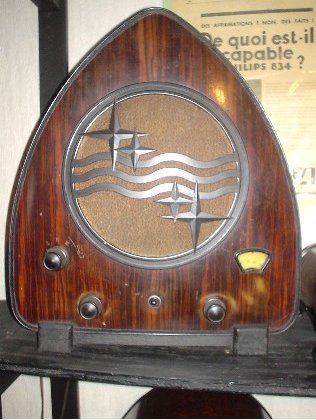
The Netherlands will be on digital radio by 2015 (I will be 70 years young by that time). All analogue radio signals will disappear and the present generation of radio equipment will be useless.

This decision was made known by the minister of Economic Affairs in a letter to parliament. He first had put the disappear act between 2015 and 2015, but has now firmly set 2015 as the end of analogue radio. With the decision of 2015, the minister is right in line with the UK and Germany, which countries will abolish the analogue radio waves and equipment.

In order to start up the digital era, the minister has already given out licenses for digital radio broadcast to the Public Broadcast System. However this has hardly been a success as there is hardly digital equipment available. PBS in fact has threatened to close the digital radio broadcasts, if digital radio is not supported.

The licenses for digital radio broadcast will be handed out before the summer of 2006. There will not be an auction for the frequencies, but a beauty contest for the present public and commercial broadcasters.

By May or June 2006 the first international negotiations will start. In 2007 or 2008 the next trench of frequencies will be assigned. At that moment parties which are not active in the Netherlands can participate.

I bet the Dutch will switch more than in time. It is a question of commercial radio starting to make the first move.


This is the so-called chapel radio, made by Philips. It is part of the collection analogue radio sets of the Belgian Jukeboxmuseum

Wednesday, November 02, 2005

O2: KPN next

The mobile telephony sector is moving again. Vodafone sells its Swedish division to Telenor. But the big news was that the Spanish incumbent Telefonica intends to acquire O2. It is like a dance.

O2 is the former mobile branch of BT. In difficult times it was split off from the fixed line business and brought to the stock exchange as an independent company. O2 has a footprint in the UK and Ireland and is active in Germany.

It has been much sought after. As it is one of the smaller companies in Germany, the Dutch incumbent KPN has been interested in buying the German part, as it is in third position with E-Plus in Germany. A month ago there were rumours that T-Mobile and KPN would make an offer. T-Mobile would sell the German part to KPN in order to avoid monopoly claims. But these rumours were denied. Now Telefonica is after O2.

Funny thing is that Telefonica has withdrawn from Germany years ago. Buying O2 would bring the company back in Germany, but still would leave it in the fourth place for mobile telephony. You can not imagine that a company like Telefonica is looking for such a position. The UK and Ireland parts would mean a substantial market share and market extension for Telefonica, but O2 Germany will be small beer for the Spanish multinational. So what would Telefonica do, if it acquires O2. There are two choices: either buy KPN (and combine the German division of O2 with E-Plus) or sell O2 Germany to KPN.

KPN and Telefonica know each other well. Five years ago KPN negotiated a merger with Telefonica. The attempt failed as KPN wanted to get more out of the deal than it was worth. Now KPN will be brought into the position to either buy the German part of O2 and after that being eaten by T-Mobile or France Telecom or being eaten by Telefonica. This last option looks like a real scenario. KPN is a fixed line, mobile and triple play business and fits well in the activities of Telefonica. The former option is less likely as it would give a change to T-Mobile or France Telecom to close off entry of the small Dutch market.

My guess will be that KPN is the next one on the block for Telefonica, if they find money in time after this gigantic acquisition. Give Telefonica a year to recuperate, before its starts eating KPN.