The scientific activities in the field of computer science
and computer construction were the source of commercial activities in the
Netherlands from 1956 onwards.
After the completion of the ARMAC (1956) the Mathematical
Centre decided to cease all computer building activities. The team involved
however started to draw up plans based on the ARMAC to start a commercial
company focusing on the manufacture of computers. But those plans needed funding.
A financial partner was found in the Nillmij, the Netherlands Indië Life
Insurance and Annuity Company, which realised the importance and potential of a
Dutch computer industry realized and was prepared to be provide venture capital.
The CEO of the insurance company, J. Engelfriet, had already taken steps to
automation within the company and was convinced of a potential market for computer
manufacturing in the Netherlands. Cooperation between the group of scientists
from the Mathematical Centre and the insurance company led in 1956 to the
creation of NV Electrologic, the first Dutch manufacturer of computers.
The development team initially consisted of A. van
Wijngaarden, B. J. Loopstra and C. S. Scholten. Engelfriet was not just an
investor, but was engaged in the company, particularly in the software
department, which was located in the building of the Nillmij until 1965.
Their first computer X1 was presented in 1958 and was a
commercial success. There were more than 30 machines sold at home and abroad.
The X1 was regarded as one of the best scientific devices of its time. Five
years later the X8 was announced. It was a faster machine and was again a
commercial success. But then the company began to produce variations on the X8,
by manufacturing lighter versions of the machine. Eventually, the development
costs became too high and there was a lot of competition, mainly from American
computer manufacturers such as IBM. Electrologic sought collaboration with the
Dutch electronics company Philips from 1965, which took over the company in
1968 and integrated it into Philips-Electrologic. It meant the end for NV
Electrologic and the X - Series, but also an end to the race that had been started
by the Mathematical Centre and had lasted. 20 years
Dutch electronics manufacturer Philips was in the fifties a
formidable company of national and international stature. It is therefore
surprising, that Philips did not jump into the market of commercial computer
manufacturers in the fifties. As reported in the first instalment, Philips
Research Laboratory built two experimental computers: Peter (1958) and the PASCAL
(Philips Awful
Speedy CALculator; 1960). But the commercial side of Philips had a problem
with computer manufacturing. The company was producing components for IBM
computers. And because this was a profitable trade, Philips preferred not to
become a competitor of IBM.
But in 1960 Philips also saw that a new and big market for
computers was open in the field of scientific research, technology and
administration. In that year, the electronics company created Philips Computer
Industry (PCI), which started the production of its own computers. Following
the acquisition of Electrologic Philips in 1968 the company changed the name
from PCI into Philips Electrologic and got its own factory in Apeldoorn.
While the production of Electrologic computers was
discontinued, Philips came in 1969 to the market with the P1000 computer series
and its predecessors such as the P880 (see photograph). The first machines were sold
to the Dutch PTT for the automation of its banking system. However, the delivery
of several hundreds of machines was mainly achieved through the existing old-boys
network and not by hard selling. In 1976 production was stopped.
Philips Electrologic had meanwhile been renamed into Philips
Data Systems ( PDS ). This company began to concentrate on minicomputers and
smaller systems. This eventually led to only two profitable years : 1984 and
1985.
Meanwhile, the first home computers and then the personal
computers entered the market. Philips was in the home computer market actively
with the Philips P2000 and later with the MSX. Following the example of the IBM
PC Philips decided in 1986 to include PCs into the manufacturing, but was not successful,
despite campaigns such as Headstart computers with bundled CD - ROMs, produced
by the Rotterdam company AND. In 2003, the PC adventure for Philips ceased with
closure of the Apeldoorn factory. The PC adventure Philips had not been
convincing. From 1986 Philips began to burn
money with the Philips CD-interactive (CD-i) adventure, which was
commercialised from 1991 to 1996. Half a billion dollars were thrown at CD-i. Philips
ambiguity can be summarized in the philosophy: you sit in front of the TV linked with a CD-I player in the living room,
but behind your personal computer in
your bedroom or study.
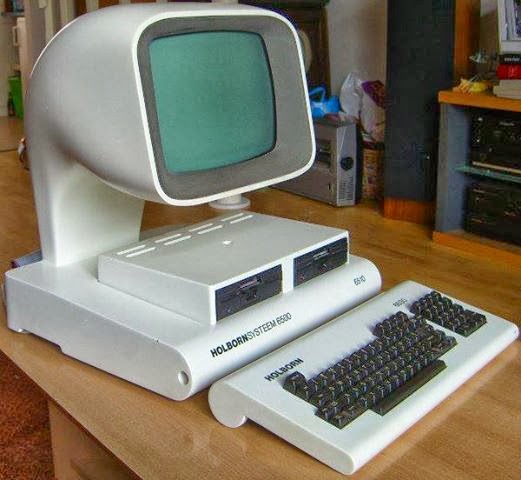
Besides the commercial manufacturers Electrologic and
Philips, there was also a company in the Netherlands which only produced PCs:
Holborn (Born in Holland). The
hardware of the machine was designed by H.A. Polak and the terminal by Vos
Industrial Designers. The terminal has been customised based on a MicroBee. The
Holborn used the CP/M operating system
The company Holborn was only active from 1980 to 1983, when
it went bankrupt. Probably only 200 units have been sold, mainly to small
businesses for administrative and accounting purposes. For the nicely designed and
ergonomic machine 30,000 guilders (about 14,000 euros ) had to be paid. Holborn
lost the race as it had to compete with office machines like the IBM PC. The
IBM PC was cheaper and rapidly gained dominance of its operating system DOS
over CP/M
The Delft quantum
computer
Overlooking the history of the Dutch manufacturing of
computers, it seems that the same scenario will be played out. The computer
construction is back at the university, in this case not in Amsterdam, but in
Delft. The difference in scenario is that are involved from the beginning the
scientific institutes and industry. In this way, the business spin-offs can be
enjoyed by industry.
However, the question remains, why a university should start
with the construction of the quantum computer. In the U.S. there are already commercial
initiatives taken by companies such as IBM and Google. Why this Dutch
initiative ? The construction of quantum computers is still in its infancy and
in Delft there is a group of experts in quantum theory and nanotechnology,
which are set to deliver, be it in 15 years. QuTech can now convert theory into
practice.
Update September 4, 2015: Intel invests in QuTech
Intel invests $ 50 million in QuTech, the research institute of TU Delft and TNO that focuses on the development of quantumcomputing. Intel will also support research efforts technical. Intel supplied an advanced 300mm wafer to QuTech, consisting of a combination of silicon and germanium. This research substrate will be used by the QuTech scientists to make qubits - the building blocks of quantum computing.