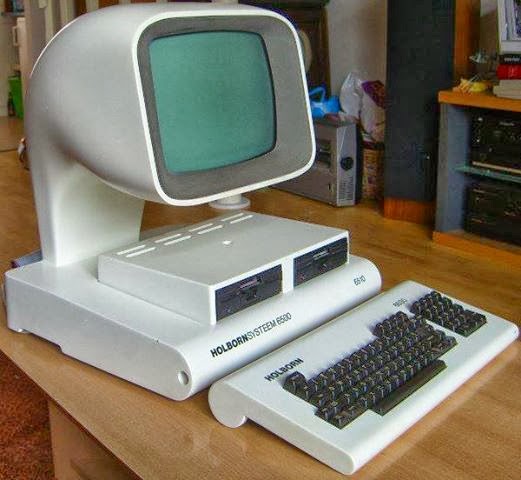
The illustration is of a Holborn 6500 and not of a Holborn 6110, which is up for auction.
Catawiki organised an auction of vintage computer objects last week. This new section at Catawiki of vintage computer objects differs from the other offered computer objects of common portable computers and tablets. The vintage objects on offer come from the eighties and nineties. They are so far old calculators, but also Apple machines like MacIntosh and Indigo as well as Commodore machines (with or without packaging). But at this auction it was possible to bid on a unique machine. And that was done by 10 bidders with a hefty price for the winner of the auction. It is not about millions as with the first Apple machines, but for a Dutch PC, 3,100 euros, excluding auction and shipping costs, is a considerable amount. This while the machine is no longer functioning due to a problem with the motherboard.operational.
But it is a Holborn (Born in Holland), made in a company that from 1979, exclusively manufactured PCs. The hardware of the machine was designed by Hans Polak together with Henny Bevers and the design of the futuristic terminal was made by Vos Industrial Designers. Inside, the terminal was a modified MicroBee monitor and used a Z80 processor. The Holborn used the operating system CP/M.
Article in the Tubantia of 21 May 2021, saying that this Dutch invention from 1978 could have beaten Apple: unbelievable, but no one saw it.
The company Holborn started with its headquarters in Holten in 1978. The first manufacturing facility was in Hengelo and later in Enschede. The company operated only briefly, from 1979 to 1983, when it went bankrupt. The company developed two production lines: the growth computer the multi 9100, an expandable, customised business system with a self-developed operating system Holborn Operating System (HOS); later the 7100 version was released, which could be expanded to the 9100. But Holborn is better known for the stand-alone Holborn 6110 under CP/M and the prototype 6500 both with the science-fiction-like monitor. There were probably only 100 devices of the 6110 produced and sold, mostly to small companies for administrative purposes. The styled and ergonomic machine was initially priced at 30,000 guilders (approx. 14,000 euros). In the Netherlands, the company had to compete against larger home-grown machines such as Elektrologica and Philips, but also against cheaper office machines such as Wang. And the real competition came in 1981 with the introduction of the PC by IBM and later clones.
The auction item is a Holborn 6110. The offered system consists of a keyboard monitor console and an external box with two floppy disk drives. The system was originally purchased in the early 1980s for about 20,000 guilders as a medium-sized business computer.
This computer stopped working in 1996. Recently, the computer has been turned on, the disk drives turn on and the fan on the computer turns on. The screen does not turn on and it seems, that it failed to repair a part on the motherboard.
Personal note. I was introduced to PCs in 1980 at the new media laboratory VNU Database Publishing International (VNU DPI). in Amsterdam. There was an Apple IIe present, but the automation department of VNU had bought a large batch of Superbrains (talking about AI) and handed out these machines, which worked with the CP/M operating system. The Superbrain was ergonomically a clunky machine, where you could get problems with your right hand from the raised edge at the keyboard. Sitting behind the Superbrain in 1980. (Photo Coll. JB)
Showing posts with label VNU DPI. Show all posts
Friday, August 26, 2022
Sunday, July 08, 2012
BPN 1605: Software directories
The Dutch Softwaregids (software guide)
exists 12,5 years. In September 1999 the Softwaregids started. From 1999 till
2001 the online guide was as a private initiative part of several websites
within the VNU Portfolio. But after the bursting of the internet bubble the
Softwaregids went on as an independent website and with success. Since its start
in 1999 no less than 5.000 software companies have registered over their 20.000 software products. Annually
about 2 million searches are performed. Since 2010 the Softwaregids is multi
lingual and active in Belgium and increasingly more software products are
registered from abroad, which are not yet represented in The Netherlands.
The objectives have been unchanged since the start. Suppliers of business software can register their products for free. But they have to be validated regularly to guarantee being up to date. Visitors can also search the database for free for functionality or for branch specificity. Filters can be applied such as price, OS, etc.
The Softwaregids has a history with VNU in internet, but it has even a longer history with VNU since the eighties. VNU is one of my former employers. In 1980 I worked for VNU database Publishing International B.V. (VNU DPI), based in Amsterdam. It was a greenhouse for electronic publishing within the division VNU Business Press Group (VNU BPG). This division was the owner of the weeklies Intermediair for college and university students and alumni, Computable, Textilia and PW (Human resources). Internationally, outside the Benelux, VNU BPG aimed at dominance in the domain of computing, these days called ICT. One of their first bases abroad was London. English language computing titles were bought from Haymarket Group and a company set up in the heart of London. But as VNU BPL wanted to grow fast, it bought CUYB Ltd in Bournemouth, the publisher of computer year books with the original title Computer Users Year Book, a publication with hardware and software information. It was a profitable acquisition, but their production method was halfway between the lead era and the photo typesetting.
In the meantime the publishing company Tosco had started up the Dutch Software guide and started to collect, maintain, enrich the profiles and is now leading the market. The company has now the impressive database of profiles of 11.000 software companies, 26.000 contact persons and 30.000 software products.
Lesson of this story: small companies can do a specific job better. Congratulations to the Dutch Softwaregids.
The objectives have been unchanged since the start. Suppliers of business software can register their products for free. But they have to be validated regularly to guarantee being up to date. Visitors can also search the database for free for functionality or for branch specificity. Filters can be applied such as price, OS, etc.
The Softwaregids has a history with VNU in internet, but it has even a longer history with VNU since the eighties. VNU is one of my former employers. In 1980 I worked for VNU database Publishing International B.V. (VNU DPI), based in Amsterdam. It was a greenhouse for electronic publishing within the division VNU Business Press Group (VNU BPG). This division was the owner of the weeklies Intermediair for college and university students and alumni, Computable, Textilia and PW (Human resources). Internationally, outside the Benelux, VNU BPG aimed at dominance in the domain of computing, these days called ICT. One of their first bases abroad was London. English language computing titles were bought from Haymarket Group and a company set up in the heart of London. But as VNU BPL wanted to grow fast, it bought CUYB Ltd in Bournemouth, the publisher of computer year books with the original title Computer Users Year Book, a publication with hardware and software information. It was a profitable acquisition, but their production method was halfway between the lead era and the photo typesetting.
At that time in 1981 I was asked to be a
consultant to the project. With the experience of automation of production
processes in reference works like encyclopaedias, this was a real challenge. So
the company was moved to HQ in London, but the changing of the production
method in order to produce printed reference works and online databases took
more time. I was seconded to the London firm to accompany the change op
process. But soon after my arrival I found out that there was a new publisher
who brought his own advisor with him. He had knowledge of new software (Mapper)
and this software had to do the job – without examples and shadow processing.
As I could not accept such a situation, I accepted two other projects: a PC
software directory and the bringing online of a daily newsletter, a blog avant
la letter. The Computer Users Year Book project with Mapper failed badly (as
expected). So VNU lost a year of revenues, except for the PC Software
directory. However in the year after a new production method was found and the directories
existed till the first decennium of 2000 era.
In the meantime the publishing company Tosco had started up the Dutch Software guide and started to collect, maintain, enrich the profiles and is now leading the market. The company has now the impressive database of profiles of 11.000 software companies, 26.000 contact persons and 30.000 software products.
Lesson of this story: small companies can do a specific job better. Congratulations to the Dutch Softwaregids.
Labels:
Computable,
CUYB,
Mapper,
Softwaregids,
Tosco,
VN,
VNU BPG,
VNU DPI
Subscribe to:
Posts (Atom)


