Showing posts with label Knoware. Show all posts

Friday, January 25, 2019

BPN 1747: Dutch telco KPN wants to redeem a precious IP brand


The Dutch telco KPN has published its intention to abolish the brand name of its IP subsidiary XS4ALL. This has led to a storm of indignation and solicited a petition to reconsider the decision, signed in the meantime by some 45.000 of the IP’s pioneers, subscribers and sympathizers. 

Dutch internet pioneer 
XS4ALL is one of the oldest Dutch IPs. It originated from the hackers’movement Hack-Tic and offered its internet services since May 1st, 1993. On its first day it registered 500 subscribers, a score which was helped by one of the rare articles on internet in the national daily de Volkskrant. XS4ALL was one of the first Dutch pioneer IPs together with NLnet, Knoware and IAF. The foundation grew fast and gained speed, when beginning 1994 the Digital City in Amsterdam was launched.

By 1998 the Dutch scene of IPs had changed drastically. Competition between the new IPs had become fiercely, with competitors like Digital City, Planet Internet and World Online. In order to stay technically ahead, the foundation was faced with heavy investments, which they could not put on the table. So they put together a bidbook and offered that to the IP community. 

Wonderment 
The press and internet community was astonished when the winner was announced. The Dutch telco  KPN had beaten the other competitors, being in need of technical knowledge and having deep pockets. The astonishment was based on the difference in company mentality. KPN being a stock listed company and technical business was not in line with the free, anarchistic mentality of XS4ALL. Yet KPN guaranteed an independent course of management. 

Not just an IP 
XS4ALL was an early Dutch IP and kept its freshness from the beginning. So it stood side by side when the IP stood sideby side in a court case of a subscriber against the Scientology Church, which lasted from 1995 till 2005. In 1996 XS4ALL together with the Voice of America supported the continuation of the broadcasts of radio station B92 from Belgrado, which had been stopped by the then Federal Republic of Juguslavia. The IP was also a party in a censoring case with the German government. It also fought a legal battle in the Pirate Bay case with the Dutch copyright watchdog Brein. 

Shift

From 2016 a shift was noticed in the attitude of KPN towards XS4ALL. KPN parted with two independent foundations, which guarded over the origin and legacy of the internet pioneers. The attempt to take over the foundations failed and the annual contributions were stopped. But with the entry of anew CEO in 2018, a new marketing plan was developed: the brand name KPN would be leading for all subsidiary brand, including XS4ALL. The announcement on January 10, 2019 to say farewell to the brandname, sollicited immediate reaction from the subscribers, who threatened to discontinue their subscription. KPN tried to appease the subscribers saying that nothing would change in the service of XS4ALL, but that only the name of the pioneer company would be abolished. But the action committee of subscribers was not appeased. Of the more than 200.000 subscribers some 20.000 joined the action group as did some 25.000 of supporters. After a talk with KPN the group threatened to leave the KPN company and even start up a new company with the help of a third party.

Tuesday, January 15, 2019

BPN 1746: Launch Digital City Amsterdam 25 years ago

Today it is 25 years ago that the Digital City Amsterdam was launched. Digital City Amsterdam was a historic project as it meant a breakthrough for internet in The Netherlands, but also an example of a virtual community. 

Breakthrough
By 1993 technical access to Internet was available in the Netherlands. Three ISPs (NLnet, XS4ALL and Knoware) delivered the technical access mostly to companies, but did not offer any other services. They invested hardly any effort in marketing and promotion as most clients found their way to the companies/foundations. This changed drastically in 1994 when the De Digitale Stad (DDS) came online. This foundation was an initiative of De Balie, XS4ALL and was set up in order to form a discussion platform for six weeks for the upcoming municipal elections. It was a success from the start, partly because a visitor got a free e-mail address and free access to other textual information. So far internet visitors had to fiddle a lot with their PC settings in order get contact with the host. But through DDS internet could be reached via a dial-in connection and through public terminals at the City Hall and the debatting centre De Balie.


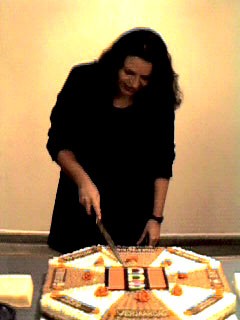
'Mayor' Marleen Stikker cuts the cake in celebration of the first year anniversary


The site
DDS was heavily promoted in the media as well as with citizens and in institutes like old folks homes by the virtual mayor of the digital city, Marleen Stikker. Once DDS was on its way, it got support to continue from the municipality of Amsterdam, grants from the ministry of Economic Affairs and the ministry of Internal Affairs and sponsorship deals. But after a year free access to Internet DDS had to close this facility. In one year DDS attracted 10.000 subscribers and by 1997 DDS had 50.000 subscribers.


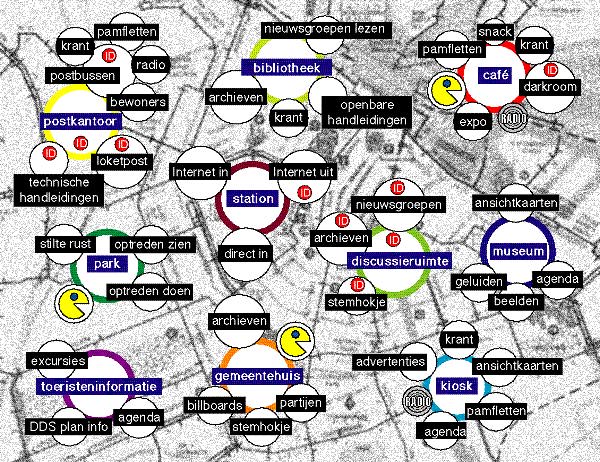
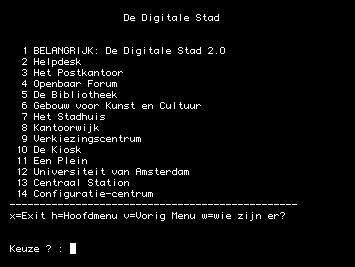
The development of the interface from a first not executed design of the digitalcity (top), the first textual screen (middle) and the first graphical screen (under)

 
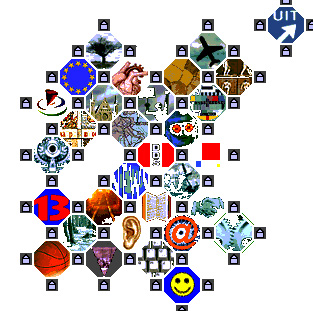
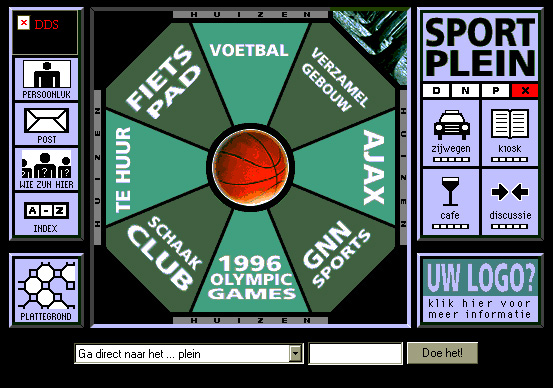
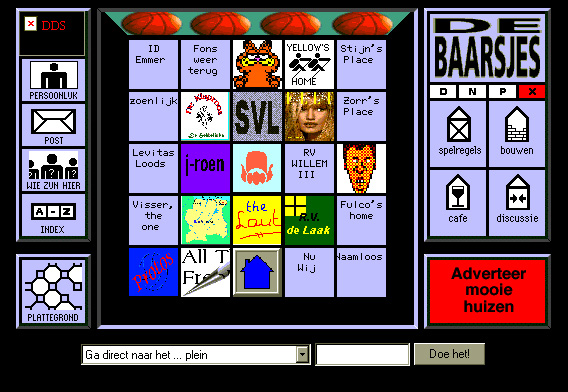
The first version of DDS was a textual interface. But this changed, when on October 15, 1994 the world wide web interface was introduced. This was a bold graphic interface, which brought out the virtual city elements such as squares and buildings as well as homes. By 1997 around 6500 subscribers had an own home, of whom 1500 inhabitants had their own front door. Besides visitors, DDS also had inhabitants, who could build their own house for free with 5Mb; they also received an e-mail address for sending mails in and outside the virtual city. Inhabitants could also accept another fantasy identity, but this could always be checked. They could also see where other people were in the city and talk to them, while in cafes they could chat with each other.


The Sports Square (left) and De Baarsjes neighbourhood with houses in the middle (right)

 
By the end of the millennium DDS did have trouble to cover debts and the board decided to change the foundation into a limited company. DDS became part of the commercial ISPs. This transition solicited a lot of emotions from inhabitants and led to a schism, named the only genuine digital city (DeDS).


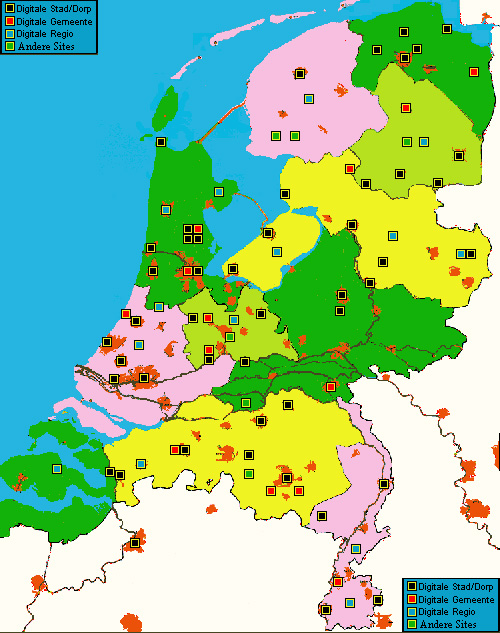
A map of the Netherlands with digital regions, digital cities and villages


Digital cities
DDS was the first digital city in the Netherlands. But soon digital regions, cities and villages popped up like mushrooms and usually died as fast as they came up. In 1986 Wegener and later on VNU Newspapers launched City Online, a project designed by Maurice de Hond. The format looked similar to that of Digital City Amsterdam, complete with houses for inhabitants. It was an expensive project, which was dependent on the goodwill of the editor-in-chief of the printed newspaper in the city or region. City Online never really took off and by January 1, 1988 the project was over. Presently regional newspapers still experiment with digital cities, villages and regions e.g. 010 in Rotterdam andDichtbij (Near) in Enschede.


Web archeology project
An archive of Digital City Amsterdam was created, when the foundation changed into a limited company. But in 2016 the web archeology project, RE: DDS, was set up by De Waag, a foundation operating at the intersection of science, technology and arts, Amsterdam Museum, the Free University and the University of Amsterdam. The recovered digital devices, magnetic tapes and CDs and were able to emulate software even to a presentation level. One of the results of the RE: DDS project was the FREEZE! manifest.


Celebration 
Ther will be a celebration in Amsterdamat the Public Library. The former virtual mayor will speak and address the pressure on the public character of the internet: "Internet companies enter the public space of the city and also put the public character of the Internet under pressure. The digital public space that we saw before us 25 years ago is now a 'market place', where power is centralized in a handful of large companies with a data hunger that seems unstoppable. Can the mores of these companies be combined with the values of our society? And who actually determines the rules, now that online and offline are becoming increasingly interwoven?"


Wednesday, May 01, 2013

BPN 1634: Twenty years internet access for Dutch consumers

It is not clear who the first Dutch supplier of Internet access for consumers was. In 1992 there were only 239 companies users of the internet systems of service providers (ISPs) such as XS4ALL, NLnet, Knoware and IAE. For example, a company would pay for a subscription 100 guilders  (45.50 euros) to XS4ALL. The number of companies connected to the Internet was not large, because the internet online system was only known by small group of entrepreneurs, mostly university graduates. Entrepreneurs outside this group did not have any idea of ​​the Internet and were linked to other systems such as Videotex Netherlands, ASCII databases and email systems as Low Cost Linking.
The  ISPs were really yet interested in consumers. The ISPs did not have the marketing machines and helpdesks. If a consumer accidentally wandered by and wanted to have a subscription, h/she would get it, but without a manual. All that started to change in 1992.
XS4ALL arose from the organization Hack-Tic, a group of people that exchanged hackers tricks, tips and files with each other. The organization initially made use of the facilities of the University of Amsterdam. But the university stopped the group from using its computernetwork. So that was the time Hac-Tic started  the foundation XS4ALL.


From 1992 XS4ALL started to accept members of the Hobby Computer Club (HCC) besides companies. And early 1993 the management decided to accept consumers. So 20 years ago on May 1, 1993 XS4ALL started to offer consumers access to its servers for 30 Dutch guilders (roughly 13 euro) a month . XS4ALL was the first ISP who started to take consumers seriously. They management predicted that  50 subscribers would sign on the first day. By the evening of May 2nd, 1993 at 19.00h the ISP had registered 500 consumers. There was clearly a need for internet among consumers. The first wave of consumer subscribers might have been helped by an article about internet, which was published in the Dutch national morning daily De Volkskrant that day.
From May 1, 1993 the number of subscriptions to Internet for consumers increased steadily, but not by the hundreds. Until later in the year XS4ALL started to collaborate with the political and cultural centre De Balie in the project and the Digital City in Amsterdam. The project had been devised to promote the municipal elections in the spring of 1994. Apart from the local television, radio and print media, the Digital City would be part of the public debate. On Monday, January 17th 1994 the Digital City opened its doors. This project caught the fascination of  many of the  national media wonder and as a side effect  it generated a lot of publicity for internet. In 1994 alone this project generated eight television and radio fragments, starting with an interview with Frank de Grave and the mayor of the Digital City Marleen Stikker in the 8 o'clock news on January 15, 1994 according to the database of Sound and Vision. After six weeks the project had tallied up more than ten thousand registered users.
In 1996 the foundation created a company, which was sold to the incumbent telecom operator KPN in 1998. However XS4ALL remained independent as a subsidiary and now offers various internet access services such as ADSL, SDSL and fibre and via KPN information and entertainment packs.

Wednesday, July 02, 2008

BPN 1146 The last days of Planet.nl


One of the oldest ISPs in the Netherlands Planet Internet will be phasing out this month and be transformed into KPN Vandaag (Today). The exercise is part of a rebranding strategy of the telecom company KPN. The make-over has been prepared since the beginning of the year and will be definite by August. Technically nothing changes for the Planet subscriber as he/she will maintain the same e-mail address and can use the same access code as well as password.

KPN has been working on its brand strategy.This has lead to the merging of services and brands. Brands as Tiscali and Speedlinq merged into the low-end market brand Telfort. Now Planet and KPN ADSL will merge into KPN Vandaag. So far the telephony brands Simyo, Hi and Ay Yildiz will continue in the market. Also the ISP XS4ALL will remain independent; merging this ISP would create havock, as the ISP has been one of the best, most progressive and the most independent Dutch ISPs.

Planet Internet was one of the first consumer ISPs, but it distinguished itself right from the beginning. The existing services such as Nlnet, XS4ALL, Knoware and Euronet*Internet offered all access to the Internet highway, but did not provide the users with maps. A complete new approach came from Michiel Frackers (see phtograph on the cover of hi book In search for the Holy Grail), a a graduate in communication science. Together with some other students he developed a business plan, which was refined by Maarten van de Biggelaar, the managing director of the publishing company Quote, where Frackers had been an intern.
The service should become a consumer service or even better an online publishing company. The service was new as it offered content, online access and marketing. In other words, consumers would get road maps, passed on by a editorial staff, consisting of cybrarians (a term coined in 1993 by Michel Bauwens, an former BP information manager in Antwerp). Journalists of the first hour were Francisco van Jole and Peter Olsthoorn. Another partner in the venture was KPN, which provide money and telecom facilities. The marketing knowledge came from the magazine publisher Quote and newspaper publisher De Telegraaf. This led to a first month free starter pack in bookshops and newspaper booths.

The service became operational on June 20, 1995. A subscription for six hours was 26,95 Dutch guilders (roughly 13,50 euro) with every additional hour 4,95 Dutch guilder. By October 1995 a country wide telecom network was realised and the service had picked up already more than 14.000 subscribers and was the largest Dutch ISP. On January 1997 Planet Internet merged with World Access into World Access/Planet Internet, starting the consolidation phase and a spade of Internet illerate managers. The publishers Quote and De Telegraaf left as ashareholders as well as many of the employees of the first hour, among which the founder Michiel Frackers.

By 1999 the name was shortened to Planet Internet. The service had 300.000 paying subscribers and by 2002 the number rose to 665.000. They yer 2002 was a year for plans: cooperative projects such as Planet Travel and Planet Money. There were also expansion plans to Great Britain, Germany and Belgium. But all these plans failed.

Over the years Planet Internet lost in importance. The quality of the news service went down, while other better news service were started up. The traffic went down. In 2005 Planet.nl attracted 57 million visitors monthly, while two years later the number went down to 19 million monthly. But the traffic number recoverd a little bit by January 2008 with 22 million visitors.

With the make-over of the branding the names Planet Internet and Planet.nl will be ready for the weblog museum. The service will be remembered for its initial excellence in online journalism.

Blog Posting Number: 1146

Tags: online journalism