Glass fibre is still hot topic in The Netherlands. Sometime ago many municipalities such as Amsterdam, The Hague, Rotterdam and Utrecht ordered a study about a glass fibre net, the costs, the financing and the organisation from a lobby group, which promoted the investment by the local authorities for the sake and benefit of Dutch economy. In the meantime things are changing. After that the EC ordered the municipality of Appingendam not to use money from the municipality for the network, things started to change. The municipality of Amsterdam planned also a glass fibre network for the city and its inhabitants. It manipulated the process for companies to quote and eventually became a small participant in the project of connecting 40.000 houses in first instance. Last year the first citizens’ fibre network became reality in Nuenen, close to Eindhoven. In this small suburb, a network was installed, officially with private money, but also supported by grants from local and national government. Now more initiatives are undertaken, claiming private financing.
The latest claim comes from Deventer, a city where the publisher Kluwer started its business. The municipality has announced that it will be the first city on glass by 2009, having connected at that time more than 40.000 households at a price of 55 million euro. The construction costs of the network Y-3network are for the company which offers the fast symmetric connections of 20Mbps; the subscribers will eventually pay 49,50 euro.
The chosen economic model has been christened the Deventer model and is unique in as far as it does not ask the municipality for money to lay the network. A housing organisation and Reggefiber will operate the network and lease capacity to service operators.
The Deventer project is also interesting because of its objective. Amsterdam and the other Dutch cities were advised to start glass fibre network as this would be good for the economy and would put The Netherlands at the top of Europe as a knowledge society. The Deventer project has more a social objective. Besides the triple play application of television, internet and telecom, tele-applications for living, working, education, recreation, social and medical care are focussed upon. Glass fibre will make tele-surveillance possible remote education, but especially social and medical care. By 2010 The Netherlands will have 4 million people older than 65 years. This will mean a lot of loneliness for many citizens as their children is living somewhere else. Camera skyping with seniors will undoubtedly be one of the applications (a mobile skype device with built-in camera and simple interface should be developed for senior citizens for daily contact with their children and grand children as well as with relatives and friends!).
The Deventer network will also be connected to the municipal network of the town hall, schools, social and medical institutes; the network will also be linked to firms.
The decision to roll out the fibre network has been taken after a pilot. Here the basic package of internet, telecom and television were offered, but will be extended with a digital platform for digital television, including HDTV quality and for local initiative from churches, sports organisations and care initiatives.
Tags: glass fibre
RSS feed: http://buziaulane.blogspot.com/rss.xml
Blog Posting Number: 606
Saturday, December 16, 2006

Friday, December 15, 2006
One million subscribers cable digital television
The distribution of digital television has gone into a new phase last Sunday night when the television signal went from analogue to digital. Presently there are three distribution networks in The Netherlands: Digital Broadcast terrestrial (DBV-T), which is used for Digitenne; IPTV through ADSL; digital cable television.
Beginning of December the 1 million milestone was reached by the cable distributors. The branch organisation of Dutch cable operators VECAI announced that 1 million subscribers had been booked. CanalDigital did reach the 1 million milestone a few months ago. Digitenne had 245.000 subscribers last September. In total 2,450.000 subscribers. The penetration has gone fast. In 1,5 years the target group grew from 380.000 subscribers to 2,450.000 viewers of digital television.
The most successful cable operator was CaiW, the operator working around The Hague. With an offer of 48 television stations and 24 radio stations, it has been able to convert 80 per cent of its analogue audience to digital television; 88.000 households went digital. The real trick lies in the offer. The analogue package offer was diminished by 20 channels. The digital decoder is offered at delivery costs, while the costs of the digital package are the same of the analogue standard package. Subscribers paid in fact only the delivery costs. The last 20 percent is happy with its limited offer.
Digital television not only offers better quality of image, but offers also more choices. The behaviour changes by the broader offer. Viewers look closer to programs of their interest. Besides they like to put together their television evening using the electronic program guide (epg).
Digital television is important for the cable operators, as they need more revenues. They invest heavily in an triple play infrastructure. The networks have to be upgraded to transmit a stronger signal for digital television and to offer the promised capacity to internet subscribers. Also the telephone infrastructure listens very closely as the competition is on with the incumbent KPN’s fixed network, which is loosing subscribers rapidly. Besides the cable operators will have to compete with the glass network of KPN in two years.
Tags: telephone, digital television
RSS feed: http://buziaulane.blogspot.com/rss.xml
Blog Posting Number: 605
Beginning of December the 1 million milestone was reached by the cable distributors. The branch organisation of Dutch cable operators VECAI announced that 1 million subscribers had been booked. CanalDigital did reach the 1 million milestone a few months ago. Digitenne had 245.000 subscribers last September. In total 2,450.000 subscribers. The penetration has gone fast. In 1,5 years the target group grew from 380.000 subscribers to 2,450.000 viewers of digital television.
The most successful cable operator was CaiW, the operator working around The Hague. With an offer of 48 television stations and 24 radio stations, it has been able to convert 80 per cent of its analogue audience to digital television; 88.000 households went digital. The real trick lies in the offer. The analogue package offer was diminished by 20 channels. The digital decoder is offered at delivery costs, while the costs of the digital package are the same of the analogue standard package. Subscribers paid in fact only the delivery costs. The last 20 percent is happy with its limited offer.
Digital television not only offers better quality of image, but offers also more choices. The behaviour changes by the broader offer. Viewers look closer to programs of their interest. Besides they like to put together their television evening using the electronic program guide (epg).
Digital television is important for the cable operators, as they need more revenues. They invest heavily in an triple play infrastructure. The networks have to be upgraded to transmit a stronger signal for digital television and to offer the promised capacity to internet subscribers. Also the telephone infrastructure listens very closely as the competition is on with the incumbent KPN’s fixed network, which is loosing subscribers rapidly. Besides the cable operators will have to compete with the glass network of KPN in two years.
Tags: telephone, digital television
RSS feed: http://buziaulane.blogspot.com/rss.xml
Blog Posting Number: 605
Thursday, December 14, 2006
One mobile per child
 Recently Nicholas Negroponte came to the ITU Telecom World 2006 in Hong Kong in order to promote his One Laptop per Child campaign. These days he is not travelling around any longer with a not-working prototype of the $100 computer as the first ones have rolled off the production line. At the conference in Hong Kong Negroponte said that he hoped to distribute between three and five million of these innovative laptops to children in six developing countries in 2007. The project has had its critics, both from the developed and developing world. But Negroponte is certain he is on the right track and makes a very compelling point. This is an education project, not a laptop project. As he said in an interview here for silicon.com: ‘People say if a child is malnourished, he doesn’t have drinking water, he’s sick, why do you want to give him a laptop? Substitute the word ‘education’ for ‘laptop’ and you will never ask that question again.’
The One Laptop per Child has its followers. Presently the telecom company Celtel International, based in Hoofddorp, The Netherlands is looking into a $10 mobile phone. The company is active with telecom and especially mobile in the African continent. Recently I met a representative of Celtel and had a talk about the project. He insisted that the company is looking into the project and has not yet taken the decision to have the mobile phone produced and rolled out. The company is presently researching the production methods and talking to mobile phone and chip manufacturers.
The plan of One Mobile per Child – it is not a project yet – has its advantages and his critics. The advantage would be to stimulate the mobility and the economy of Africa. Despite the fact that a heavy investment will be needed, the mobile roll out would be cheaper than creating a fixed line infrastructure. Setting up a mobile infrastructure with masts takes less time than digging ducts. The plan could also contribute by micro-education, learning by mobile phone. But this plan has also its critics. Of course the plan would upset the growth curve of the mobile phone companies in Africa. Now it still is seen as a growth area. But the companies would also look at the fraud aspect. How do you ensure that these cheap mobiles get to the right people and prevent fraud. The Negroponte project had a solution for that: the colour of the computer. The computer had a kind of green radio-active colour, which made them hard to sell on the market, so the organisers reasoned. A similar idea could be used in this plan.
Tags: mobile
RSS feed: http://buziaulane.blogspot.com/rss.xml
Blog Posting Number: 604
Wednesday, December 13, 2006
Google searchers don’t scroll any longer
Google searchers have grown lazy. No longer do they scroll down the page in search of a proper answer. That is the result of a study among a panel, which got 450 search assignments. Using eye tracking the eye movements of the panel members could closely be watched. In 48 percent of 14.000 executed searches the user got no further than the first page. The rest of the pages were not consulted nor were the advertisements looked at.
Researchers blame the users, who are getting lazy. As soon as the first page does not contain relevant information, a new search is launched. This should have effects on advertisement positions as well as on optimalisation of advertisements on pages and on costs.
Since the arrival of Google, searchers have received many references on a simple question. This is caused by duplication of documents and the Boolean search criteria. The search engines have become marketing tools and are no longer search tools. Precision and recall are not exactly the objectives of a search engine like Google.
Recently two Dutch PhD students Bas van Gils and Paul de Vrieze, took the position in their thesis that Google should be like an experienced librarian, who understand what information is adequate at a particular moment. Now Google throws many references to the questioner, but computers systems and algorithms should adopt themselves to the users. Search systems should assist users in finding the proper information at the right time and in the right form. If a users searches for information on a mobile, the search system should understand that it should not return loads of results for a small screen. If there is no media player on a computer, the search system should not return references to audio and video. Also personal characteristics of the searcher (young/old, education, employment or study etc.) should be taken into account.
Bas van Gils developed a method to to evaluate the information better. He used an economic model by seeing the world wide web as an information market, where users spend money for finding valuable information. Search engines are in this model brokers. They have a profile of the party which asks for information. This broker uses characteristics as subject, form, format, language, length of document to evaluate the relevance of a document for this user in his particular situation. He pleads to separate form and content.
Paul de Vrieze developed a model for adapative personalisation which works for all kinds of software. With the adaptation engine various applications, including search engines can work together without the loss of privacy sensitive data. He puts the adaptation engine with the data between the user and the software
Both developments yield more precise and relevant data and let the searcher be in command.
Tags: searching
RSS feed: http://buziaulane.blogspot.com/rss.xml
Blog Posting Number: 603
Researchers blame the users, who are getting lazy. As soon as the first page does not contain relevant information, a new search is launched. This should have effects on advertisement positions as well as on optimalisation of advertisements on pages and on costs.
Since the arrival of Google, searchers have received many references on a simple question. This is caused by duplication of documents and the Boolean search criteria. The search engines have become marketing tools and are no longer search tools. Precision and recall are not exactly the objectives of a search engine like Google.
Recently two Dutch PhD students Bas van Gils and Paul de Vrieze, took the position in their thesis that Google should be like an experienced librarian, who understand what information is adequate at a particular moment. Now Google throws many references to the questioner, but computers systems and algorithms should adopt themselves to the users. Search systems should assist users in finding the proper information at the right time and in the right form. If a users searches for information on a mobile, the search system should understand that it should not return loads of results for a small screen. If there is no media player on a computer, the search system should not return references to audio and video. Also personal characteristics of the searcher (young/old, education, employment or study etc.) should be taken into account.
Bas van Gils developed a method to to evaluate the information better. He used an economic model by seeing the world wide web as an information market, where users spend money for finding valuable information. Search engines are in this model brokers. They have a profile of the party which asks for information. This broker uses characteristics as subject, form, format, language, length of document to evaluate the relevance of a document for this user in his particular situation. He pleads to separate form and content.
Paul de Vrieze developed a model for adapative personalisation which works for all kinds of software. With the adaptation engine various applications, including search engines can work together without the loss of privacy sensitive data. He puts the adaptation engine with the data between the user and the software
Both developments yield more precise and relevant data and let the searcher be in command.
Tags: searching
RSS feed: http://buziaulane.blogspot.com/rss.xml
Blog Posting Number: 603
Tuesday, December 12, 2006
iLiad and De Tijd eNewsPaper (close)
Overlooking the summaries of the research and the PDF presentation of De Tijd eNewsPaper pilot, a general picture starts to become clear.
This was a live pilot of a new device, which has been destined for rendering newspapers and books. It has not been a small pilot as 200 people, selected out of a group of 500 interested people, have participated in the pilot. More than 60 issues were published for this pilot during 2,5 months, giving the publisher and the telco the assurance that it worked. What did we learn?
The research results show many a detail such as a SWOT analysis, activities or better a lack of activities by interactive users and usability points. In general, the results are almost obligatory. The pilot was performed for more than 60 days; it worked and despite some small remarks on the usability of the iLiad, the experiment was successful. However the iLiad will only be used in the remote future.
I personally think that two main questions have been left unanswered. One question is the multi-functionality of the device and the audience. The other question is about the audience.
Multi-functionality
The iLiad however is limited in its purpose. It is a text iPod, storing documents such as newspapers, books and manuals for reading. In surveys taken in the past with electronic books every time the single purpose of the e-book readers was see as a problem. E-book readers were expensive for the single function they performed: rendering the texts and illustrations.
In these surveys the e-books were compared with PDAs, the multi-functional devices, which have been extended with mobile facilities these days.
Granted the iLiad has wireless connectivity, which has not been used to the fullest yet. Also the annotation/writing facility has not been tested in De Tijd experiment. But this writing facility will not turn the iLiad into a PDA.
I have likened the iLiad to an iPod. So far the iPod has proven to be a single music device. And yet, contrary to a PDA, it has sold like crazy. So why should a text iPod not sell like crazy? In an earlier instalment I have indicated that a number of conditions are needed for success: a promoter, reasonable prices of the devices and of the content and ease of distribution. With the iLiad and similar devices (even the Sony e-book) they clearly lack a promoter and a reasonable price for the device so far.
Audience
In an earlier instalment I have indicated that the pilot group of users of De Tijd were early adopters: highly educated business men, who were versatile with computers. So this pilot group of users can be seen as the pioneers of this device; on the other hand they prove that the device is not ready yet for a general roll-out.
So will it work with an audience of a general newspaper? I guess that the versatility with computers of such an audience is lower than De Tijd pilot group. Besides it is clear that the need to know the news is less lower. It will be interesting to see what the results will be of the Dutch consortium, which will be a follow up to De Tijd experiment.
So far the iLiad has proven that it the screen is an absolute pleasure to the eye. But from De Tijd experiment it is also clear that the iLiad is something of the remote future. It is not a break-through for the publishing industry like the iPod was for the music industry. The big question is now how remote is remote: short term, middle long term or long term?.
Tags: iliad, irex, e-book, e-ink, e-reader, newspaper
This was a live pilot of a new device, which has been destined for rendering newspapers and books. It has not been a small pilot as 200 people, selected out of a group of 500 interested people, have participated in the pilot. More than 60 issues were published for this pilot during 2,5 months, giving the publisher and the telco the assurance that it worked. What did we learn?
The research results show many a detail such as a SWOT analysis, activities or better a lack of activities by interactive users and usability points. In general, the results are almost obligatory. The pilot was performed for more than 60 days; it worked and despite some small remarks on the usability of the iLiad, the experiment was successful. However the iLiad will only be used in the remote future.
I personally think that two main questions have been left unanswered. One question is the multi-functionality of the device and the audience. The other question is about the audience.
Multi-functionality
The iLiad however is limited in its purpose. It is a text iPod, storing documents such as newspapers, books and manuals for reading. In surveys taken in the past with electronic books every time the single purpose of the e-book readers was see as a problem. E-book readers were expensive for the single function they performed: rendering the texts and illustrations.
In these surveys the e-books were compared with PDAs, the multi-functional devices, which have been extended with mobile facilities these days.
Granted the iLiad has wireless connectivity, which has not been used to the fullest yet. Also the annotation/writing facility has not been tested in De Tijd experiment. But this writing facility will not turn the iLiad into a PDA.
I have likened the iLiad to an iPod. So far the iPod has proven to be a single music device. And yet, contrary to a PDA, it has sold like crazy. So why should a text iPod not sell like crazy? In an earlier instalment I have indicated that a number of conditions are needed for success: a promoter, reasonable prices of the devices and of the content and ease of distribution. With the iLiad and similar devices (even the Sony e-book) they clearly lack a promoter and a reasonable price for the device so far.
Audience
In an earlier instalment I have indicated that the pilot group of users of De Tijd were early adopters: highly educated business men, who were versatile with computers. So this pilot group of users can be seen as the pioneers of this device; on the other hand they prove that the device is not ready yet for a general roll-out.
So will it work with an audience of a general newspaper? I guess that the versatility with computers of such an audience is lower than De Tijd pilot group. Besides it is clear that the need to know the news is less lower. It will be interesting to see what the results will be of the Dutch consortium, which will be a follow up to De Tijd experiment.
So far the iLiad has proven that it the screen is an absolute pleasure to the eye. But from De Tijd experiment it is also clear that the iLiad is something of the remote future. It is not a break-through for the publishing industry like the iPod was for the music industry. The big question is now how remote is remote: short term, middle long term or long term?.
Tags: iliad, irex, e-book, e-ink, e-reader, newspaper
RSS feed: http://buziaulane.blogspot.com/rss.xml
Blog Posting Number: 602
Monday, December 11, 2006
iLiad and De Tijd eNewsPaper (6)
Looking at the summary of the results of the research Group for media and ICT, it can be said that the SWOT analysis at the beginning of the project is basically an obligatory action. The iLiad was compared to the existing printed newspaper on the one hand and had a remarkable screen and wireless facilities. On the other hand it was compared to online ePapers and found equalling in offering new possibilities. I am not as convinced on this point as newspapers delivered through broadband have the possibility of playing out video; a facility not existing on the reading machine presently and most likely not in the immediate future, given the page- and the consequent power orientation.
I personally think that the iLiad is comparable to the printed edition. Yet it is smaller (A5 format), has wireless facilities for delivering and updating (which is not scoring high) and has interactive facilities to be used for navigating. It can also be compared to PDA edition of newspaper.
It is depressing to read that the advertising industry was invited to participate in the project, but did not show up. Only 14 per cent of the 392 invited persons responded and partook. Of course this says something about the Belgian advertising industry. On the other hand it says also something about advertising on the iLiad. Making an iLiad advertisement interactive is not really interesting as the interactivity is only used for navigation; it will for example not be possible to produce an interactive advertgame for the iLiad, given the page and power orientation. Responding to an advertisement would mean that the wireless should be used as a return channel; this could be an opportunity, which would have to be organised by the newspaper.
To me, it is clear that the page and power orientation are a limitation to full interactivity of the iLiad in a such a way that it will not be able to compared with the interactivity of a non-PDF newspaper site. It can be compared with a PDF edition of newspapers, but instead of being delivered online it is delivered offline by wi-fi.
IBBT
IBBT ePaper Project – Media and ICT (MICT)
The Research Group for Media and ICT (MICT) was responsible for two research tasks.
At the beginning of the project, MICT-IBBT conducted a SWOT analysis of the ePaper concept on the basis of a literature review. Concerning the potential of the digital ‘e-paper’ to substitute printed newspapers, the study pointed at the critical condition that the new medium should offer the same qualities and the same ‘look and feel’ as print media, so that it can compete with the old medium in terms of portability, flexibility and usability. The strengths and opportunities of the ePaper concept (‘a newspaper distributed on an e-ink display device’) lay in the combination and integration of the key benefits of print and online newspapers. Like online newspapers, the ePaper has the potential to offer new possibilities for interactivity, customization of content and audience targeting, while equalling the reading comfort of print newspapers (wireless and portable, high readability, flexibility, etc.). An additional major benefit for newspaper publishers would be, of course, the enormous reduction of costs for paper and distribution.
Secondly, MICT-IBBT focused on the expectations and needs of Belgian advertisers regarding interactive advertising in general, and the potential of the ePaper as a new advertising channel in particular. In September 2005, an online survey on interactive advertising was sent out to 392 representatives of the 152 companies, which are member of the Belgian Union of Advertisers (UBA). The respondents were asked about their experiences with interactive advertising, the benefits and constraints, and their expectations about future developments in the advertising market.
Although the response rate of 16% was too low to generalize the results to the whole
advertising sector, the survey confirmed that advertisers tend to remain slow adopters of
interactive media. Only 14% of the respondents believed that iDTV will become a major channel for advertising, and more than 80% did not find mobile applications an important channel for advertising. When focussing on interactive advertising, advertisers seem to prefer well-known channels, such as portal websites and e-mail. It is interesting to note that 60% of the respondents agreed to the statement that advertisers have a rather conservative attitude towards interactive advertising. Reach, return on investment (ROI) and cost-efficiency are still the most important parameters to evaluate the effectiveness of advertising campaigns. Lack of information about interactive advertising and about the return on investment (ROI) was seen as major barriers to invest in interactive advertising. About 40% of the respondents said that interactive advertising is still ‘too new’; a similar group believes that the formats for interactive advertising are still insufficient, whereas a quarter of the respondents find that interactive advertising campaigns are often not creative enough.
On the other hand, the members of the UBA also identified some major opportunities. The
opportunities in targeting and personalization of advertisements, the direct relation that can be built with the consumers and the fact that the effect of campaigns is measurable are the three most important advantages of interactive advertising media. The respondents are less convinced that interactive media will provide more possibilities in multimedia and creativity. In general, the questions about the future of interactive advertising show that new media are a major challenge for all advertisers. 9 out of 10 respondents agreed that it will become more important in the interactive media environment to know where, when and how the target group can be reached in the best possible way.
Tags: iliad, irex, e-book, e-ink, e-reader, newspaper
RSS feed: http://buziaulane.blogspot.com/rss.xml
Blog Posting Number: 601
I personally think that the iLiad is comparable to the printed edition. Yet it is smaller (A5 format), has wireless facilities for delivering and updating (which is not scoring high) and has interactive facilities to be used for navigating. It can also be compared to PDA edition of newspaper.
It is depressing to read that the advertising industry was invited to participate in the project, but did not show up. Only 14 per cent of the 392 invited persons responded and partook. Of course this says something about the Belgian advertising industry. On the other hand it says also something about advertising on the iLiad. Making an iLiad advertisement interactive is not really interesting as the interactivity is only used for navigation; it will for example not be possible to produce an interactive advertgame for the iLiad, given the page and power orientation. Responding to an advertisement would mean that the wireless should be used as a return channel; this could be an opportunity, which would have to be organised by the newspaper.
To me, it is clear that the page and power orientation are a limitation to full interactivity of the iLiad in a such a way that it will not be able to compared with the interactivity of a non-PDF newspaper site. It can be compared with a PDF edition of newspapers, but instead of being delivered online it is delivered offline by wi-fi.
IBBT
IBBT ePaper Project – Media and ICT (MICT)
The Research Group for Media and ICT (MICT) was responsible for two research tasks.
At the beginning of the project, MICT-IBBT conducted a SWOT analysis of the ePaper concept on the basis of a literature review. Concerning the potential of the digital ‘e-paper’ to substitute printed newspapers, the study pointed at the critical condition that the new medium should offer the same qualities and the same ‘look and feel’ as print media, so that it can compete with the old medium in terms of portability, flexibility and usability. The strengths and opportunities of the ePaper concept (‘a newspaper distributed on an e-ink display device’) lay in the combination and integration of the key benefits of print and online newspapers. Like online newspapers, the ePaper has the potential to offer new possibilities for interactivity, customization of content and audience targeting, while equalling the reading comfort of print newspapers (wireless and portable, high readability, flexibility, etc.). An additional major benefit for newspaper publishers would be, of course, the enormous reduction of costs for paper and distribution.
Secondly, MICT-IBBT focused on the expectations and needs of Belgian advertisers regarding interactive advertising in general, and the potential of the ePaper as a new advertising channel in particular. In September 2005, an online survey on interactive advertising was sent out to 392 representatives of the 152 companies, which are member of the Belgian Union of Advertisers (UBA). The respondents were asked about their experiences with interactive advertising, the benefits and constraints, and their expectations about future developments in the advertising market.
Although the response rate of 16% was too low to generalize the results to the whole
advertising sector, the survey confirmed that advertisers tend to remain slow adopters of
interactive media. Only 14% of the respondents believed that iDTV will become a major channel for advertising, and more than 80% did not find mobile applications an important channel for advertising. When focussing on interactive advertising, advertisers seem to prefer well-known channels, such as portal websites and e-mail. It is interesting to note that 60% of the respondents agreed to the statement that advertisers have a rather conservative attitude towards interactive advertising. Reach, return on investment (ROI) and cost-efficiency are still the most important parameters to evaluate the effectiveness of advertising campaigns. Lack of information about interactive advertising and about the return on investment (ROI) was seen as major barriers to invest in interactive advertising. About 40% of the respondents said that interactive advertising is still ‘too new’; a similar group believes that the formats for interactive advertising are still insufficient, whereas a quarter of the respondents find that interactive advertising campaigns are often not creative enough.
On the other hand, the members of the UBA also identified some major opportunities. The
opportunities in targeting and personalization of advertisements, the direct relation that can be built with the consumers and the fact that the effect of campaigns is measurable are the three most important advantages of interactive advertising media. The respondents are less convinced that interactive media will provide more possibilities in multimedia and creativity. In general, the questions about the future of interactive advertising show that new media are a major challenge for all advertisers. 9 out of 10 respondents agreed that it will become more important in the interactive media environment to know where, when and how the target group can be reached in the best possible way.
Tags: iliad, irex, e-book, e-ink, e-reader, newspaper
RSS feed: http://buziaulane.blogspot.com/rss.xml
Blog Posting Number: 601
Flash: The Dutch step into the digital era
 It is 00.01 a.m. In another half hour the Dutch take a leap into the digital era. From now on Dutch TV will be distributed digitally. Distribution of TV signals on the basis of Digital Video Broadcast Terrestrial (DVB-T) protocol will be 11 million euro a year cheaper, while on the other hand more digital channels will become available.
The Netherlands is one of the first countries going digital TV. This is possible as most Dutch households receive cable TV, inclusing 1 million households are digital TV. All public broadcast companies will distribute their broadcasts uncode, free to air without a smart card or a subscription.
In total some 220.000 households will be unable to receive the digital TV signals: 74.000 households and the rest recreational venues (boats, recreational homes). They will not receive any broadcast, unless they buy a decoder to receive the public broadcasts, a subscription to Digitenne, the KPN digital TV distribution organisation, or digital satellite.
Does it change anything? We will not notice anything as our household is on the cable with UPC. The present cable signal is lousy and snowy since a week. A complaint to the customer service of UPC a week ago and a visit of an engineer, who checked the in-house situation, have not changed the situation, as the block signal has gone weak (most likely due to some fiddling of a UPC engineer on the blockhead). In short, things change when UPC has the intention and time to do so. Service to the customer; forget it.
BTW This is the 600th posting since May 1, 2005. Every day one or more postings have been launched ever since.
Tags: digital TV, UPC
RSS feed: http://buziaulane.blogspot.com/rss.xml
Blog Posting Number: 600
Sunday, December 10, 2006
iLiad and De Tijd eNewsPaper (5)
During the iLiad trial, the ePaper project DuistriNet was launched; basically it investigated the management of digital usage rights. The press release starts with the statement that Digital Rights Management is the main challenge for publishers. The research focussed among other things on the right to read tye news paper for a certain time. DRM systems can set a time limit for readers. In practice it means that a reader can be granted permission to read the newspaper for 24 hours after which deadline the edition deletes itself.
The press release is unclear about the area of DRM. I take it that it DRM as protection has been of the entire edition has been the subject of study. I guess that the researchers have not looked into saving for example a series with instalments; saving the articles of an series, could have been a marketing exercise. I was wondering whether the advertisers had also been involved ion this part of the study. Of course they could have experimented with an offer for a limited period.
DRM has developed since 1996 for text products. So far protection has been the main driever in the usage of it. The marketing facilities have hardly been experimented with on a large scale in emagazines, enewspapers and ebooks. From this experiment the newspaper publishers can conmclude that it seems more efficient to reuse generic DRM building blocks, and it is unrealistic to dream of a single ‘complete’ DRM system.
IBBT
IBBT ePaper Project – DistriNet
In the context of the ePpaper project, the DistriNet research group of the K.U.Leuven has realized a study that investigates how to extend the software platform of the publisher in order to facilitate management of digital usage rights.
What is digital rights management?
Managing and enforcing digital usage rights (Digital Rights Management or DRM) is a complex task to achieve – think for instance of illegal downloading of mp3 music files from the Internet.
DRM systems allow for instance to specify a usage model that enables consumers to read a digital news paper for an indefinite period of time, but only on a specified set of devices. DRM techniques make use of digital watermarks that identify the consumer what enables to trace abusers.
Main challenges for publishers
It is, by consequence, crucial for publishers like De Tijd to ensure protection of copyrights associated with digital content of high commercial value. Such content should only be consumed as prescribed by the subscription of the consumer.
Given the rapid evolution of DRM technologies, it is not preferable and still too early to decide once and for all which DRM technology is most suited to be integrated in the ICT platforms of the publisher. By consequence, publishers do not want, and cannot bind to one specific DRM technology.
DistriNet contribution
DistriNet has analyzed the design of current DRM systems. Many of them support the same or similar features next to a number of specific extensions. It seems more efficient to reuse generic DRM building blocks, and it is unrealistic to dream of a single ‘complete’ DRM system. Combining is the key message.
Based on this analysis, DistriNet has designed a software architecture that isolates common building blocks and that documents how they can cooperate. This study has resulted in a blueprint for DRM systems that facilitates to compose DRM systems from available software components. The proposed software architecture has been further refined to support the development of proof-of-concept prototype implementations.
Tags: iliad, irex, e-book, e-ink, e-reader, newspaper
RSS feed: http://buziaulane.blogspot.com/rss.xml
Blog Posting Number: 599
The press release is unclear about the area of DRM. I take it that it DRM as protection has been of the entire edition has been the subject of study. I guess that the researchers have not looked into saving for example a series with instalments; saving the articles of an series, could have been a marketing exercise. I was wondering whether the advertisers had also been involved ion this part of the study. Of course they could have experimented with an offer for a limited period.
DRM has developed since 1996 for text products. So far protection has been the main driever in the usage of it. The marketing facilities have hardly been experimented with on a large scale in emagazines, enewspapers and ebooks. From this experiment the newspaper publishers can conmclude that it seems more efficient to reuse generic DRM building blocks, and it is unrealistic to dream of a single ‘complete’ DRM system.
IBBT
IBBT ePaper Project – DistriNet
In the context of the ePpaper project, the DistriNet research group of the K.U.Leuven has realized a study that investigates how to extend the software platform of the publisher in order to facilitate management of digital usage rights.
What is digital rights management?
Managing and enforcing digital usage rights (Digital Rights Management or DRM) is a complex task to achieve – think for instance of illegal downloading of mp3 music files from the Internet.
DRM systems allow for instance to specify a usage model that enables consumers to read a digital news paper for an indefinite period of time, but only on a specified set of devices. DRM techniques make use of digital watermarks that identify the consumer what enables to trace abusers.
Main challenges for publishers
It is, by consequence, crucial for publishers like De Tijd to ensure protection of copyrights associated with digital content of high commercial value. Such content should only be consumed as prescribed by the subscription of the consumer.
Given the rapid evolution of DRM technologies, it is not preferable and still too early to decide once and for all which DRM technology is most suited to be integrated in the ICT platforms of the publisher. By consequence, publishers do not want, and cannot bind to one specific DRM technology.
DistriNet contribution
DistriNet has analyzed the design of current DRM systems. Many of them support the same or similar features next to a number of specific extensions. It seems more efficient to reuse generic DRM building blocks, and it is unrealistic to dream of a single ‘complete’ DRM system. Combining is the key message.
Based on this analysis, DistriNet has designed a software architecture that isolates common building blocks and that documents how they can cooperate. This study has resulted in a blueprint for DRM systems that facilitates to compose DRM systems from available software components. The proposed software architecture has been further refined to support the development of proof-of-concept prototype implementations.
Tags: iliad, irex, e-book, e-ink, e-reader, newspaper
RSS feed: http://buziaulane.blogspot.com/rss.xml
Blog Posting Number: 599
Saturday, December 09, 2006
iLiad and De Tijd eNewsPaper (4)
The release on usability indicates that there were a number of requests for improvements which have come to light.
- visible feedback, when an action has been taken;
- the icons have to be undertstandable internationally;
- it must be possible to change the keys of the virtual keyboard from qwerty to azerty;
- representation of photographs and graphics have to be improved;
- integration of a help-function.
Also the functioning of the devices has been tested. I guess that the researchers mean that they have looked how people handle the device. They do no say anything about the hidden place of the on/off button or the wi-fi button in the right hand corner, which can mistaken for the on/off knob. Also in the design the device is not square, as the top part is supposed to symbolise a physical page. In some cases, especially with PDFs, which were not the subject of the usability test, it looks like the PDF is projected skewed. I still miss a cover/flap as protection of the screen.
I have been unable to test a newspaper myself. I received two newspaper editions by mail, but have been unable to load them due to the file structure. I would have loved to see how the newspaper itself worked. How the interactions are performed such as leafing through the pages.
I like also to remind the readers of the fact that the device was only intended to represent a newspaper edition as is. There were no extras such as sound.
IBBT
IBBT ePaper Project – Centre for Usability research (CUO)
The Centre for Usability Research was responsible for the testing, evaluating and improving the user
friendliness of the content and interface developed during the epaper project.
Usability is defined as “the extent to which a product can be used by specified users to achieve specified goals with effectiveness, efficiency and satisfaction in specified context of use” (ISO 9241-11). Users have to be able to achieve their goals and required tasks easily and fast using the developed product. Different focal points can be defined in function of the evaluation, depending on the product. A few examples of these focal points are: Can the user find the right product? Do users like to work with the software? Can users recover from their mistakes? Do users understand the used terminology?
Usability evaluation is best situated as early as possible in the development phase of the product and has to be seen as an iterative process.
In the first stage of the evaluation a user and task analysis was conducted. The task analysis was supported by three pillars, the user (not only the newspaper reader, but also the advertisers), the tasks (e.g. reading, leafing through the newspaper, searching for information,…) en the environment (at home, on the road,…).
The main intentions were not only to acquire insight in the way tasks have to be executed, but also to define the complete set of tasks and subtasks. The user’s characteristics and the different environment factors were also taken into account.
User tests were conducted for the usability evaluation of the ePaper device. Not only the functioning of the prototype was evaluated, but also the personal experience of the test users. A few focal points were e.g. the mobile characteristic of the device, the organisation of the information, the level of difficulty of the data delivery, the attractiveness of the interface,…
Through the different test situations, interesting observations arose, a few examples given below. It is necessary that the user has visible feedback when an action has been taken, e.g. when a new screen is loading. This increases the user friendliness of the device, and the user’s feelings of frustration and confusion will decrease considerable. It is also very important that an indication is given of the life expectancy of the battery on the screen. The user has to have the feeling of complete control and knowledge on how full or empty the battery is. Unclear terminology also has a negative effect on the user. This results in frustration and doubt, which then will result in the fact that users will not utilize certain functionalities, because they are not clear. The used icons and labels on the buttons have to be unambiguously understandable, and the placement of the buttons on the device has to be logical. If the device is developed for international use and a keyboard is integrated in the interface, the user has to be able to choose to have the keyboard labelled in qwerty or azerty. The photo or graphic accompanying an article was too small, not very visible and disappeared when selecting the article. This was a real bottleneck for the users, and had a very negative effect on the surplus value of the device. The possibility of viewing the photo or graphic in detail has to be offered. A help functionality has to be integrated in the device, this because the user can try to solve their problems and answer any questions they have. These are a few observations and suggestions to increase the devices’ user friendliness, which is an important factor that is directly linked to the success of any new device.
Source: IBBT, 2006
Tags: iliad, irex, e-book, e-ink, e-reader, newspaper
RSS feed: http://buziaulane.blogspot.com/rss.xml
Blog Posting Number: 598
- visible feedback, when an action has been taken;
- the icons have to be undertstandable internationally;
- it must be possible to change the keys of the virtual keyboard from qwerty to azerty;
- representation of photographs and graphics have to be improved;
- integration of a help-function.
Also the functioning of the devices has been tested. I guess that the researchers mean that they have looked how people handle the device. They do no say anything about the hidden place of the on/off button or the wi-fi button in the right hand corner, which can mistaken for the on/off knob. Also in the design the device is not square, as the top part is supposed to symbolise a physical page. In some cases, especially with PDFs, which were not the subject of the usability test, it looks like the PDF is projected skewed. I still miss a cover/flap as protection of the screen.
I have been unable to test a newspaper myself. I received two newspaper editions by mail, but have been unable to load them due to the file structure. I would have loved to see how the newspaper itself worked. How the interactions are performed such as leafing through the pages.
I like also to remind the readers of the fact that the device was only intended to represent a newspaper edition as is. There were no extras such as sound.
IBBT
IBBT ePaper Project – Centre for Usability research (CUO)
The Centre for Usability Research was responsible for the testing, evaluating and improving the user
friendliness of the content and interface developed during the epaper project.
Usability is defined as “the extent to which a product can be used by specified users to achieve specified goals with effectiveness, efficiency and satisfaction in specified context of use” (ISO 9241-11). Users have to be able to achieve their goals and required tasks easily and fast using the developed product. Different focal points can be defined in function of the evaluation, depending on the product. A few examples of these focal points are: Can the user find the right product? Do users like to work with the software? Can users recover from their mistakes? Do users understand the used terminology?
Usability evaluation is best situated as early as possible in the development phase of the product and has to be seen as an iterative process.
In the first stage of the evaluation a user and task analysis was conducted. The task analysis was supported by three pillars, the user (not only the newspaper reader, but also the advertisers), the tasks (e.g. reading, leafing through the newspaper, searching for information,…) en the environment (at home, on the road,…).
The main intentions were not only to acquire insight in the way tasks have to be executed, but also to define the complete set of tasks and subtasks. The user’s characteristics and the different environment factors were also taken into account.
User tests were conducted for the usability evaluation of the ePaper device. Not only the functioning of the prototype was evaluated, but also the personal experience of the test users. A few focal points were e.g. the mobile characteristic of the device, the organisation of the information, the level of difficulty of the data delivery, the attractiveness of the interface,…
Through the different test situations, interesting observations arose, a few examples given below. It is necessary that the user has visible feedback when an action has been taken, e.g. when a new screen is loading. This increases the user friendliness of the device, and the user’s feelings of frustration and confusion will decrease considerable. It is also very important that an indication is given of the life expectancy of the battery on the screen. The user has to have the feeling of complete control and knowledge on how full or empty the battery is. Unclear terminology also has a negative effect on the user. This results in frustration and doubt, which then will result in the fact that users will not utilize certain functionalities, because they are not clear. The used icons and labels on the buttons have to be unambiguously understandable, and the placement of the buttons on the device has to be logical. If the device is developed for international use and a keyboard is integrated in the interface, the user has to be able to choose to have the keyboard labelled in qwerty or azerty. The photo or graphic accompanying an article was too small, not very visible and disappeared when selecting the article. This was a real bottleneck for the users, and had a very negative effect on the surplus value of the device. The possibility of viewing the photo or graphic in detail has to be offered. A help functionality has to be integrated in the device, this because the user can try to solve their problems and answer any questions they have. These are a few observations and suggestions to increase the devices’ user friendliness, which is an important factor that is directly linked to the success of any new device.
Source: IBBT, 2006
Tags: iliad, irex, e-book, e-ink, e-reader, newspaper
RSS feed: http://buziaulane.blogspot.com/rss.xml
Blog Posting Number: 598
Friday, December 08, 2006
iLiad and De Tijd eNewsPaper (3)
The Belgian research institute IBBT has produced short notices on De Tijd eNewsPaper project, especially on the usability research, the DRM software, a SWOT analysis on e-paper, expectations of the advertisers and the business modelling.
Having read the releases, I selected the release Positive, but remote future as the most relevant one. I will first discuss the main thrust of the release and attach the full release.
De Tijd e-paper project researched by the IBBT revealed in what way readers want to read their daily newspaper on a digital device. Of course readers should realise that it was a study of 2,5 months and as such a snapshot, limited to the iLiad e-reader, a reading device based on the e-ink technology.
The e-reader was tested in a living lab setting by 200 test users during 2,5 months. (April-June). Each day “De Tijd” could be downloaded and read, and personal documents could be read in PDF. Some other functionalities that will be accessible in the device, e.g. the ability to take notes and to play music, were not yet available during the trial. So, during the trial the basic e-Reader was used for receiving and reading the newspaper. Lacking the sound and taking notes facilities is not a disadvantage, as it makes the print newspaper compare 1:1 with the e-newspaper.
For the test 200 trial users were selected who constituted a representative sample of “De Tijd” readers. This implied that the majority of the panel consisted of higher educated men, with high computer skills and a busy job. This statement is interesting as the profile of the trial users shows them to be early technology adaptors. This must lead to the main conclusion that launching this type of electronic newspaper and newspaper device is still too early. In the press release it is said remote future. In some of the notes there is talk of the long future.
Between long and remote there is some light for manoeuvring. Given favourable circumstances (user-friendly equipment, easy-to-download network, reasonable prices) the use of the eReader can change in a matter of a year to one and a half years. Look at how the iPod changed the music world. When did you see someone listening to his/her walkman in the last two year? The same could happen to the eReader as it no more than an iPod.
So the main question is whether the eReader is already a user-friendly device? The question about the distribution network is less important; yet the wi-fi connectivity is essential. Reasonable pricing of electronic editions (free, subscription, pay per article) is still a knotty subject in the newspaper world. Besides the newspaper companies will not make it on their own account. They need a respected promoter like Apple was for the audio iPod. Question is who that will be? As the eReader is produced by a spin-off of Royal Philips, one could think about that company as the promoter; yet despite its status as a respected multinational, it does not have content and media-affinity like Apple has. What about Apple, Google, Yahoo or Microsoft (no order of preference intended)
IBBT ePaper Project – SMIT
Positive, but remote future: The digital version of the newspaper is promising, but still has not beaten the traditional paper
In the context of the IBBT e-paper project, SMIT-IBBT1, a research centre at the Vrije Universiteit Brussel, studied in what way readers want to read their daily newspaper on a digital device.
The eReader, a reading device based on the e-ink technology with an excellent screen quality, was tested in a living lab setting by 200 test users during 2,5 months. (April-June). Each day “De Tijd” could be downloaded and read, and personal documents could be read in PDF. Some other functionalities that will be accessible in the device, e.g. the ability to take notes and to play music, were not yet available during the trial.
The 200 trial users constituted a representative sample of “De Tijd” readers. This implied that the majority of the panel consisted of higher educated men, with high computer skills and a busy job.
Especially the screen quality and the good readability was highly rated by the test clients. In contrary to normal computer screens there is little eyestrain when using the eReader for extented periods of time.
The eReader is found to be particularly handy in specific situations in which people are mobile, but in which it is not easy to read a real newspaper. The test users used their eReader for example while using public transport (rain, tram, bus) in the car (in traffic jams) and even on foot. The eReader was also seen as an ideal travel companion, with which people can download their daily newspaper abroad, and where books and travel guides can be stored on the eReader device instead of in people’s suitcases.
Despite these new uses, the test users did hold on to their old habits. Especially on weekends, the look and feel of the traditional newspaper is preferred at the breakfast table. And although the eReader is practical on holidays, people still prefer to read a real book at home. A fully stocked library does remain a status symbol. People stick to traditions, therefore it is important that the paper on the eReader delivers the same level of comfort people are used to with the traditional paper.
It is important to start from the present reading behaviour of the newspaper reader, who looks for recognisable formats. This means that the epaper should be offered in a similar layout with clickthrough articles. Next to that, an additional search function and the option for personalised information, like stock markets, can be considered as an advantage.
Most of the respondents do think that a bug free eReader could replace the traditional newspaper in the long run. Obviously, a few technical limitations with which the trial was confronted have to be solved. The eReader has to be stable and fast, and the e-paper has to be easily downloadable.
The eReader also has to have the ability to enable some of the old habits associated with newspapers, like saving and archiving articles. When in time several titles (books, magazines, ...) become available at a reasonable cost, this device will become a worthy adversary for the printed paper.
The eReader will undoubtedly offer a contribution to a paperless society. But, as any evolution, the transition from a printed to an electronic paper on the eReader will be a gradual one.
Source: IBBT, 2006
Tags: iliad, irex, e-book, e-ink, e-reader, newspaper
RSS feed: http://buziaulane.blogspot.com/rss.xml
Blog Posting Number: 597
Having read the releases, I selected the release Positive, but remote future as the most relevant one. I will first discuss the main thrust of the release and attach the full release.
De Tijd e-paper project researched by the IBBT revealed in what way readers want to read their daily newspaper on a digital device. Of course readers should realise that it was a study of 2,5 months and as such a snapshot, limited to the iLiad e-reader, a reading device based on the e-ink technology.
The e-reader was tested in a living lab setting by 200 test users during 2,5 months. (April-June). Each day “De Tijd” could be downloaded and read, and personal documents could be read in PDF. Some other functionalities that will be accessible in the device, e.g. the ability to take notes and to play music, were not yet available during the trial. So, during the trial the basic e-Reader was used for receiving and reading the newspaper. Lacking the sound and taking notes facilities is not a disadvantage, as it makes the print newspaper compare 1:1 with the e-newspaper.
For the test 200 trial users were selected who constituted a representative sample of “De Tijd” readers. This implied that the majority of the panel consisted of higher educated men, with high computer skills and a busy job. This statement is interesting as the profile of the trial users shows them to be early technology adaptors. This must lead to the main conclusion that launching this type of electronic newspaper and newspaper device is still too early. In the press release it is said remote future. In some of the notes there is talk of the long future.
Between long and remote there is some light for manoeuvring. Given favourable circumstances (user-friendly equipment, easy-to-download network, reasonable prices) the use of the eReader can change in a matter of a year to one and a half years. Look at how the iPod changed the music world. When did you see someone listening to his/her walkman in the last two year? The same could happen to the eReader as it no more than an iPod.
So the main question is whether the eReader is already a user-friendly device? The question about the distribution network is less important; yet the wi-fi connectivity is essential. Reasonable pricing of electronic editions (free, subscription, pay per article) is still a knotty subject in the newspaper world. Besides the newspaper companies will not make it on their own account. They need a respected promoter like Apple was for the audio iPod. Question is who that will be? As the eReader is produced by a spin-off of Royal Philips, one could think about that company as the promoter; yet despite its status as a respected multinational, it does not have content and media-affinity like Apple has. What about Apple, Google, Yahoo or Microsoft (no order of preference intended)
IBBT ePaper Project – SMIT
Positive, but remote future: The digital version of the newspaper is promising, but still has not beaten the traditional paper
In the context of the IBBT e-paper project, SMIT-IBBT1, a research centre at the Vrije Universiteit Brussel, studied in what way readers want to read their daily newspaper on a digital device.
The eReader, a reading device based on the e-ink technology with an excellent screen quality, was tested in a living lab setting by 200 test users during 2,5 months. (April-June). Each day “De Tijd” could be downloaded and read, and personal documents could be read in PDF. Some other functionalities that will be accessible in the device, e.g. the ability to take notes and to play music, were not yet available during the trial.
The 200 trial users constituted a representative sample of “De Tijd” readers. This implied that the majority of the panel consisted of higher educated men, with high computer skills and a busy job.
Especially the screen quality and the good readability was highly rated by the test clients. In contrary to normal computer screens there is little eyestrain when using the eReader for extented periods of time.
The eReader is found to be particularly handy in specific situations in which people are mobile, but in which it is not easy to read a real newspaper. The test users used their eReader for example while using public transport (rain, tram, bus) in the car (in traffic jams) and even on foot. The eReader was also seen as an ideal travel companion, with which people can download their daily newspaper abroad, and where books and travel guides can be stored on the eReader device instead of in people’s suitcases.
Despite these new uses, the test users did hold on to their old habits. Especially on weekends, the look and feel of the traditional newspaper is preferred at the breakfast table. And although the eReader is practical on holidays, people still prefer to read a real book at home. A fully stocked library does remain a status symbol. People stick to traditions, therefore it is important that the paper on the eReader delivers the same level of comfort people are used to with the traditional paper.
It is important to start from the present reading behaviour of the newspaper reader, who looks for recognisable formats. This means that the epaper should be offered in a similar layout with clickthrough articles. Next to that, an additional search function and the option for personalised information, like stock markets, can be considered as an advantage.
Most of the respondents do think that a bug free eReader could replace the traditional newspaper in the long run. Obviously, a few technical limitations with which the trial was confronted have to be solved. The eReader has to be stable and fast, and the e-paper has to be easily downloadable.
The eReader also has to have the ability to enable some of the old habits associated with newspapers, like saving and archiving articles. When in time several titles (books, magazines, ...) become available at a reasonable cost, this device will become a worthy adversary for the printed paper.
The eReader will undoubtedly offer a contribution to a paperless society. But, as any evolution, the transition from a printed to an electronic paper on the eReader will be a gradual one.
Source: IBBT, 2006
Tags: iliad, irex, e-book, e-ink, e-reader, newspaper
RSS feed: http://buziaulane.blogspot.com/rss.xml
Blog Posting Number: 597
Thursday, December 07, 2006
iLiad and the De Tijd eNewsPaper (2)
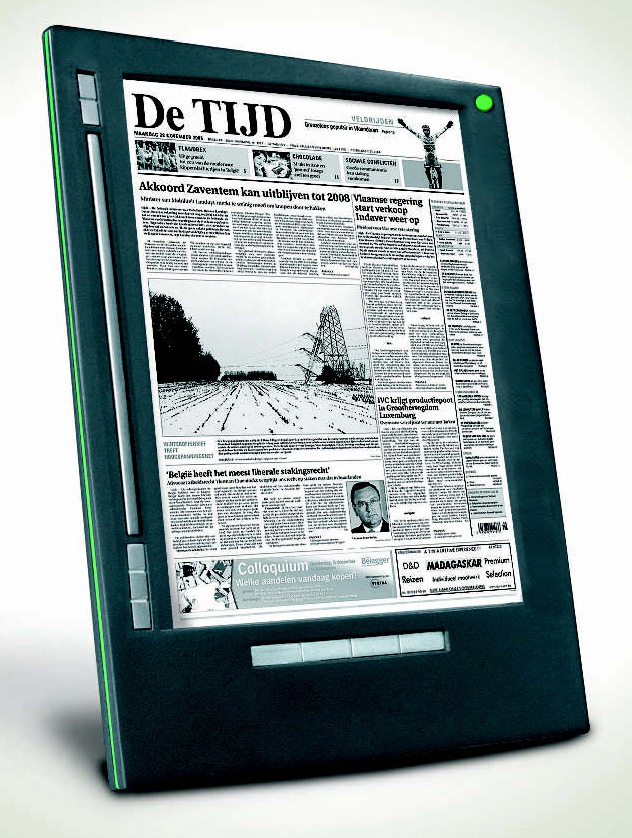 On November 24th, 2006 there was a seminar in Maastricht on “The Daily newspapers entering the network society”, organised by the European Journalism Centre (EJC). I was unable to attend, being abroad. But I was very anxious to hear what the report was on the experiment of the iLiad by the users of the Belgian financial daily De Tijd. So I started to surf and I found two reports, one in Dutch and one in English.
The English report is a summary by the chairman of the seminar, Mr Jan Bierhoff. It reads:
This summer, a fairly large field test has been conducted by the Belgian financial paper De Tijd, using the Iliad, an e-ink mounted reading pane produced by Philips subsidiary i-Rex. E-reader devices are mobile to start with (A5 folder size), have the look and feel of normal paper, don’t require a lot of energy and show superior reading quality in daylight conditions.
Nico Verplancke of IBBT summed up some final results delivered by the group of 200 test users. Feedback is positive, in general. Half of the group would consider buying a device provided the delivered content is sufficiently compelling. A strong recommendation was to speed up the refresh time and improve layout of content. Meanwhile, i-Rex has issued improved software with better performance characteristics.
Further development is required though, to promote the device from the present e-book to the aspired e-newspaper status.
To my surprise, I read also: De Tijd will not continue with the experiment, but five Dutch newspapers have meanwhile joined forces for a continued research effort, more focused on the creative part of the venture, the development of the right editorial formats. IBBT will join this consortium as well. I tried to find a reference to the five Dutch newspapers, but I will have to guess that it will be a consortium of De Telegraaf, PCM, Het Financieele Dagblad, Wegener and VBK/NDC.
From IBBT, the Belgian research institute, which accompanied the experiment, I received notes on various aspects of the study such as usability, distribution and the business model. I will come back on these notes in the coming days.
Tags: iliad, irex, e-book, e-ink, e-reader, newspaper
RSS feed: http://buziaulane.blogspot.com/rss.xml
Blog Posting Number: 596
Wednesday, December 06, 2006
TTA 2006: Top Talent Content Fusion Award
For the third time the EUROPRIX Top Talent Award has selected an award winner for the content fusion award. The Award was instituted to focus on the emotionally captive audio side of new media. Multimedia has too much been understood as visual content. Immersion into cross-media and content-fusion worlds should be stressed. Integrating sight and sound is proving to be an exciting and necessary development in the multimedia industry. Why listen to silence, or the clicks and beeps of your computer when e-content could be invigorating the senses with new expressions of multimedia creativity? In addition to the general contest, the expert jury evaluated all entered projects for a Special Award on the best fusion of multimedia and music, on the use of audio components in multimedia projects
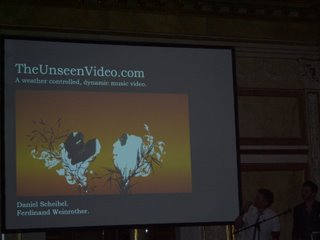 The UnseenVideo (Germany) is a weather controlled dynamic music video. It is affected by the weather and local time from the position of the viewer. The video’s background, images and main animation change and there are additional animations of snow, rain, pollen and clouds that dynamically alter in position and scale according to the environmental conditions. The system localises the viewer through their IP-Address. All information about the weather from each city is updated daily and stored in a MySQL database. By creating synergies between the music, the video and the natural surroundings of the viewer, local changes in the environment mean that
the viewer will never see the same video twice. While it may change only slightly in an hour, it will have a different character within a few months.
Team: Ferdinand Weinrother, Daniel Scheibel
Tags: europrix
RSS feed: http://buziaulane.blogspot.com/rss.xml
Blog Posting Number: 595
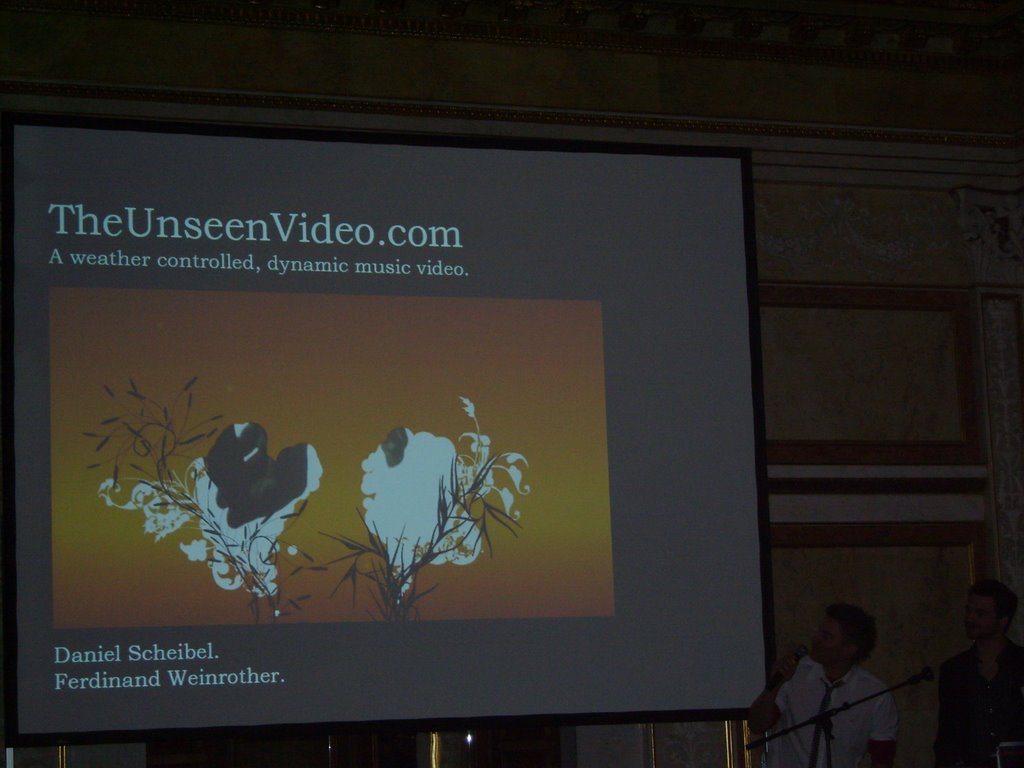 The UnseenVideo (Germany) is a weather controlled dynamic music video. It is affected by the weather and local time from the position of the viewer. The video’s background, images and main animation change and there are additional animations of snow, rain, pollen and clouds that dynamically alter in position and scale according to the environmental conditions. The system localises the viewer through their IP-Address. All information about the weather from each city is updated daily and stored in a MySQL database. By creating synergies between the music, the video and the natural surroundings of the viewer, local changes in the environment mean that
the viewer will never see the same video twice. While it may change only slightly in an hour, it will have a different character within a few months.
Team: Ferdinand Weinrother, Daniel Scheibel
Tags: europrix
RSS feed: http://buziaulane.blogspot.com/rss.xml
Blog Posting Number: 595
Tuesday, December 05, 2006
TTA 2006: Digital Video and Animations
This category is always worth a discussion in as far as interactivity in the digital video entries. So again this year. The movie if( ) then( ) else( ) did draw discussion on two points: interactivity and its content. The movie was captured on a home video the images redefined on a computer. Yet the contents was heavy as a dichotomy was present between reality and an actor attempting to recreate convincingly the predicament.
As far as the animation entries there was no problem for the jury. The nomination was a star product. Given the origin it had to be. The nomination Tadam was an entry from students of the Paris Ecole d’Images de Gobelin. This school has had winners for the last three years: such as ,261001, (2004), DVD-Maxi edelweiss Müller juicy panic (overall winner of 2004) and Non-violence (2003). The education method of this school , a combination of school labour and internships in a company, generate beautiful multimedia projects. Besides the students do get into industry. With this year’s entry the students brought puppeteering to multimedia. Virtual puppeteering has been done before. In this case it was digitising the art of puppeteering.
Here are the laudations of the jury.
 Tadam (France) is a multimedia puppet show which brings computer animations to life and stages the animation film in a traditional theatre. Users initially build up a plot scene by scene through the director module and can select different well-designed graphic environments and themes. The show can be pre-cut in several parts. Using software similar to moviemaker, static sequences (e.g. transition, fade or text) or sound effects can be added, edited and saved. The puppeteers are free to manipulate 3D marionettes in real time by interacting with a wooden cross lever which is equipped with movement sensors. The puppet’s mouth can even be animated by speaking through a microphone. Once the show is performed, it can be burned on DVD. Hand-crafted and fully customisable for beginners or professionals, Tadam continues the reinvention of this ancient art.
Team: Jonathan Da Costa, Jean-Kanora You, Nicolas Rajabaly, Mathieu Allemand
Cinema trades off its fundamental claim on authenticity, its power deriving from this basic capacity to capture reality 24 frames a second. However, digital media redefines the very identity of cinema because data is processed through a computer. if( ) then( ) else( ) (Ireland) utilises some aesthetic issues arising from recent developments in image technology. It uses a home-video aesthetic and the experience of encountering multiple streams of different media through the computer interface. This film explores the link between cinema and reality by portraying the problem of expressing the reality of terrorism on film. if ( ) then ( ) else ( ) asks the viewer to think about what is more real and convincing: home video footage of an actor expressing his frustrations of not being able to act authentically enough, or the apparently real documentary footage of a terrorist hostage which inspired him?
Team: Francis Heery, Carole Holohan, Mike Liffey
(Unfortunately, there is no link available)
Tags: europrix
RSS feed: http://buziaulane.blogspot.com/rss.xml
Blog Posting Number: 594
As far as the animation entries there was no problem for the jury. The nomination was a star product. Given the origin it had to be. The nomination Tadam was an entry from students of the Paris Ecole d’Images de Gobelin. This school has had winners for the last three years: such as ,261001, (2004), DVD-Maxi edelweiss Müller juicy panic (overall winner of 2004) and Non-violence (2003). The education method of this school , a combination of school labour and internships in a company, generate beautiful multimedia projects. Besides the students do get into industry. With this year’s entry the students brought puppeteering to multimedia. Virtual puppeteering has been done before. In this case it was digitising the art of puppeteering.
Here are the laudations of the jury.
 Tadam (France) is a multimedia puppet show which brings computer animations to life and stages the animation film in a traditional theatre. Users initially build up a plot scene by scene through the director module and can select different well-designed graphic environments and themes. The show can be pre-cut in several parts. Using software similar to moviemaker, static sequences (e.g. transition, fade or text) or sound effects can be added, edited and saved. The puppeteers are free to manipulate 3D marionettes in real time by interacting with a wooden cross lever which is equipped with movement sensors. The puppet’s mouth can even be animated by speaking through a microphone. Once the show is performed, it can be burned on DVD. Hand-crafted and fully customisable for beginners or professionals, Tadam continues the reinvention of this ancient art.
Team: Jonathan Da Costa, Jean-Kanora You, Nicolas Rajabaly, Mathieu Allemand
Cinema trades off its fundamental claim on authenticity, its power deriving from this basic capacity to capture reality 24 frames a second. However, digital media redefines the very identity of cinema because data is processed through a computer. if( ) then( ) else( ) (Ireland) utilises some aesthetic issues arising from recent developments in image technology. It uses a home-video aesthetic and the experience of encountering multiple streams of different media through the computer interface. This film explores the link between cinema and reality by portraying the problem of expressing the reality of terrorism on film. if ( ) then ( ) else ( ) asks the viewer to think about what is more real and convincing: home video footage of an actor expressing his frustrations of not being able to act authentically enough, or the apparently real documentary footage of a terrorist hostage which inspired him?
Team: Francis Heery, Carole Holohan, Mike Liffey
(Unfortunately, there is no link available)
Tags: europrix
RSS feed: http://buziaulane.blogspot.com/rss.xml
Blog Posting Number: 594
Monday, December 04, 2006
TTA 2006: Content Tools & Interface Design
The category of content tools and interface design is an area for innovation. In the past I have seen interface design of islands instead of files. Some of those islands contained audio files and the closer you got, the louder the music was. This year there were three innovative nominations.
Recreating Movement is an interesting content tool for analysing film and movements in films. I saw some 3D pictures of a movie in the past, present and future. It is interesting for analysing, but also for using creatively in a movie itself. The FlashFilterLab is clearly a content tool which make it easy for a developer to create complex flash effects without writing a line of code.
Shgared Design Space is a continuation of a projects which was entered last years by the same team. Roughly you can say that the team aims at producing an electronic, interactive office space. They use the latest technologies like electronic paper with fountain pens equipped with a small camera. Although the office spaces are still not fully compatible, Shared Design Space gives you a good insight in new office developments.
Here are the laudations of the jury.
 Recreating Movement (Germany) allows users to analyse the evolution of film movement in vivid detail – frame by frame. A host of useful features can be controlled via the keyboard and menu bar. Single film frames can be extracted and rendered onto a set of tube-like frames which ‘freeze’ a particular time span in a film and offer a unique overview. Users can therefore simultaneously see present, past and future can also be rearranged in any order and scaled in 3D space. The structural details of a film’s content can be studied by either analysing the film according to its volume level or by analysing specific colour ranges. Colour can be isolated, deleted or made transparent. Recreating Movement could be used by film analysts, coaches hoping to analyse a player’s technique or even car crash testers.
Team: Martin Hilpoltsteiner
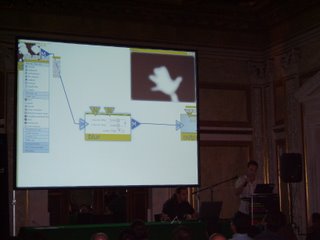 FlashFilterLab (Hungary) helps users to create complex flash effects and movies without having to write a single line of code. It is an intuitive visual programming environment that can be “wired” together to build complex visual filters, effects and Flash movies. Users create graphical flowcharts to perform real-time effects on their content. The simple interface allows the creation of rapid prototypes or complex projects by building a tree of boxes. The number of filter and omponent combinations is unlimited. The software’s website also provides users with their own storage space where they can upload and share their Flash movies and pictures. The website’s community can then grade and comment on other people’s work, share ideas and exchange techniques.
Team: Gabor Levai, Balazs Serenyi, Balazs Kovari, Aron Mezei
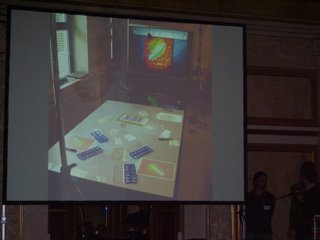 Shared Design Space (Austria) enhances meetings and presentations by making them interactive through intuitive collaborative tools and a tabletop environment. By integrating physical and digital paper, data can be overlaid on a table-top surface and modified by a touch-sensitive interactive wall. Using a digital pen, participants can annotate virtual paper or pick up digital data from the table (e.g. video, image) and drop it on real paper. Users can scroll through the documents by simply touching the interactive screen or zoom in on documents by changing the distance between their hands. A timeline on top provides a map-like overview that can also be used for quick navigation. The display menus are simple to customize for other software and can distinguish between different pens, allowing flexible functionality for various types of users.
Team: Aron Mezei, Thomas Seifried, Doris Zachhuber, Jakob Leitner, Peter Brandl, Doris Bernert, Daniel Leithinger
Tags: europrix
RSS feed: http://buziaulane.blogspot.com/rss.xml
Blog Posting Number: 593
Recreating Movement is an interesting content tool for analysing film and movements in films. I saw some 3D pictures of a movie in the past, present and future. It is interesting for analysing, but also for using creatively in a movie itself. The FlashFilterLab is clearly a content tool which make it easy for a developer to create complex flash effects without writing a line of code.
Shgared Design Space is a continuation of a projects which was entered last years by the same team. Roughly you can say that the team aims at producing an electronic, interactive office space. They use the latest technologies like electronic paper with fountain pens equipped with a small camera. Although the office spaces are still not fully compatible, Shared Design Space gives you a good insight in new office developments.
Here are the laudations of the jury.
 Recreating Movement (Germany) allows users to analyse the evolution of film movement in vivid detail – frame by frame. A host of useful features can be controlled via the keyboard and menu bar. Single film frames can be extracted and rendered onto a set of tube-like frames which ‘freeze’ a particular time span in a film and offer a unique overview. Users can therefore simultaneously see present, past and future can also be rearranged in any order and scaled in 3D space. The structural details of a film’s content can be studied by either analysing the film according to its volume level or by analysing specific colour ranges. Colour can be isolated, deleted or made transparent. Recreating Movement could be used by film analysts, coaches hoping to analyse a player’s technique or even car crash testers.
Team: Martin Hilpoltsteiner
 FlashFilterLab (Hungary) helps users to create complex flash effects and movies without having to write a single line of code. It is an intuitive visual programming environment that can be “wired” together to build complex visual filters, effects and Flash movies. Users create graphical flowcharts to perform real-time effects on their content. The simple interface allows the creation of rapid prototypes or complex projects by building a tree of boxes. The number of filter and omponent combinations is unlimited. The software’s website also provides users with their own storage space where they can upload and share their Flash movies and pictures. The website’s community can then grade and comment on other people’s work, share ideas and exchange techniques.
Team: Gabor Levai, Balazs Serenyi, Balazs Kovari, Aron Mezei
 Shared Design Space (Austria) enhances meetings and presentations by making them interactive through intuitive collaborative tools and a tabletop environment. By integrating physical and digital paper, data can be overlaid on a table-top surface and modified by a touch-sensitive interactive wall. Using a digital pen, participants can annotate virtual paper or pick up digital data from the table (e.g. video, image) and drop it on real paper. Users can scroll through the documents by simply touching the interactive screen or zoom in on documents by changing the distance between their hands. A timeline on top provides a map-like overview that can also be used for quick navigation. The display menus are simple to customize for other software and can distinguish between different pens, allowing flexible functionality for various types of users.
Team: Aron Mezei, Thomas Seifried, Doris Zachhuber, Jakob Leitner, Peter Brandl, Doris Bernert, Daniel Leithinger
Tags: europrix
RSS feed: http://buziaulane.blogspot.com/rss.xml
Blog Posting Number: 593
Sunday, December 03, 2006
TTA 2006: Interactive Computer Graphics
The category interactive graphics has proven a difficult one over the years for the juries. Where does interactivity of computer graphics start and where does it end. The three nominees prove exactly the point. The first nominee Ball of Bastards is computer graphics with an interactive menu. The Robotic Dance proves the interactivity in computer graphics in a different way: interactivity of the robots. Neigbours proved its interactivity in the interface and its database.
The Ball of Bastards has to be placed into the framework of the soccer championship. It is a cynical take-off on the championships. Robotic dancer is nice technical project. Neighbours is a very charming project from a technical point of view, but also from a story telling point of view.
These are the laudations of the jury.
 Ball of Bastards (Germany) allows football fans to punish the football monarchy through entertaining interactive online games. The website can even be enjoyed wearing 3D glasses. Developed for the 2006 World Cup, this website addresses the aggression and violent tendencies of fans and athletes in football culture. Users can fire a free-kick into David Beckham’s sensitive areas; let Frank Rijkard’s llama help them spit into Francesco Totti’s mouth; or even scream at a referee through a microphone and drive him insane. Users can also humiliate the “Bastard of the Week” or solve a puzzle and its secret message by wearing 3D glasses. The interactive menu itself acts as a humorous critique of iconic German images and personalities. Ball of Bastards aims to transfer real violence into a virtual space through parody and crude humour.
Team: Jan Philipp Behrens, Ingo Feisthamel, Franz Blach
 Robotic Dancer (The Netherlands) is a highly interactive game which contains a playful combination of rigid body dynamics and musical synchronisation. The user can experiment by linking the instruments from a musical score directly to forces and torques on the body parts of a 3D model. An innovative user interface visualises all the musical elements and is perfectly linked to the robot’s physical motion. If users choose the right instrument at the right time in the music, the user will see an applied force visualised either by a purple arrow or a purple fan. Users simply press ‘play’ to watch how the robot dances to the beat. Key features include the possibility to use a wide variety of robots, to load models directly from an Internet community or even build a customised
robot.
Team: Edwin Jakobs, Jorik Blaas
 This online interactive comic works on a theme that everyone knows about: nosey neighbours. Neighbours (Hungary) presents its own little-big world where everyone is somehow connected to everybody else. Users must work out that connection themselves and piece the narrative together by exploring each room in the five storey apartment block. Users can also search through various buildings in Green Tree Street and view a photo gallery, the producer’s work or find out details about the characters. Created in Macromedia Flash using hand drawn characters and backgrounds, users will find themselves becoming curious about each character. What is Margaret Pepper doing in the middle of the night? What is the strange noise on the roof? Who is Cecile’s secret lover? What is the favourite tale of little Lily Cube? Users will be intrigued into finding out the link between all of them.
Team: Adrienn Szekacs, Szilard Szell
Tags: europrix
RSS feed: http://buziaulane.blogspot.com/rss.xml
Blog Posting Number: 592
The Ball of Bastards has to be placed into the framework of the soccer championship. It is a cynical take-off on the championships. Robotic dancer is nice technical project. Neighbours is a very charming project from a technical point of view, but also from a story telling point of view.
These are the laudations of the jury.
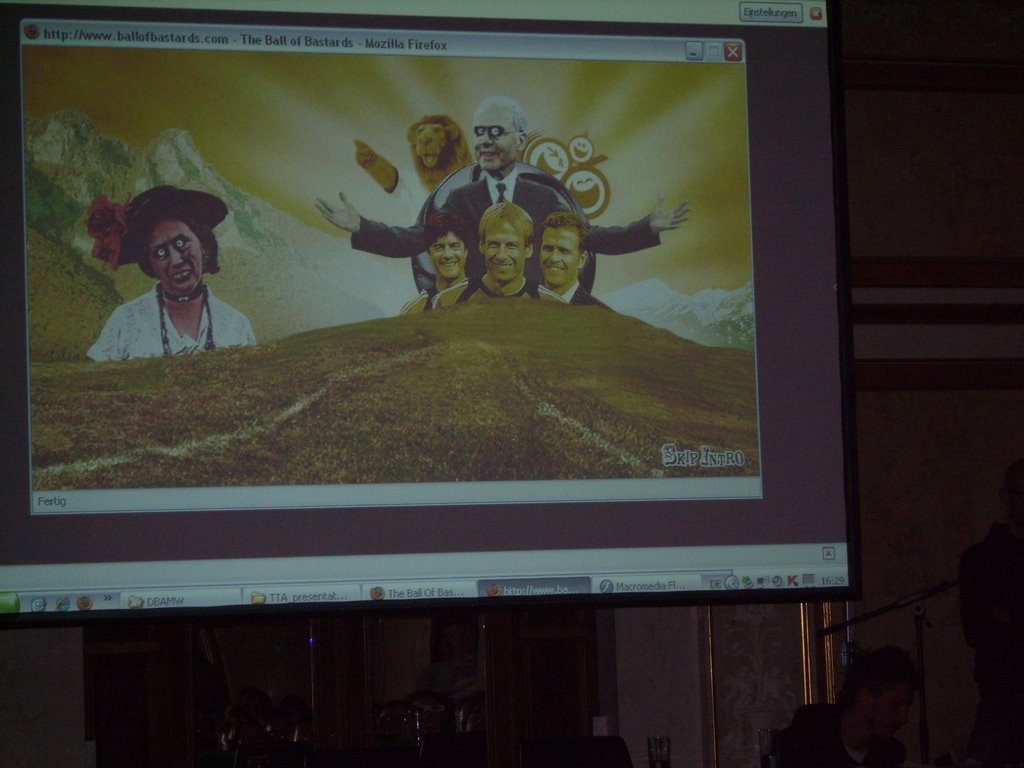 Ball of Bastards (Germany) allows football fans to punish the football monarchy through entertaining interactive online games. The website can even be enjoyed wearing 3D glasses. Developed for the 2006 World Cup, this website addresses the aggression and violent tendencies of fans and athletes in football culture. Users can fire a free-kick into David Beckham’s sensitive areas; let Frank Rijkard’s llama help them spit into Francesco Totti’s mouth; or even scream at a referee through a microphone and drive him insane. Users can also humiliate the “Bastard of the Week” or solve a puzzle and its secret message by wearing 3D glasses. The interactive menu itself acts as a humorous critique of iconic German images and personalities. Ball of Bastards aims to transfer real violence into a virtual space through parody and crude humour.
Team: Jan Philipp Behrens, Ingo Feisthamel, Franz Blach
 Robotic Dancer (The Netherlands) is a highly interactive game which contains a playful combination of rigid body dynamics and musical synchronisation. The user can experiment by linking the instruments from a musical score directly to forces and torques on the body parts of a 3D model. An innovative user interface visualises all the musical elements and is perfectly linked to the robot’s physical motion. If users choose the right instrument at the right time in the music, the user will see an applied force visualised either by a purple arrow or a purple fan. Users simply press ‘play’ to watch how the robot dances to the beat. Key features include the possibility to use a wide variety of robots, to load models directly from an Internet community or even build a customised
robot.
Team: Edwin Jakobs, Jorik Blaas
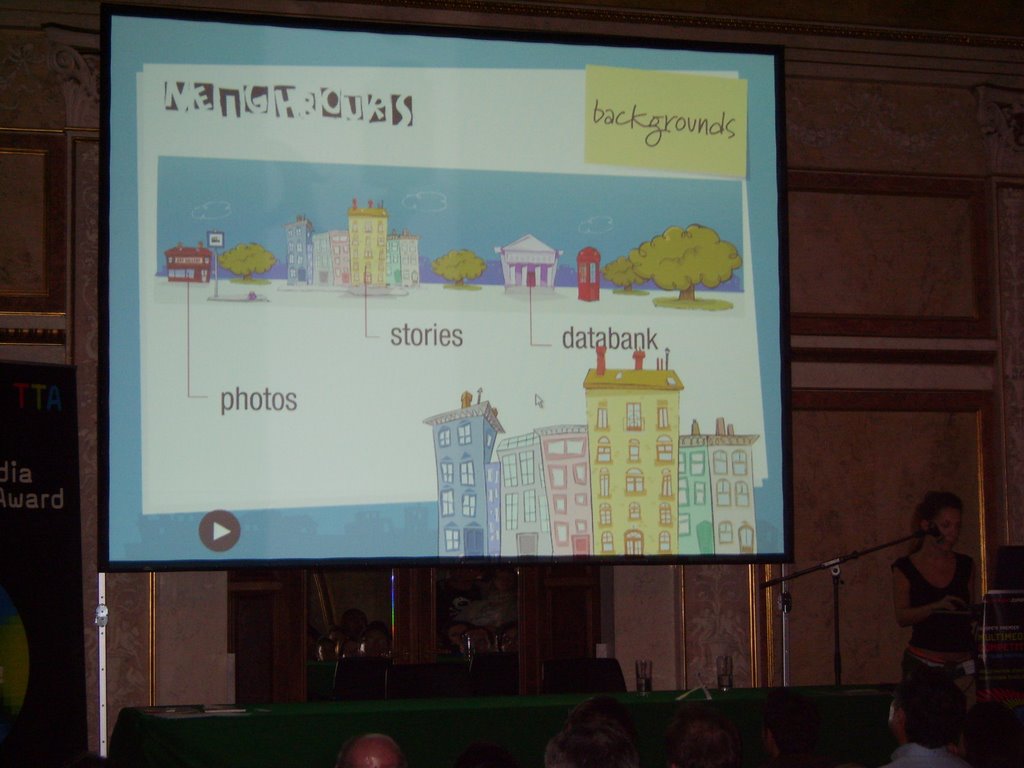 This online interactive comic works on a theme that everyone knows about: nosey neighbours. Neighbours (Hungary) presents its own little-big world where everyone is somehow connected to everybody else. Users must work out that connection themselves and piece the narrative together by exploring each room in the five storey apartment block. Users can also search through various buildings in Green Tree Street and view a photo gallery, the producer’s work or find out details about the characters. Created in Macromedia Flash using hand drawn characters and backgrounds, users will find themselves becoming curious about each character. What is Margaret Pepper doing in the middle of the night? What is the strange noise on the roof? Who is Cecile’s secret lover? What is the favourite tale of little Lily Cube? Users will be intrigued into finding out the link between all of them.
Team: Adrienn Szekacs, Szilard Szell
Tags: europrix
RSS feed: http://buziaulane.blogspot.com/rss.xml
Blog Posting Number: 592
Saturday, December 02, 2006
TTA 2006: Interactive Installations & TV
The EUROPRIX Top talent Award has generated enough nominated interactive installations to start a circus. Over the past years many installations have been presented to the great delight of the jury members who could play with them. Once they were nominated they often were available during the Festival in Vienna. The collection comprises: Kick Ass Kung-Fu, the Jumping Rope, Interactive projection System, Interactive Window Display and the Tone Ladders, a performance with ladders equipped with sensors, producing a light and sound show. One of the most social interfaces I ever saw was the cyborg webcam for an absolute colourblind person, who was able to experinece colours by having them translated into sounds. This years entry was rather abstract, but called up emotions as people started to stroke it.
The interactive TV section of this category did not deliver any nominations this year. This section has been a worrisome section. To me it indicates that interactive TV is not seen as a research area in the universitiesand colleges and the production companies are not interested. Of course there is an award for interactive TV which is being presented during the MIP/Milia in Cannes in April. But not being able to attract a nomination or a winner, is a pity in a competition for young producers.
In this category there was only one nomination. The entry turned out to be the category winner and also the overall winner, to the great surprise of many Festival participants.
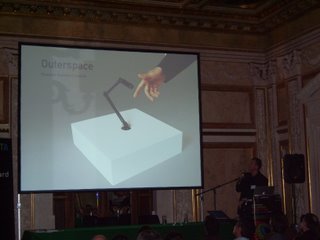 Outerspace (Germany) is a reactive robotic creature that explores the surrounding space by responding to light, motion and human contact. Using various aspects of industrial design, physical computing and artificial intelligence, the robot’s body consists of three limbs made from fibreglass pipes which are controlled by wires and pulleys. The head, the upper limb, contains five photo sensors which are used as eyes to detect brightness and simple motion recognition. All limbs have sensors which react to human body contact. Connected via controllers to a PC, special JAVA software processes all the calculations. Inspired by insect antennae that are able to make flexible movements in order to explore the environment, this robot feeds on curiosity and interaction. People can touch or play with it and watch its animal-like behaviour.
Team: André Stubbe, Markus Lerner
Tags: europrix
RSS feed: http://buziaulane.blogspot.com/rss.xml
Blog Posting Number: 591
The interactive TV section of this category did not deliver any nominations this year. This section has been a worrisome section. To me it indicates that interactive TV is not seen as a research area in the universitiesand colleges and the production companies are not interested. Of course there is an award for interactive TV which is being presented during the MIP/Milia in Cannes in April. But not being able to attract a nomination or a winner, is a pity in a competition for young producers.
In this category there was only one nomination. The entry turned out to be the category winner and also the overall winner, to the great surprise of many Festival participants.
 Outerspace (Germany) is a reactive robotic creature that explores the surrounding space by responding to light, motion and human contact. Using various aspects of industrial design, physical computing and artificial intelligence, the robot’s body consists of three limbs made from fibreglass pipes which are controlled by wires and pulleys. The head, the upper limb, contains five photo sensors which are used as eyes to detect brightness and simple motion recognition. All limbs have sensors which react to human body contact. Connected via controllers to a PC, special JAVA software processes all the calculations. Inspired by insect antennae that are able to make flexible movements in order to explore the environment, this robot feeds on curiosity and interaction. People can touch or play with it and watch its animal-like behaviour.
Team: André Stubbe, Markus Lerner
Tags: europrix
RSS feed: http://buziaulane.blogspot.com/rss.xml
Blog Posting Number: 591
Friday, December 01, 2006
Flash: Dutch Institute for Image and Sound open
Today Queen Beatrix opens the Institute of Image and Sound, the Dutch public broadcast archive in Hilversum, the Netherlands. The institute has 1,5 million radio and television programs of 700.000 hours on 100 various carriers preserved in analogue form, while about 10.000 hours have been digitised.

This is an artist's impression of the very colourful building. I have seen it, but I did not have a camera with me at that time.
The institute is not only a library, where video and audio can be borrowed, but the institute will also be an entertainment venue. People will be able to present in front of a camera; they can walk down on a stairways. But they can also call up their favourite programs from their time as a child.
Besides video 2006 has become the years of the broadcast archives. Besides the Institute of Image and Sound in The Netherlands, Archives for All in France has gone online offering a database with almost 1000.000 radio and TV recordings and 10.000 hours of audio and video. In Switzerland the broadcast archive offers an online overview of Swiss history since 1931.
Tags: archive, broadcast
RSS feed: http://buziaulane.blogspot.com/rss.xml
Blog Posting Number 590

This is an artist's impression of the very colourful building. I have seen it, but I did not have a camera with me at that time.
The institute is not only a library, where video and audio can be borrowed, but the institute will also be an entertainment venue. People will be able to present in front of a camera; they can walk down on a stairways. But they can also call up their favourite programs from their time as a child.
Besides video 2006 has become the years of the broadcast archives. Besides the Institute of Image and Sound in The Netherlands, Archives for All in France has gone online offering a database with almost 1000.000 radio and TV recordings and 10.000 hours of audio and video. In Switzerland the broadcast archive offers an online overview of Swiss history since 1931.
Tags: archive, broadcast
RSS feed: http://buziaulane.blogspot.com/rss.xml
Blog Posting Number 590
TTA 2006: Games
The Europrix and later on the Europrix Top talent Award have a history of awarding games. Not just the drill and shoot-them-up games but the mysterious and creative games. The tone was set with the first overall winner Ceremony of Innocence in 1998. This fabulous multimedia product presented many an hour of intellectual pleasure. Another game in this tradition was Timehunt. It has now been taken off Internet, but it was in principle an encyclopaedic game which took more than two years to solve with the help of all kind of discussion platforms. You can still see some remnants on internet. Now the Tulse Luper Journey is joining the tradition.
What are the elements of the tradition. It is a search game. One starts on a trip and can move on after solving a riddle. It has a mysterious atmosphere. In Ceremony of Innocence a bundle of letters arrived with assignments. In Timehunt alchemists and medieval riddles were mixed with contemporary puzzles. The game existed of subgames. In the ceremony of innocence it were letters; in Timehunt it were sunrays; in the Tulse Luper Journey it is a suitcase. All these games were the products of creative multimedia minds. So the selection of the Tulse Luper Journey as a category winner has been done rightfully so (for me it was the overall winner; but I do not want to be a nationalist).
Here are the laudations of the jury.
 The Tulse Luper Journey (The Netherlands) reconstructs the life of writer and collector Tulse Luper, who archived his entire life in 92 suitcases. Despite spending most of his years in prison, he mysteriously managed to be at important 20th century events. Based on director Peter Greenaway’s film trilogy, the Tulse Luper Journey is an enormous community project which invited young flash designers from across Europe to submit interactive Flash games. Film fragments, puzzles and letters written by different characters must be unlocked and solved. By collecting all 92 film fragments from each suitcase, gamers reconstruct a 90 minute film about his life. Gamers also have the chance to discuss their ‘research’ in forums or compete for a round-the-world holiday. The installation version features real suitcases which contain LCD screens and hidden PC’s.
Team: Bruno Felix, Femke Wolting, Christiaan de Rooij
 Stoked Rider (Austria) gives gamers the rush of storming down colossal Alaskan mountains. Gamers can explore more than 64 square-kilometres of immense outdoor terrains by dropping down anywhere. Offering no silly gimmicks, the goal is simply survival. This simulator’s breathtaking background visuals and realistic snowboard physics are made possible by a new breed of computer chip that takes the strain of physics calculations away from the central microprocessor. The snow-boarder can be simply controlled by using four directional controls and pressing a key to execute indy airs, backside airs and spins. Upgrades, extended runs and bonuses are earned by free-riding around the various locations. ‘Sick’ runs and records can also be uploaded or downloaded from the game’s website server. Set to be regularly updated, Stoked Rider packs in over a hundred challenges onto 60 MB.
Team: Michael Putz, Klaus Hufnagl
Tags: europrix, games
RSS feed: http://buziaulane.blogspot.com/rss.xml
Blog Posting Number: 589
What are the elements of the tradition. It is a search game. One starts on a trip and can move on after solving a riddle. It has a mysterious atmosphere. In Ceremony of Innocence a bundle of letters arrived with assignments. In Timehunt alchemists and medieval riddles were mixed with contemporary puzzles. The game existed of subgames. In the ceremony of innocence it were letters; in Timehunt it were sunrays; in the Tulse Luper Journey it is a suitcase. All these games were the products of creative multimedia minds. So the selection of the Tulse Luper Journey as a category winner has been done rightfully so (for me it was the overall winner; but I do not want to be a nationalist).
Here are the laudations of the jury.
 The Tulse Luper Journey (The Netherlands) reconstructs the life of writer and collector Tulse Luper, who archived his entire life in 92 suitcases. Despite spending most of his years in prison, he mysteriously managed to be at important 20th century events. Based on director Peter Greenaway’s film trilogy, the Tulse Luper Journey is an enormous community project which invited young flash designers from across Europe to submit interactive Flash games. Film fragments, puzzles and letters written by different characters must be unlocked and solved. By collecting all 92 film fragments from each suitcase, gamers reconstruct a 90 minute film about his life. Gamers also have the chance to discuss their ‘research’ in forums or compete for a round-the-world holiday. The installation version features real suitcases which contain LCD screens and hidden PC’s.
Team: Bruno Felix, Femke Wolting, Christiaan de Rooij
 Stoked Rider (Austria) gives gamers the rush of storming down colossal Alaskan mountains. Gamers can explore more than 64 square-kilometres of immense outdoor terrains by dropping down anywhere. Offering no silly gimmicks, the goal is simply survival. This simulator’s breathtaking background visuals and realistic snowboard physics are made possible by a new breed of computer chip that takes the strain of physics calculations away from the central microprocessor. The snow-boarder can be simply controlled by using four directional controls and pressing a key to execute indy airs, backside airs and spins. Upgrades, extended runs and bonuses are earned by free-riding around the various locations. ‘Sick’ runs and records can also be uploaded or downloaded from the game’s website server. Set to be regularly updated, Stoked Rider packs in over a hundred challenges onto 60 MB.
Team: Michael Putz, Klaus Hufnagl
Tags: europrix, games
RSS feed: http://buziaulane.blogspot.com/rss.xml
Blog Posting Number: 589
Thursday, November 30, 2006
TTA 2006: Mobile
The category Mobile was exciting this year. Normally this category has many an innovation. Last year it had a PDA as sport trainer. So far the entries came from the UK and Austria, especially from the Johanneum in Graz. But this year the Germans came in strong.
Two of the nominations were variations on the same themes of the years past. Anna’s secrets was a PDA/GPS game. MORE for Graz was a PDA/GPS tourist guide application. The Austrian have produced several applications in this field such as a PDA walking assistant and a PDA ski assistant.
But this year there was a real innovation. Not with a PDA, but with a lot of electronic gear, hidden in shoes. Special engineered shoes, which might help people with handicaps (e.g. blind people) to walk an accidental course. The boots correct the feet positions, if needed. In his presentation the creator was asked whether he had found a manufacturer for this application; his answer was negative. It was a pity that no innovation consultants were in the room. In order to demonstrate the working the creator got on the table and started walking: these boots are made for walking…
Here are the laudations from the Festival brochure.
 Anna’s Secret (Germany) is a location-based adventure game that uses GPS localisation and a PDA to immerse the player into another era. Anna, an 18th century German countess, needs two players to solve the gaps and peculiarities of her old stories by searching the area for clues. Through solving her secret, users discover Weimar’s culturally historic sights.By walking through physical guideposts in the area, the GPS technology triggers the next clue in the game. Users must apply the general knowledge they acquire through the game to progress, or unlock the next clue by searching the location. Anna, for example, encourages users to explore the statues in Weimar’s beautiful Ilmpark or to look up books in the city library. Users are free to pause during the game or take any route. However her treasure must be found within the 75 minute time-limit.
Team: Jan Ulrich Schmidt
 CabBoots (Germany) are specially engineered shoes which tell your feet where to go using a pedestrian guidance application. Most natural paths have a concave shape. If one foot is at the edge, the feet intuitively countersteer themselves against the angle. Using this principle, the electromechanic parts in the sole of CabBoots are able to generate the angle of the shoes and feet artificially. By using the kinaesthetic cognition of the foot and ankle, these shoes can intuitively guide users from A to B or to nearby points-of-interest without hitting obstacles. Tests with the prototype demonstrate that the principle of “walking on a path” also works with the virtually produced topography. In future developments, the computer could be embedded in the shoes and the software for positioning and generating the path will be able to run on any mobile device and connect wirelessly to the shoes using GPS. CabBoots has the potential to transform the lives of blind people.
Team: Martin Frey
 MORE for Graz (Austria) allows anyone to find out interesting historical information as they wander around this Austrian city. Users simply start the application on their Internet connected smartphone and take a photo of a building. They will promptly receive a detailed text and picture based description from the server. The sophisticated object recognition software functions regardless of the environmental conditions or photo angle. The client application can be installed directly via an Internet connection or PC onto a mobile phone. The portal also offers customers the possibility to present their digital photo album. The software could be easily commercially developed with a mobile phone operator as an MMS service, or it could be implemented on an Internet portal where customers purchase various packages for the object recognition service.
Team: Stefan Ladstaetter, Alexander Almer, Christin Seifert, Gerald Fritz, Lucas Paletta, Patrick Luley
Tags: europrix, innovation
RSS feed: http://buziaulane.blogspot.com/rss.xml
Blog Posting Number: 588
Two of the nominations were variations on the same themes of the years past. Anna’s secrets was a PDA/GPS game. MORE for Graz was a PDA/GPS tourist guide application. The Austrian have produced several applications in this field such as a PDA walking assistant and a PDA ski assistant.
But this year there was a real innovation. Not with a PDA, but with a lot of electronic gear, hidden in shoes. Special engineered shoes, which might help people with handicaps (e.g. blind people) to walk an accidental course. The boots correct the feet positions, if needed. In his presentation the creator was asked whether he had found a manufacturer for this application; his answer was negative. It was a pity that no innovation consultants were in the room. In order to demonstrate the working the creator got on the table and started walking: these boots are made for walking…
Here are the laudations from the Festival brochure.
 Anna’s Secret (Germany) is a location-based adventure game that uses GPS localisation and a PDA to immerse the player into another era. Anna, an 18th century German countess, needs two players to solve the gaps and peculiarities of her old stories by searching the area for clues. Through solving her secret, users discover Weimar’s culturally historic sights.By walking through physical guideposts in the area, the GPS technology triggers the next clue in the game. Users must apply the general knowledge they acquire through the game to progress, or unlock the next clue by searching the location. Anna, for example, encourages users to explore the statues in Weimar’s beautiful Ilmpark or to look up books in the city library. Users are free to pause during the game or take any route. However her treasure must be found within the 75 minute time-limit.
Team: Jan Ulrich Schmidt
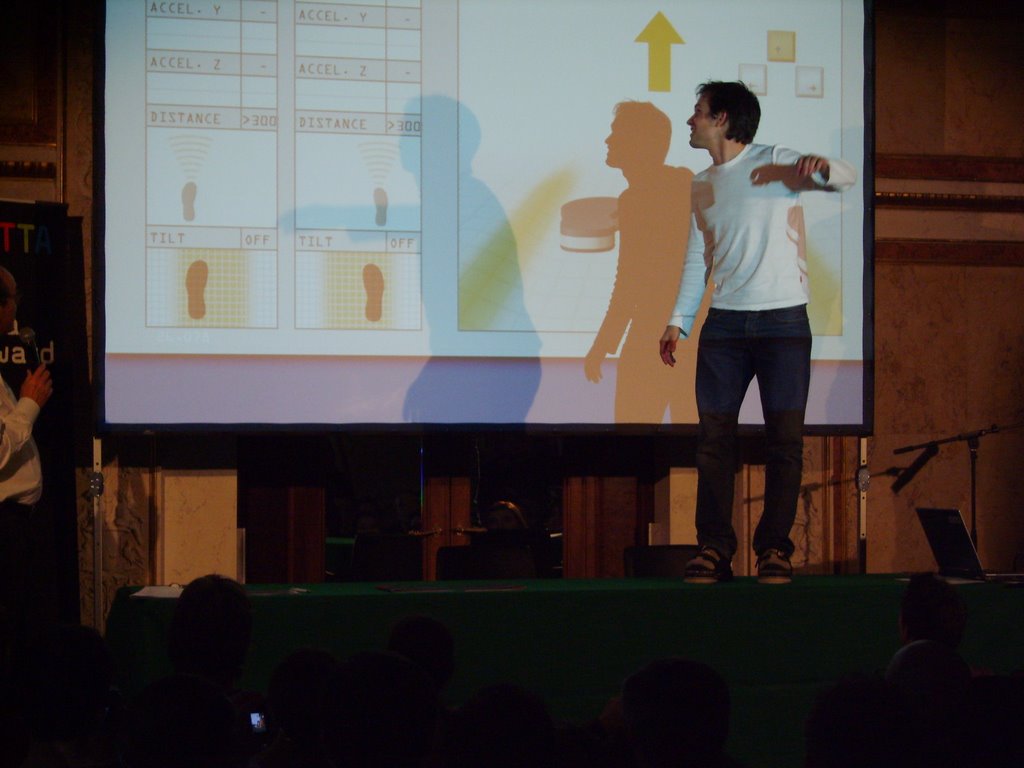 CabBoots (Germany) are specially engineered shoes which tell your feet where to go using a pedestrian guidance application. Most natural paths have a concave shape. If one foot is at the edge, the feet intuitively countersteer themselves against the angle. Using this principle, the electromechanic parts in the sole of CabBoots are able to generate the angle of the shoes and feet artificially. By using the kinaesthetic cognition of the foot and ankle, these shoes can intuitively guide users from A to B or to nearby points-of-interest without hitting obstacles. Tests with the prototype demonstrate that the principle of “walking on a path” also works with the virtually produced topography. In future developments, the computer could be embedded in the shoes and the software for positioning and generating the path will be able to run on any mobile device and connect wirelessly to the shoes using GPS. CabBoots has the potential to transform the lives of blind people.
Team: Martin Frey
 MORE for Graz (Austria) allows anyone to find out interesting historical information as they wander around this Austrian city. Users simply start the application on their Internet connected smartphone and take a photo of a building. They will promptly receive a detailed text and picture based description from the server. The sophisticated object recognition software functions regardless of the environmental conditions or photo angle. The client application can be installed directly via an Internet connection or PC onto a mobile phone. The portal also offers customers the possibility to present their digital photo album. The software could be easily commercially developed with a mobile phone operator as an MMS service, or it could be implemented on an Internet portal where customers purchase various packages for the object recognition service.
Team: Stefan Ladstaetter, Alexander Almer, Christin Seifert, Gerald Fritz, Lucas Paletta, Patrick Luley
Tags: europrix, innovation
RSS feed: http://buziaulane.blogspot.com/rss.xml
Blog Posting Number: 588
Wednesday, November 29, 2006
TTA 2006: Offline/Interactive DVD
You would expect that in the age of internet CD-ROM and DVD will be used as data carriers and DVD in particular as storage of linear productions. Yet this category delivers every year still some fine productions. .
This year two music productions were nominated. 2006 being the jubilee year of Mozarts’ birth a CD-ROM production on this topic could be expected from Austria. And yes there was one from Salzburg. It was a very interesting production, which made use of some fine techniques for example magnifying glasses for manuscripts and accompanying the manuscript with the music. No new concepts, but the execution was well done. Sonorama is a great production databasing music from South Benin. The database has everything about the music pieces, ranging from movies, animations of the dance to the geographic area.
The German entry The best of all possible worlds is a philosophical production. Users do not just look and read with this CD-ROM production, but can also edit movies and music.
The question can be posed, whether these productions could not have been put online in stead of being stored on CD-ROM and DVD. I think that the question is dependent on the country where the producers live. Sure Austria, Germany and France have broadband, but it is not yet a common product. Besides, the Mozart CD-ROM works best on CD-ROM for music quality, I think.
Here are the laudations of the Festival brochure.
 Mozart Digital (Austria) presents the original notations of Fantasy and Sonata in C Minor, published in 1785, enabling music-lovers to study the genesis of Mozart’s creative process and the real dramatic structure of the music in close detail. This highly instructive DVD allows users to zoom in and study the music note by note – as well as the additions and corrections – while it is being played. Alternative phrases of the piece can be selected as one hears the music. The programme’s clear navigation and expertly written content allows users to study the piece’s cultural context as well as Mozart’s innovations in composition and technique. Since very few of Mozart’s hand-written notations still exist, this programme offers a unique insight into his compositional methods and the rest of his work.
Team: Tobias Werner, Barbara Herzog, Jürgen Grünberger
 The best of all possible worlds (Germany) is an interactive DVD which aims to create the fascinating and also threatening experience of living in a consumer society. The menu presents a typical suburban neighbourhood. By selecting from eight houses - each representing different aspects of modern life - users are presented with interactive stories inspired by the post-modern German philosopher Günter Anders. Through exploring each visualisation and the quotation which inspired it, users can interpret and reflect upon quotes which describe consumer society such as “Wherever we reach, we always get something to grab”. Each module expresses an intriguing idea with provocative visuals and contemporary graphic design. Users can, for example, create a movie by editing repetitive clips and music or destroy and rebuild a block of flats using their mouse. By interacting with the visual presentations, users must contemplate the logic of consumer society for themselves.
Team: Peer Runge, Joachim Kerkhoff
 At the margins of West Africa lies Benin, a place where a love of music provides the link between migrants from Togo, Ghana and Nigeria. Sonorama (France), South Benin offers a fascinating interactive DVD database and audio CD of unique recordings, documentary footage, interviews and photos acquired through three years of field research. The menu-map provides a wealth of options including thematically organised content and music from around the region. By intuitively following the architecture of the interface and the interactive lexicon, users can make the connection between different languages or sounds and instruments. The musical style, rhythms and melodies can also be studied. Dance moves can even be analysed using the “Rhythm Box” tool. The interconnection between different types of media enables an immersive non-linear introduction to Benin’s traditional music and its vibrant cultural scene.
Team: François-Romain Dumont, Jean-Baptiste Miel
Tags: europrix
RSS feed: http://buziaulane.blogspot.com/rss.xml
Blog Posting Number: 587
This year two music productions were nominated. 2006 being the jubilee year of Mozarts’ birth a CD-ROM production on this topic could be expected from Austria. And yes there was one from Salzburg. It was a very interesting production, which made use of some fine techniques for example magnifying glasses for manuscripts and accompanying the manuscript with the music. No new concepts, but the execution was well done. Sonorama is a great production databasing music from South Benin. The database has everything about the music pieces, ranging from movies, animations of the dance to the geographic area.
The German entry The best of all possible worlds is a philosophical production. Users do not just look and read with this CD-ROM production, but can also edit movies and music.
The question can be posed, whether these productions could not have been put online in stead of being stored on CD-ROM and DVD. I think that the question is dependent on the country where the producers live. Sure Austria, Germany and France have broadband, but it is not yet a common product. Besides, the Mozart CD-ROM works best on CD-ROM for music quality, I think.
Here are the laudations of the Festival brochure.
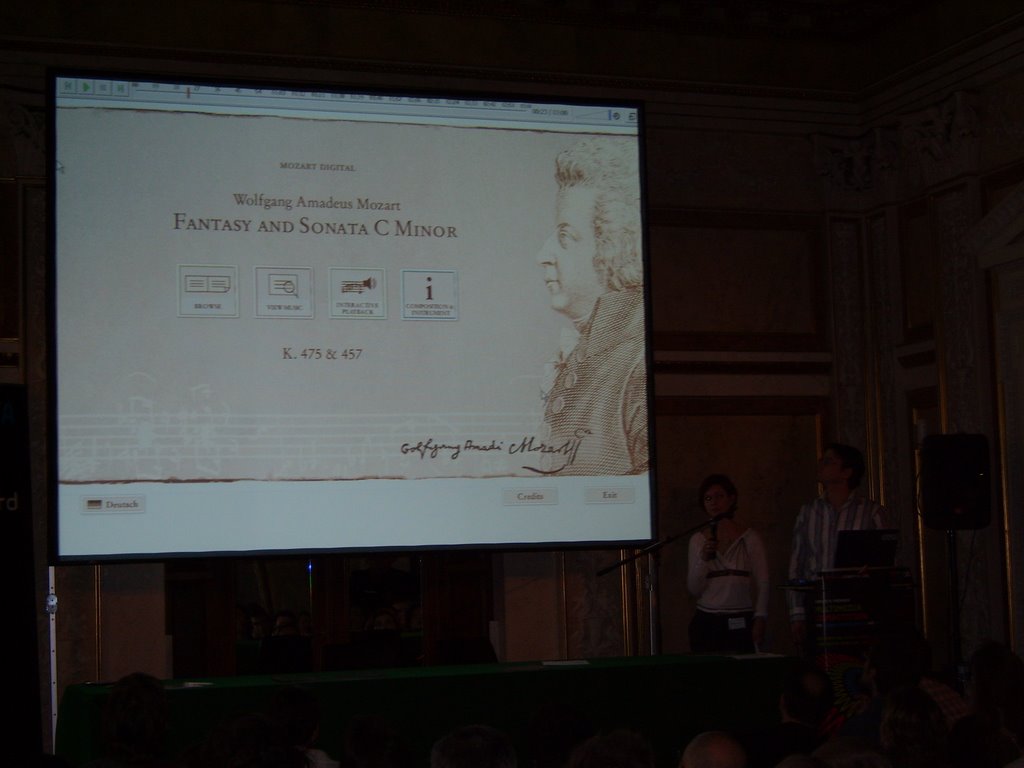 Mozart Digital (Austria) presents the original notations of Fantasy and Sonata in C Minor, published in 1785, enabling music-lovers to study the genesis of Mozart’s creative process and the real dramatic structure of the music in close detail. This highly instructive DVD allows users to zoom in and study the music note by note – as well as the additions and corrections – while it is being played. Alternative phrases of the piece can be selected as one hears the music. The programme’s clear navigation and expertly written content allows users to study the piece’s cultural context as well as Mozart’s innovations in composition and technique. Since very few of Mozart’s hand-written notations still exist, this programme offers a unique insight into his compositional methods and the rest of his work.
Team: Tobias Werner, Barbara Herzog, Jürgen Grünberger
 The best of all possible worlds (Germany) is an interactive DVD which aims to create the fascinating and also threatening experience of living in a consumer society. The menu presents a typical suburban neighbourhood. By selecting from eight houses - each representing different aspects of modern life - users are presented with interactive stories inspired by the post-modern German philosopher Günter Anders. Through exploring each visualisation and the quotation which inspired it, users can interpret and reflect upon quotes which describe consumer society such as “Wherever we reach, we always get something to grab”. Each module expresses an intriguing idea with provocative visuals and contemporary graphic design. Users can, for example, create a movie by editing repetitive clips and music or destroy and rebuild a block of flats using their mouse. By interacting with the visual presentations, users must contemplate the logic of consumer society for themselves.
Team: Peer Runge, Joachim Kerkhoff
 At the margins of West Africa lies Benin, a place where a love of music provides the link between migrants from Togo, Ghana and Nigeria. Sonorama (France), South Benin offers a fascinating interactive DVD database and audio CD of unique recordings, documentary footage, interviews and photos acquired through three years of field research. The menu-map provides a wealth of options including thematically organised content and music from around the region. By intuitively following the architecture of the interface and the interactive lexicon, users can make the connection between different languages or sounds and instruments. The musical style, rhythms and melodies can also be studied. Dance moves can even be analysed using the “Rhythm Box” tool. The interconnection between different types of media enables an immersive non-linear introduction to Benin’s traditional music and its vibrant cultural scene.
Team: François-Romain Dumont, Jean-Baptiste Miel
Tags: europrix
RSS feed: http://buziaulane.blogspot.com/rss.xml
Blog Posting Number: 587
Tuesday, November 28, 2006
TTA 2006: Broadband/Online
This year the entries in this category were more directed toward broadband. All three nominations are massive projects in terms of content, type of content such as text, audio and video and database structures.
It is not surprising that the Swiss broadcast archival application won. The broadcast companies all around Europe are busy to digitise and archive their historical material, not just for preservation, but also for use in education and entertainment. In fact on December 1, 2006 a new institute for image and sound will be opened in The Netherlands (I will report on this on that day).
 Swiss Timeline (Switserland) provides an overview of Swiss history since 1931 as reflected by public service radio and television. Searchable according to subject, period, type of media and language, users can warp themselves back in time and follow Swiss life as it was originally reported. Site visitors can follow the cycle of events and their context by using the dynamic timeline interface, or simply select a wide range of thematically organised reports, interviews and debates. By using the powerful search engine or following the editor’s selections, users can follow the historical cycles of events (e.g. natural disasters) or national issues (e.g. debates about nuclear power, immigration or WWII). Developed in cooperation with the Swiss Broadcasting Corporation and designed using an attractive hybrid Flash/HTML composition, Swiss Timeline aims to raise awareness about Switzerland both at home and abroad.
Team: Dominik Stankowski, Cecile Cosman, Dani Wihler, Laurent Andrey, Denise Hegnauer, Andrea Stephani, Marco Majoleth, Kai Reusser, Lukas Jaggi.
 Archives For All (France) clearly organises almost 100,000 radio and TV recordings and 10,000 hours of material into four capsules: explore, discover, share and download. The “Explorer” module enables users to search for particular topics, personalities and programmes or focus on any year or decade. The “Decouvrir” module surprises users with random selections from ten archives, carefully chosen educational programmes, an interactive timeline about the history of French media and even the daily news since 1963. The “Partager” module offers thematically organised forums and the editors’ daily selections. Users can subscribe to the service or download any content in the “Telecharger” module. Selections can be fully customised and even shared in the “mon espace personnel” section. The “ma zone mémoire” toolbar compresses any recently viewed clips, enabling the user to retain control.
Team: Safia Dziri, Paul Fleury, Jean Miguel Kawamura, Pauline Thomas, Pierre Cordani.
 Mundo (Israel) was developed as a potential broadband site for broadcasting the 2006 World Cup online. Through its compact design and intelligent website architecture, Mundo aims to meet the needs of every football fan. Users can watch different games simultaneously and in diverse hierarchies or check out video based statistics pages. The betting application allows continuous betting during the match while the gift shop presents relevant video clips of every product in close-up. The comprehensive video archive enables users to record and save selected scenes. Fans are also brought together through the video and messenger based chat rooms. The website’s advance notice system also reminds viewers about any future broadcasts online, by email or SMS.
Team: Nir Yuz, Sagi Itah
Tags: broadband, archives,soccer broadband, archives, soccer
RSS feed: http://buziaulane.blogspot.com/rss.xml
Blog Posting Number: 586
It is not surprising that the Swiss broadcast archival application won. The broadcast companies all around Europe are busy to digitise and archive their historical material, not just for preservation, but also for use in education and entertainment. In fact on December 1, 2006 a new institute for image and sound will be opened in The Netherlands (I will report on this on that day).
 Swiss Timeline (Switserland) provides an overview of Swiss history since 1931 as reflected by public service radio and television. Searchable according to subject, period, type of media and language, users can warp themselves back in time and follow Swiss life as it was originally reported. Site visitors can follow the cycle of events and their context by using the dynamic timeline interface, or simply select a wide range of thematically organised reports, interviews and debates. By using the powerful search engine or following the editor’s selections, users can follow the historical cycles of events (e.g. natural disasters) or national issues (e.g. debates about nuclear power, immigration or WWII). Developed in cooperation with the Swiss Broadcasting Corporation and designed using an attractive hybrid Flash/HTML composition, Swiss Timeline aims to raise awareness about Switzerland both at home and abroad.
Team: Dominik Stankowski, Cecile Cosman, Dani Wihler, Laurent Andrey, Denise Hegnauer, Andrea Stephani, Marco Majoleth, Kai Reusser, Lukas Jaggi.
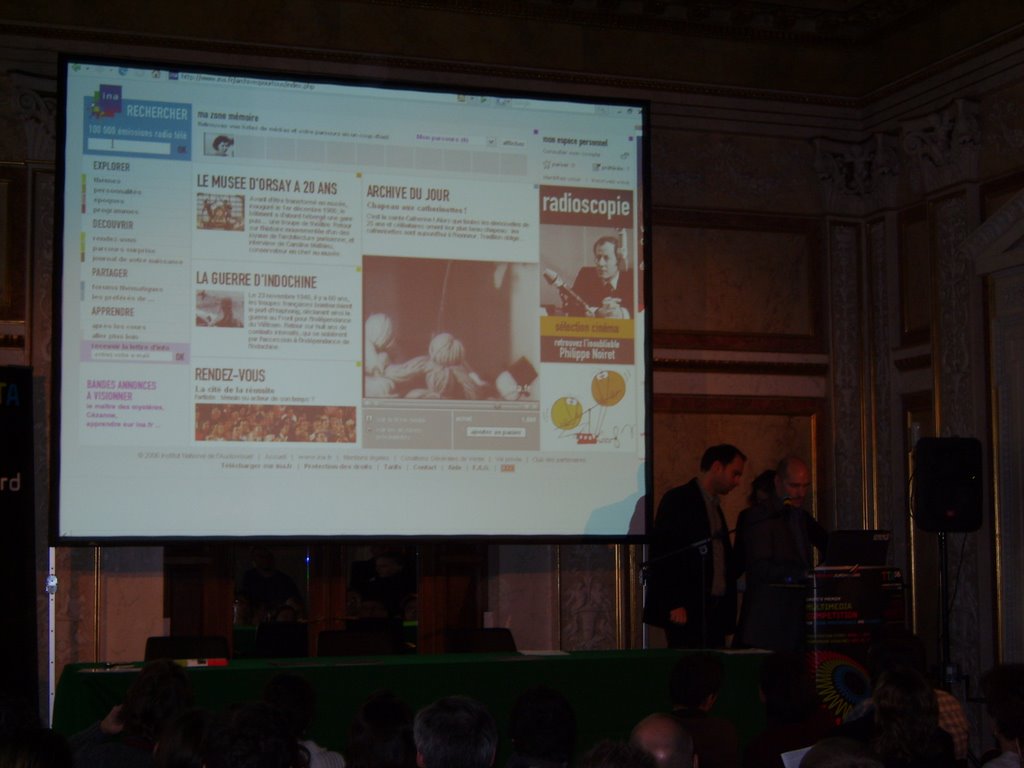 Archives For All (France) clearly organises almost 100,000 radio and TV recordings and 10,000 hours of material into four capsules: explore, discover, share and download. The “Explorer” module enables users to search for particular topics, personalities and programmes or focus on any year or decade. The “Decouvrir” module surprises users with random selections from ten archives, carefully chosen educational programmes, an interactive timeline about the history of French media and even the daily news since 1963. The “Partager” module offers thematically organised forums and the editors’ daily selections. Users can subscribe to the service or download any content in the “Telecharger” module. Selections can be fully customised and even shared in the “mon espace personnel” section. The “ma zone mémoire” toolbar compresses any recently viewed clips, enabling the user to retain control.
Team: Safia Dziri, Paul Fleury, Jean Miguel Kawamura, Pauline Thomas, Pierre Cordani.
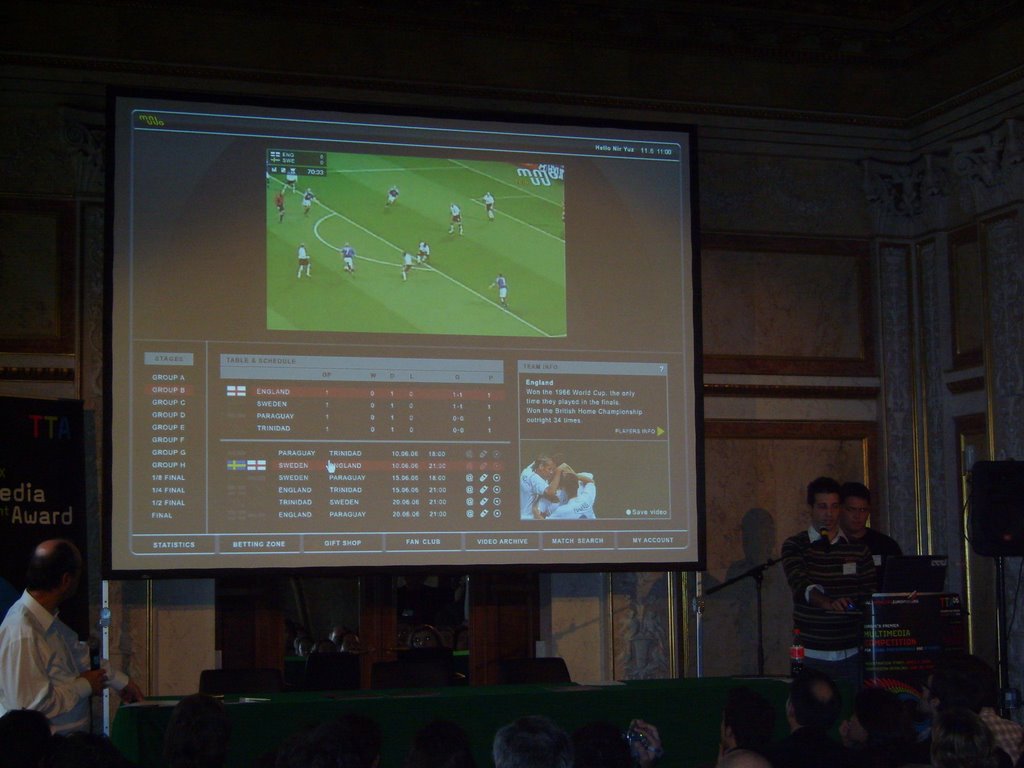 Mundo (Israel) was developed as a potential broadband site for broadcasting the 2006 World Cup online. Through its compact design and intelligent website architecture, Mundo aims to meet the needs of every football fan. Users can watch different games simultaneously and in diverse hierarchies or check out video based statistics pages. The betting application allows continuous betting during the match while the gift shop presents relevant video clips of every product in close-up. The comprehensive video archive enables users to record and save selected scenes. Fans are also brought together through the video and messenger based chat rooms. The website’s advance notice system also reminds viewers about any future broadcasts online, by email or SMS.
Team: Nir Yuz, Sagi Itah
Tags: broadband, archives,soccer broadband, archives, soccer
RSS feed: http://buziaulane.blogspot.com/rss.xml
Blog Posting Number: 586
Monday, November 27, 2006
Flash: Iliad and De Tijd eNewsPaper (1)
On the 24 of November there was a conference on digital newspapers in Maastricht organised by the European Journalism Centre (EJC). Amongst others a lecture was presented on the results of the iLiad pilot with the Belgian financial newspaper De Tijd. This is the press release.
Ghent, 24 November 2006 – The IBBT ePaper project intended to test users’ reaction to real life newspaper content on a dedicated electronic device, in this case the Iliad e-reader (using e-ink technology). A field test involving 200 users finished June 30th 2006, and the project consortium is pleased to present interesting results on several levels.
As it turns out, users did not seem to compare the ePaper experience to internet news-sites, but rather to their existing ‘classic’ paper version. They were in fact expecting the same look and feel. They were also looking for the newspaper’s editorial concept. Getting last minute updates or the RSS style micro news seemed to be of less interest.
Many considered the device to be a complementary tool, ideal for mobile use. Users did consider it probable, however, that devices like the e reader would replace the paper version in the future. Over 45% of the participants indicated that they would consider the purchase of a next-generation e-reader device. If left up to the reader, newspapers will survive, but on new paper…
The project also yielded insights in business models, network distribution technology, content and device usability, and digital rights management. Short summaries of the research results can be found in attachment.
The following partners participated in the ePaper project: De Tijd, Philips, iRex Technologies, Belgacom, Agency.com, iMerge and IBBT.
I have received from ibbt a number of documents about the pilot and will be dealing with them in the coming week.
Tags: e-book, digital paper, iLiad
RSS feed: http://buziaulane.blogspot.com/rss.xml
Blog Posting Number: 585
Ghent, 24 November 2006 – The IBBT ePaper project intended to test users’ reaction to real life newspaper content on a dedicated electronic device, in this case the Iliad e-reader (using e-ink technology). A field test involving 200 users finished June 30th 2006, and the project consortium is pleased to present interesting results on several levels.
As it turns out, users did not seem to compare the ePaper experience to internet news-sites, but rather to their existing ‘classic’ paper version. They were in fact expecting the same look and feel. They were also looking for the newspaper’s editorial concept. Getting last minute updates or the RSS style micro news seemed to be of less interest.
Many considered the device to be a complementary tool, ideal for mobile use. Users did consider it probable, however, that devices like the e reader would replace the paper version in the future. Over 45% of the participants indicated that they would consider the purchase of a next-generation e-reader device. If left up to the reader, newspapers will survive, but on new paper…
The project also yielded insights in business models, network distribution technology, content and device usability, and digital rights management. Short summaries of the research results can be found in attachment.
The following partners participated in the ePaper project: De Tijd, Philips, iRex Technologies, Belgacom, Agency.com, iMerge and IBBT.
I have received from ibbt a number of documents about the pilot and will be dealing with them in the coming week.
Tags: e-book, digital paper, iLiad
RSS feed: http://buziaulane.blogspot.com/rss.xml
Blog Posting Number: 585
TTA: the Dutch categorywinner
 Today I am pushing out the good news of our Dutch category winner to the media. The Dutch company Submarine has won the award in the category Games with the Tulkse Luper Journey. The press release has gone to traditional print media such as daily newspapers and magazines as well to internet publications. Planet Internet, brought the news with a photograph, about half an hour after the release. The press release has also gone to the colleges and universities.
This publicity is intended in order to get the name of the winner and EUROPRIX spread. Of course we hope that next year these schools and young producers will participate in the Dutch competition EUROPRIX.nl, organised by the foundation EUROPRIX.nl. It has been a habit to enter the Dutch nominations to the European edition of the EUROPRIX Top Talent Award. So the more entries we receive in the Netherlands the more choice there is to select quality.
The nomination was for the game of the Tulse Luper Journey. This game reconstructs the life of writer and collector Tulse Luper, who archived his entire life in 92 suitcases. Despite spending most of his years in prison, he mysteriously managed to be at important 20th century events. Based on director Peter Greenaway’s film trilogy, the Tulse Luper Journey is an enormous community project which invited young flash designers from across Europe to submit interactive Flash games. Film fragments, puzzles and letters written by different characters must be unlocked and solved. By collecting all 92 film fragments from each suitcase, gamers reconstruct a 90 minute film about his life. Gamers also have the chance to discuss their ‘research’ in forums or compete for a round-the-world holiday. The installation version features real suitcases which contain LCD screens and hidden PC’s.
Of course the Dutch delegation was very happy for the company Submarine and specifically for the young producer Christiaan de Rooij (see photograph). This year there was a large delegation from The Netherlands. Besides the project team, there were representative of the Noordelijke Hogeschool Leeuwarden and the Hogeschool Rotterdam. There were attending the EADiM Academic Network Conference which ran parallel to the Festival.
In the coming week I will present an overview of the nominations in the various categories including the category winners as well as the links to the projects. You can find a list of the nominees.
Tags: europrix
RSS feed: http://buziaulane.blogspot.com/rss.xml
Blog Posting Number: 584
Sunday, November 26, 2006
TTA: the 2006 awards
I am just back from Vienna in Austria, where the 9th EUROPRIX was held, in fact the Top Talent Award (TTA) for young producers under 30 years of age. The Festival started last Thursday and ended last night with a big gala to celebrate the nominees, the category winners and the overall winner.
 The winner of the Thesis Award in the hall of the Arsenaal (c Jak Boumans)
The Gala night was great. It was held in the Arsenaal, a military museum full with statues, plaquettes and paintings. Peter Bruck the initiator of the EUROPRIC Top Talent Award reminded the audience that this museum was about destruction, while we had come together to celebrate creativity.
Before the Gala I circled around the approximately 350 guests from 20 countries. There were Austrian government people. I got also the occasion to shake hands with Mr Fischler the former EU commissioner. But I saw also former employees of the organising bureau ICNM such as Verena and Barbara Korn. Of course all the members of the nominated teams were present. There was also a lot of bear hugging with former jury members such as Ted Baracas, and Martin Sperka. Great was the presence of the Irishman Martin Casey, whoever won the first student award with Broken Tongue and presently has a company which works for AOL and the real estate site Funda Ireland. An there was many a member of the European Academy of Digital Media (EADiM). There were also participants of the EADiM Academic Network, which held a conference in the framework of the TTA Festival; there were some 30 professors and instructors from the Arts and Media School in Tampere (Finaland), Thames Valley University (UK), Hogeschool Rotterdam and Hogeschool Leeuwarden (NL) and Israel. I will come back to this conference later in the mini-serie on the TTA.
The Gala was presented by two former winners of the EUROPRIX. It was great to see these winners come back in such a great shape. They called up the persons presenting the awards. After four categories, a small female combo played some music and when hardly the last note had died, the presenters moved on to the last four categories, ready for the overall winner.
Categorywinners
Category: Broadband/Online:
Project: Swiss Timeline, an overview of Swiss history as reflected in radio and television since 1931.
Country: Switzerland
Category: Offline/Interactive DVD
Project: Sonorama, music from south Benin
Country: France
Category: Mobile contents
Project: CabBoots, specially engineered boots which guide a walker GPS.
Country: Germany
Category: Games
Project: Tulse Luper Journey, a game with riddles in 92 suitcases
Country: Netherlands
Category: Interactive installations & TV
Project: Outerspace, a reactive robotic creature
Country: Germany
Category: Interactive computer graphics
Project: Neighbours
Country: Hungary
Catgory: Content Tools & Interface Design
Project: Shared Design Space, a collaborative tool
Country: Austria
Category: Digital Video and Animations
Project: Tadam, a multimedia puppet show
Country: France.
The overall winner can only be selected from the category winners. In this case it was the project Outerspace was selected. Immediately after the presentations of the awards a discussion started to ensue about the overall winner. It was more robotic than anything else was the main critique. On the other hand the equipment was in the category Installations and does fill well in it. Personally I would have liked to see a multi-channel and multimedia project with more content to it. But I was not on the jury this time; I had jury duty for seven consecutive years. The discussions were always very good with debates going till deep at night.
Tags: europrix
RSS feed: http://buziaulane.blogspot.com/rss.xml
Blog Posting Number: 583
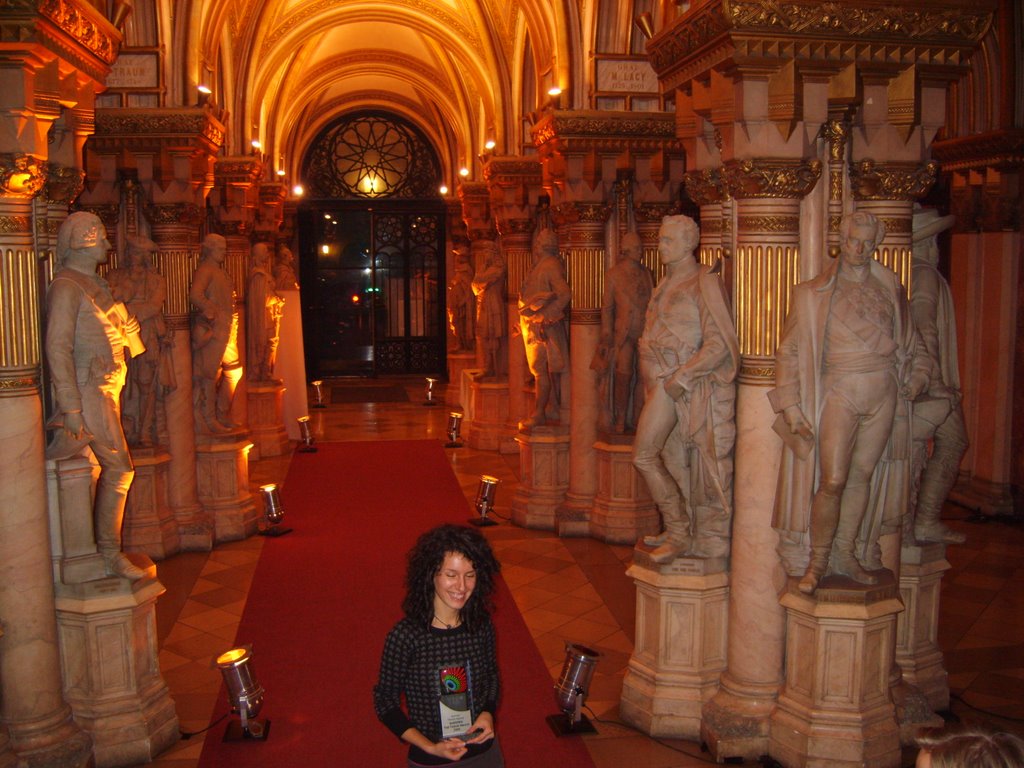 The winner of the Thesis Award in the hall of the Arsenaal (c Jak Boumans)
The Gala night was great. It was held in the Arsenaal, a military museum full with statues, plaquettes and paintings. Peter Bruck the initiator of the EUROPRIC Top Talent Award reminded the audience that this museum was about destruction, while we had come together to celebrate creativity.
Before the Gala I circled around the approximately 350 guests from 20 countries. There were Austrian government people. I got also the occasion to shake hands with Mr Fischler the former EU commissioner. But I saw also former employees of the organising bureau ICNM such as Verena and Barbara Korn. Of course all the members of the nominated teams were present. There was also a lot of bear hugging with former jury members such as Ted Baracas, and Martin Sperka. Great was the presence of the Irishman Martin Casey, whoever won the first student award with Broken Tongue and presently has a company which works for AOL and the real estate site Funda Ireland. An there was many a member of the European Academy of Digital Media (EADiM). There were also participants of the EADiM Academic Network, which held a conference in the framework of the TTA Festival; there were some 30 professors and instructors from the Arts and Media School in Tampere (Finaland), Thames Valley University (UK), Hogeschool Rotterdam and Hogeschool Leeuwarden (NL) and Israel. I will come back to this conference later in the mini-serie on the TTA.
The Gala was presented by two former winners of the EUROPRIX. It was great to see these winners come back in such a great shape. They called up the persons presenting the awards. After four categories, a small female combo played some music and when hardly the last note had died, the presenters moved on to the last four categories, ready for the overall winner.
Categorywinners
Category: Broadband/Online:
Project: Swiss Timeline, an overview of Swiss history as reflected in radio and television since 1931.
Country: Switzerland
Category: Offline/Interactive DVD
Project: Sonorama, music from south Benin
Country: France
Category: Mobile contents
Project: CabBoots, specially engineered boots which guide a walker GPS.
Country: Germany
Category: Games
Project: Tulse Luper Journey, a game with riddles in 92 suitcases
Country: Netherlands
Category: Interactive installations & TV
Project: Outerspace, a reactive robotic creature
Country: Germany
Category: Interactive computer graphics
Project: Neighbours
Country: Hungary
Catgory: Content Tools & Interface Design
Project: Shared Design Space, a collaborative tool
Country: Austria
Category: Digital Video and Animations
Project: Tadam, a multimedia puppet show
Country: France.
The overall winner can only be selected from the category winners. In this case it was the project Outerspace was selected. Immediately after the presentations of the awards a discussion started to ensue about the overall winner. It was more robotic than anything else was the main critique. On the other hand the equipment was in the category Installations and does fill well in it. Personally I would have liked to see a multi-channel and multimedia project with more content to it. But I was not on the jury this time; I had jury duty for seven consecutive years. The discussions were always very good with debates going till deep at night.
Tags: europrix
RSS feed: http://buziaulane.blogspot.com/rss.xml
Blog Posting Number: 583
Saturday, November 25, 2006
Video in The Netherlands: a news video site (6)
I wrote before about the site of Skoeps, a site with two major Dutch shareholders: the national newspaper company PCM and the commercial broadcast company Talpa... Where YouTube is a fun site, Skoeps (Scopes) is a site, which bring generates the news in pictures and video.
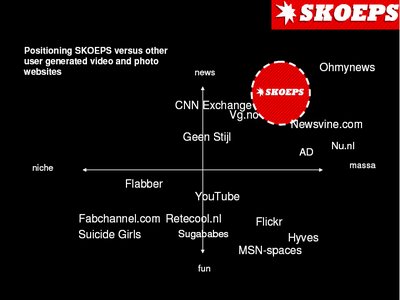 The site wants to break the publishing circle of the professional news companies. These companies will be alerted to a news fact, send a reporter and turn the item in. Following the journalistic trend of user generated content Skoeps explicitly turns the principle around. This had already been seen during the London bombings and the murder of the Dutch movie maker Theo van Gogh. The founders follow the reasoning, that there are eyes at every news happening, and these people always have recording equipment as photo cameras and video cameras with them. They need a post box to send in the photographs and videos, ready for publishing on the site. People can now share the personal experience of a news event.
The site has a number of categories, from regions to sports, from celebrities to fires. It has a RSS- and e-mailservice, the SMS-service, Skoeplogs, small new sites for individual Skoeps reporters and a community site for the cooperation of Skoeps reporters. The site is expandable with a digital TV channel.
Skoeps selects and recruits potential reporters from news tifosi and journalism students. Selected reporters get a Nokia N73 mobile, sim card, one year subscription to online NRC-Next or Volkskrant, a press card, business cards, and an original Skoeps calamity tape. Skoeps will also have training sessions
User generated content can often be replaced by the expression free content and free licence. The site operator does not want to pay for the pics or the videos and feels free to forward on the pics and videos to other sites. Skoeps has other rules. The pics and videos on the site are for free. But the revenues from the pics and videos sold by Skoeps or onwards sold by a wire press bureau, will be split with the creator. This money will be an incentive for Skoeps reporters. Skoeps has made a deal already with the Dutch wire ANP, which can sell on the pics or videos to media and corporate communication departments.
Tags: video, movie, TV
RSS feed: http://buziaulane.blogspot.com/rss.xml
Blog Posting Number: 582
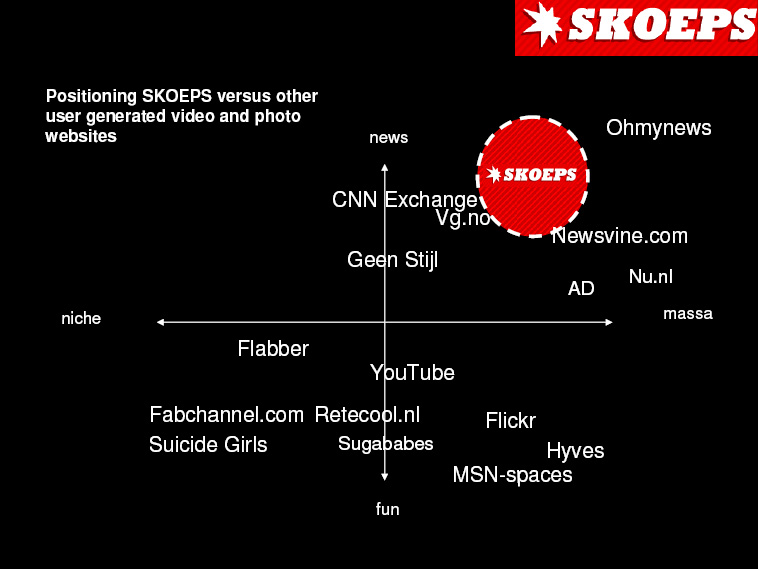 The site wants to break the publishing circle of the professional news companies. These companies will be alerted to a news fact, send a reporter and turn the item in. Following the journalistic trend of user generated content Skoeps explicitly turns the principle around. This had already been seen during the London bombings and the murder of the Dutch movie maker Theo van Gogh. The founders follow the reasoning, that there are eyes at every news happening, and these people always have recording equipment as photo cameras and video cameras with them. They need a post box to send in the photographs and videos, ready for publishing on the site. People can now share the personal experience of a news event.
The site has a number of categories, from regions to sports, from celebrities to fires. It has a RSS- and e-mailservice, the SMS-service, Skoeplogs, small new sites for individual Skoeps reporters and a community site for the cooperation of Skoeps reporters. The site is expandable with a digital TV channel.
Skoeps selects and recruits potential reporters from news tifosi and journalism students. Selected reporters get a Nokia N73 mobile, sim card, one year subscription to online NRC-Next or Volkskrant, a press card, business cards, and an original Skoeps calamity tape. Skoeps will also have training sessions
User generated content can often be replaced by the expression free content and free licence. The site operator does not want to pay for the pics or the videos and feels free to forward on the pics and videos to other sites. Skoeps has other rules. The pics and videos on the site are for free. But the revenues from the pics and videos sold by Skoeps or onwards sold by a wire press bureau, will be split with the creator. This money will be an incentive for Skoeps reporters. Skoeps has made a deal already with the Dutch wire ANP, which can sell on the pics or videos to media and corporate communication departments.
Tags: video, movie, TV
RSS feed: http://buziaulane.blogspot.com/rss.xml
Blog Posting Number: 582
Subscribe to:
Posts (Atom)
